




Title: Quantifying Sulfur Dioxide Corrosion in Modern Electronics: Methodologies, Standards, and Advanced Chamber Technology
Abstracto: The proliferation of electronic systems across diverse and demanding environments necessitates rigorous validation of material and component resilience against corrosive atmospheres. Among these, sulfur dioxide (SO₂) exposure presents a significant degradation vector, particularly for metallic contacts, connectors, and printed circuit board assemblies. This article examines the scientific principles underpinning SO₂ corrosion testing, analyzes relevant international compliance standards, and details the implementation of controlled environmental chambers. A technical evaluation of the LISÚN SQ-010 Sulfur Dioxide Test Chamber is provided as a paradigm for precise, standards-compliant accelerated life testing.
The Electrochemical Mechanisms of Sulfur Dioxide Degradation
Sulfur dioxide, a prevalent industrial pollutant, undergoes dissolution in atmospheric moisture to form sulfurous acid (H₂SO₃), which readily oxidizes further to sulfuric acid (H₂SO₄). This acidic electrolyte facilitates aggressive electrochemical corrosion processes on metallic surfaces. For electronic components, the primary failure modes include increased contact resistance, conductive anodic filament formation, and the breakdown of protective platings such as gold, nickel, or tin. The corrosion mechanism is predominantly localized, attacking pores in protective coatings and leading to galvanic corrosion between dissimilar metals. In electrónica del automóvil located near combustion exhaust systems, or in sistemas de control industrial operating in manufacturing zones with high fossil fuel consumption, the concentration of SO₂ can be sufficient to initiate these processes within operational lifespans. The rate of degradation is a non-linear function of SO₂ concentration, relative humidity, temperature, and the presence of other pollutants, making controlled laboratory simulation both critical and complex.
International Standards Governing SO₂ Corrosion Testing
Compliance testing is not arbitrary; it is prescribed by a suite of international standards that define precise environmental conditions, exposure cycles, and post-test evaluation criteria. These standards ensure reproducibility and provide a common benchmark for component qualification across global supply chains.
- IEC 60068-2-42: This foundational standard, “Test Kc: Sulfur dioxide test for contacts and connections,” specifies methods for assessing the corrosive effects of SO₂ on electrical contacts and connections. It defines test severities based on concentration (e.g., 0.5, 1, 2, 5, 10, 25 ppm) and exposure durations, typically utilizing a continuous exposure profile.
- IEC 60068-2-43: A complementary standard, “Test Kd: Hydrogen sulfide test for contacts and connections,” is often referenced in conjunction with SO₂ testing, as mixed flowing gas tests may be required for certain geographies or applications.
- ISO 21207:2015: “Corrosion tests in artificial atmospheres – Accelerated corrosion tests involving alternate exposure to corrosion-promoting gases, neutral salt-spray and drying” is increasingly relevant for aerospace and aviation components y equipos de telecomunicaciones destined for harsh environments. It defines complex cyclic tests combining SO₂, salt spray, and dry periods, simulating real-world diurnal and seasonal cycles.
- GB/T 2423.19 & GB/T 2423.20: Chinese national standards, widely adopted in the Material eléctrico y electrónico y Electrónica de consumo sectors, which align closely with but may have specific variances from IEC standards, particularly for products marketed within China.
Adherence to these standards is mandatory for manufacturers seeking certification for products like medical device enclosures, lighting fixture housings in coastal industrial areas, and electrical components such as relays and sockets used in outdoor or industrial settings.
Architectural Principles of a Precision SO₂ Test Chamber
A modern SO₂ test chamber is an engineered ecosystem designed to maintain precise and stable environmental parameters. The core subsystems include:
- Gas Generation and Introduction System: Requires a method for generating a consistent, low-concentration SO₂/air mixture. This often involves precision mass flow controllers blending pure SO₂ or a pre-mixed gas cylinder with filtered, conditioned air.
- Conditioned Air Supply System: Provides air at controlled temperature and humidity. This system typically incorporates a humidifier (often a steam generator for rapid response), a dehumidifier (condenser), and a heater to maintain the specified test climate, usually at 25°C ± 2°C and 75% ± 5% RH as per common standards.
- Corrosion-Resistant Chamber Workspace: The interior must be constructed from materials inert to SO₂ and sulfuric acid, such as polyvinyl chloride (PVC), polypropylene, or PTFE-coated surfaces. All internal fixtures, sample racks, and sensors must similarly resist corrosion.
- Exhaust Gas Neutralization System: A critical safety and environmental component. Exhaust gases must be scrubbed, typically using a wet chemical scrubber with an alkaline solution (e.g., sodium hydroxide), to neutralize the SO₂ before release into the laboratory atmosphere.
- Advanced Control and Data Logging System: A programmable logic controller (PLC) or industrial computer manages the test profile, cycling between gas introduction, humidification, and purging phases. Continuous data logging of temperature, humidity, and gas concentration is essential for audit trails and test validation.
The LISUN SQ-010: A Technical Analysis for Standards-Compliant Validation
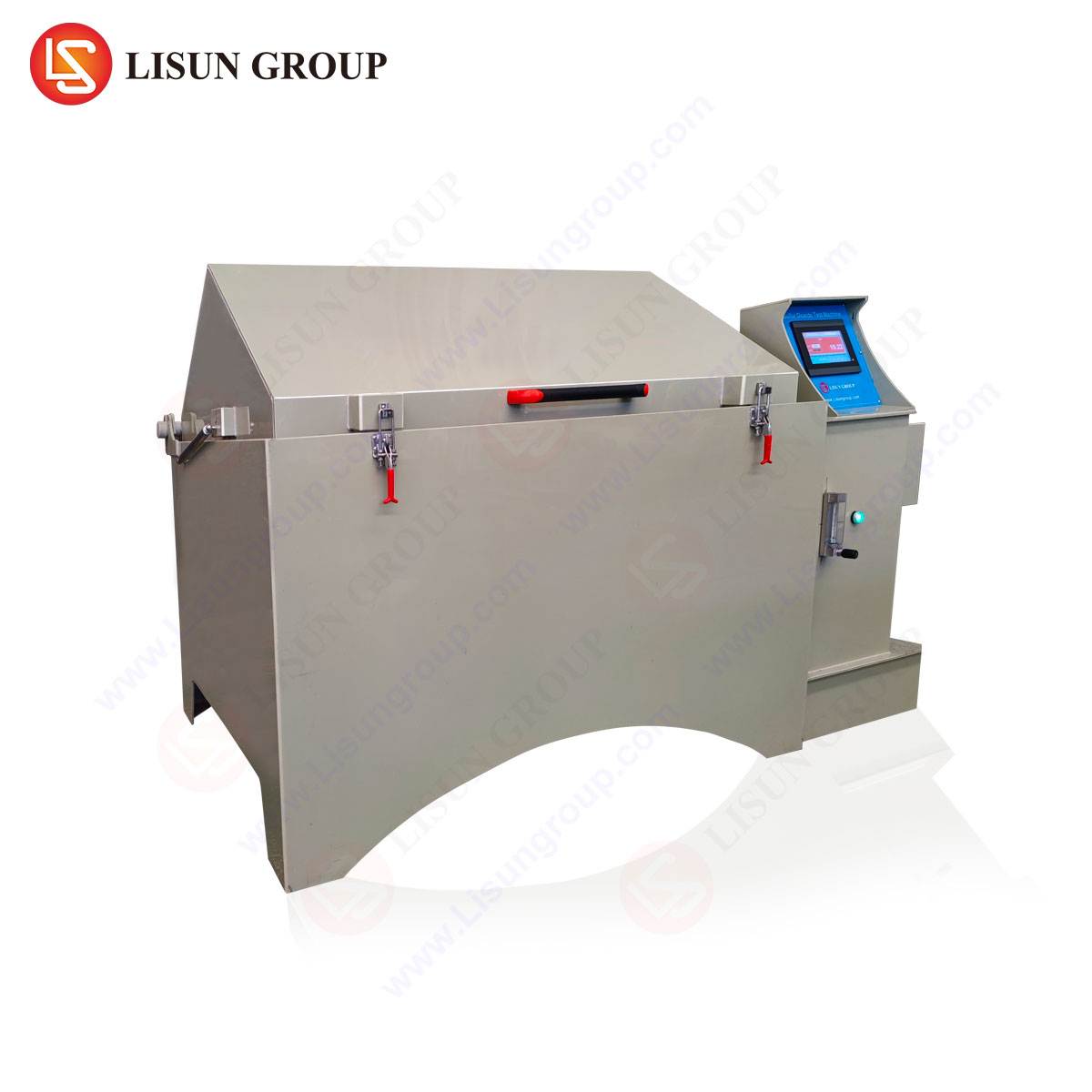
The LISUN SQ-010 Sulfur Dioxide Test Chamber embodies the engineering principles required for rigorous, repeatable compliance testing. Its design prioritizes parameter stability, user safety, and adherence to the aforementioned international standards.
Core Specifications and Operational Parameters:
- Gama de temperaturas: +15°C to +50°C.
- Humidity Range: 60% to 95% RH.
- SO₂ Concentration Range: 0 to 20 ppm (volumetric), with higher concentrations available upon request for specialized testing.
- Volumen de la cámara: Standard models available, typically from 225 to 1000 liters, accommodating bulk components or full assemblies.
- Interior Construction: Fabricated from imported PVC plastic plate, with PTFE-sealed viewing window and corrosion-resistant sample supports.
- Gas Introduction: Utilizes a precision needle valve and flow meter for controlled injection of SO₂ from a standard gas cylinder.
- Sistema de control: Microprocessor-based touchscreen controller with PID logic for stable temperature/humidity control. Pre-programmed test modes for common standards (IEC 60068-2-42) and custom programmable cycles.
- Safety Systems: Includes over-temperature protection, gas leak monitoring, and a dedicated exhaust scrubber system.
Testing Principle and Workflow: The SQ-010 operates on a volumetric mixing principle. Conditioned air is circulated within the sealed workspace while a calibrated volume of SO₂ gas is injected. A built-in fan ensures homogeneous distribution. The controller maintains the specified temperature and humidity, creating the corrosive environment. Tests can be run as continuous exposure or complex cycles involving gas injection periods followed by purging with fresh air, simulating real-world intermittent exposure.
Industry Use Cases and Application: The chamber is deployed across the product development and quality assurance lifecycle.
- Electrical Components & Cable Systems: Testing the corrosion resistance of silver-plated contacts in switches and sockets, and the jacket materials of wiring harnesses for electrónica del automóvil.
- Telecommunications & Office Equipment: Validating the long-term reliability of backplane connectors and RF shielding in base station units and network servers exposed to urban industrial atmospheres.
- Household Appliances & Consumer Electronics: Qualifying control boards and sensor connections in kitchen appliances or outdoor entertainment systems where airborne contaminants may be present.
- Lighting Fixtures & Industrial Control Systems: Assessing the integrity of aluminum heat sinks, steel enclosures, and terminal blocks in fixtures and PLC cabinets installed in factories or coastal regions.
Competitive Advantages in Technical Context:
- Parameter Uniformity: Advanced air circulation design ensures a temperature uniformity of ≤±0.5°C and humidity uniformity of ≤±2% RH, which is critical for generating consistent, comparable corrosion results across all samples.
- Corrosion-Resistant Sensor Technology: The employment of specialized humidity and temperature sensors with corrosion-resistant coatings ensures long-term measurement accuracy and reduces maintenance downtime, a common failure point in competitive chambers.
- Integrated Scrubbing Efficacy: The multi-stage wet scrubber system achieves a neutralization efficiency exceeding 99%, ensuring laboratory safety and environmental compliance, which is a paramount concern for facilities conducting frequent testing.
- Cyclic Testing Fidelity: The controller’s ability to precisely execute not only steady-state but also complex cyclic profiles per standards like ISO 21207 allows for more accurate simulation of real-world environmental stress, providing superior predictive value for product reliability.
Interpreting Test Results and Correlative Field Performance
Post-test evaluation is as critical as the test itself. Standard procedures involve visual inspection per ISO 10289 rating systems (e.g., protection rating numbers for substrates and appearance), measurement of electrical continuity and contact resistance, and mechanical function checks. For a medical device connector, a post-test contact resistance increase beyond a specified milliohm threshold would constitute a failure. The correlation between accelerated chamber hours and real-world years is not a simple multiplier; it is derived from comparative studies of field returns and known environmental data. A 21-day test in the SQ-010 at 10 ppm SO₂ and 75% RH might correlate to 10-15 years of service in a moderately polluted urban environment for a specific material stack-up. This correlation must be established empirically by each manufacturer for their specific components and target markets.
Future Trajectories in Corrosive Gas Testing
The evolution of materials and miniaturization of electronics drives testing innovation. Future trends include the development of chambers capable of ultra-low concentration testing (ppb level) for high-reliability aerospace components, and the integration of real-time in-situ monitoring techniques, such as electrochemical noise sensors, to detect the initiation of corrosion within the chamber without interrupting the test. Furthermore, the demand for testing complex mixtures of gases (SO₂, H₂S, NO₂, Cl₂) to simulate specific industrial or geographical profiles will require chambers with more sophisticated gas delivery and monitoring systems.
Preguntas más frecuentes (FAQ)
Q1: What is the typical duration of a standard SO₂ corrosion test in the LISUN SQ-010?
Test duration is dictated by the referenced standard and the chosen severity. A common test per IEC 60068-2-42, Severity 1 (e.g., 10 ppm for 4 days continuous exposure), would run for 96 hours. More complex cyclic tests per ISO 21207 can extend to 7, 14, or 21 days, incorporating repeated cycles of gas exposure, wet, and dry phases.
Q2: How do you calibrate and verify the SO₂ concentration within the chamber?
The SQ-010 uses a volumetric injection method calibrated via precision flow meters. Concentration verification is performed using an independent analytical method, typically a portable or fixed gas analyzer with electrochemical or spectroscopic detection, calibrated with NIST-traceable standard gases. This verification should be part of a routine quality assurance schedule.
Q3: Can the chamber test the effects of mixed corrosive gases?
The standard SQ-010 is designed for single-gas (SO₂) testing. For mixed flowing gas (MFG) tests involving combinations of SO₂, H₂S, NO₂, and Cl₂, a specially engineered multi-gas chamber with separate gas injection lines, enhanced mixing, and compatible materials of construction is required. LISUN and other manufacturers offer such systems as specialized variants.
Q4: What sample preparation is required prior to testing?
Samples must be clean and free of fingerprints or other contaminants that could influence results. Standards often specify a cleaning procedure using a solvent like isopropanol. Components should be mounted in a manner representative of their end-use, ensuring all critical surfaces are exposed to the gas flow and not shielded.
Q5: How is the corrosive exhaust gas safely disposed of?
The SQ-010 is equipped with an integrated wet scrubber. The exhaust gas is ducted into a column where it is counter-currently contacted with an alkaline scrubbing solution (e.g., sodium hydroxide). The SO₂ reacts to form neutral salts (sodium sulfite/sulfate), rendering the vented air safe. The scrubbing solution must be monitored and replaced periodically based on usage.

 ES
ES  EN
EN  RU
RU  PT
PT  TR
TR  AR
AR  DE
DE  PL
PL  IT
IT  FR
FR  KO
KO  JA
JA  ID
ID