

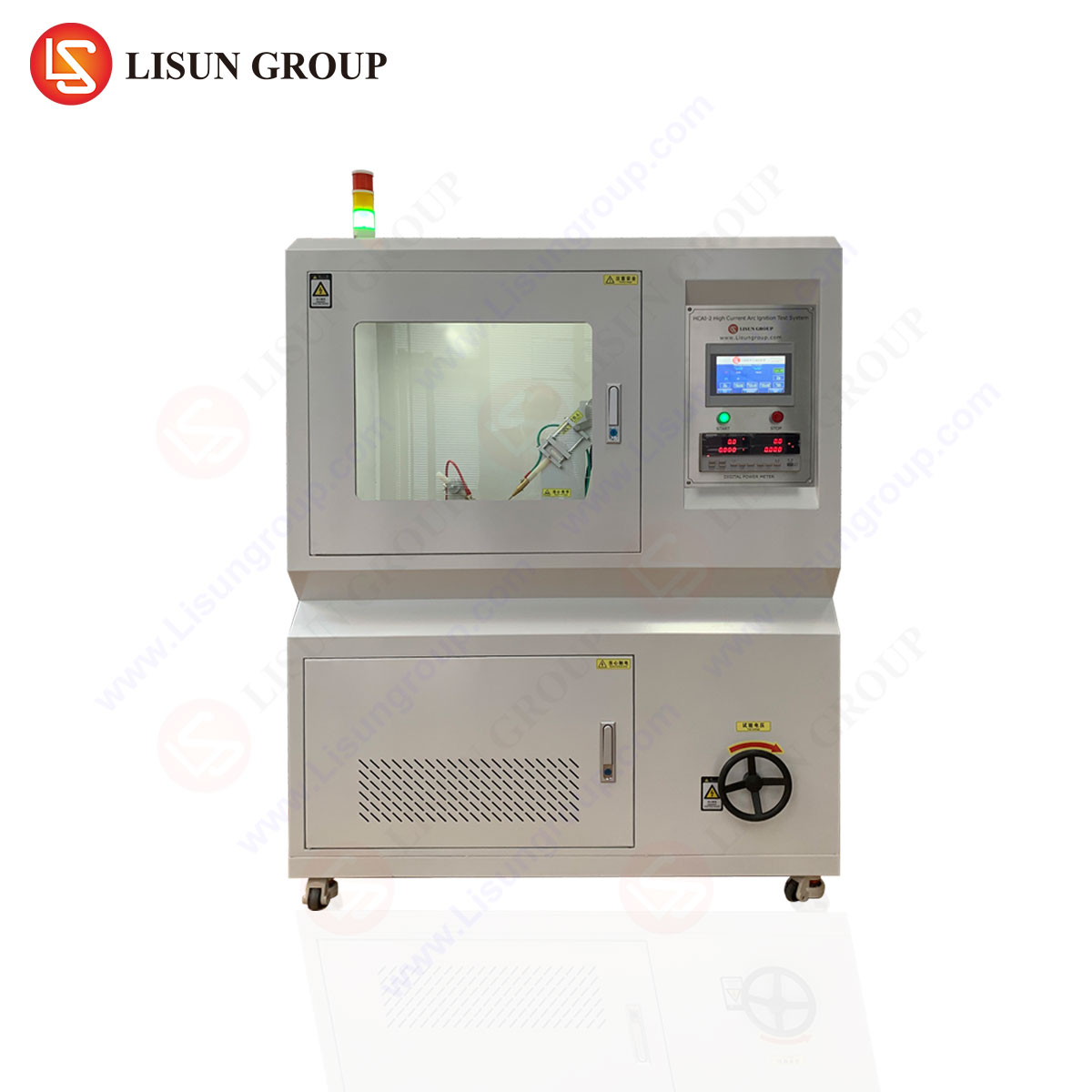



Ensuring Material Safety with High Current Arc Resistance Ignition Tests
Introducción
In the intricate ecosystem of modern electrical and electronic systems, the integrity of insulating materials is not merely a performance parameter but a fundamental safety imperative. The operational environment for components across diverse sectors—from automotive electronics to aerospace avionics—is increasingly characterized by higher power densities, compact designs, and elevated operational stresses. Within this context, the propensity for electrical arcing presents a persistent and severe hazard. Arcing events, often initiated by component degradation, contamination, or transient faults, can generate localized temperatures exceeding several thousand degrees Celsius, directly threatening to ignite surrounding materials. Consequently, the rigorous evaluation of a material’s resistance to ignition under high-current arc conditions has become a critical discipline in the product safety validation lifecycle. This article examines the technical principles, standardized methodologies, and practical applications of High Current Arc Ignition (HCAI) testing, with a specific focus on its role in preempting fire risks and ensuring regulatory compliance across global industries.
The Physics of High-Current Arcing and Ignition Mechanisms
To appreciate the necessity of specialized testing, one must first understand the distinct nature of high-current arcing. Unlike low-energy tracking or glow-wire phenomena, a high-current arc involves the sustained conduction of substantial electrical energy through ionized air or plasma. This is typically representative of fault conditions in power circuits, such as a loose connection in a terminal block, a failed switch contact, or damaged wiring within an appliance.
The ignition threat is multifaceted. The primary mechanism is intense radiative and convective heating from the arc plasma column, which can directly pyrolyze organic polymer surfaces, liberating combustible gases. Secondary effects include the ejection of molten conductive material (e.g., from electrodes or component leads), which can act as potent ignition sources for adjacent materials. Furthermore, the arc’s thermal shock can cause rapid material cracking or carbonization, creating conductive paths that sustain and propagate the fault. The objective of HCAI testing is to subject material samples to this severe, simulated fault in a controlled laboratory environment to quantitatively assess their ignition resistance and self-extinguishing properties.
Standardized Frameworks for Arc Resistance Ignition Evaluation
The development of reproducible and internationally recognized test methods is paramount. Several key standards govern HCAI testing, each with specific procedures and acceptance criteria tailored to different applications.
- IEC 60950-1 / IEC 62368-1 (Hazard-Based Safety Engineering): These foundational standards for Information and Communication Technology (ICT) and Audio/Video equipment outline fault condition tests that often involve creating arcs across insulating surfaces or through air gaps to verify that ignition does not occur or is contained.
- UL 746A (Polymeric Materials – Short Term Property Evaluations): This standard includes specific tests for “High-Current Arc Ignition to Ignition” and “Arc Resistance.” It provides a structured methodology to rank materials based on the number of arc ignition cycles required to cause flaming combustion, offering a comparative metric for material selection.
- Automotive and Aerospace Specifications: Standards such as ISO 20653 (road vehicles – degrees of protection) and various SAE AS y DO-160 sections for aviation implicitly require validation against electrical fault-induced fire. OEM-specific specifications often mandate HCAI testing for materials used in battery management systems, power distribution units, and cabin electronics.
These standards collectively mandate the use of specialized apparatus capable of generating and controlling high-current arcs with precise energy levels, durations, and electrode configurations.
El LISÚN HCAI-2 Prueba de ignición por arco de alta corriente System: Architecture and Operation
The LISUN HCAI-2 High Current Arc Ignition Test System represents a sophisticated instrumentation platform engineered to fulfill the exacting requirements of contemporary arc resistance testing standards. Its design prioritizes operational fidelity, repeatability, and user safety, enabling laboratories to generate definitive data on material performance.
Core Testing Principle: The system operates by generating a programmable series of high-current arc pulses across a pair of tungsten electrodes placed in a specific orientation on or near the test specimen. A defined circuit impedance controls the short-circuit current. The test sequence typically applies arcs of a set duration (e.g., 0.5 seconds) followed by a rest period. This cycle repeats until the material ignites and sustains flame for a specified time, or until a predetermined number of non-ignition cycles is completed. The count of cycles-to-ignition serves as the primary performance metric.
Key Technical Specifications and Capabilities:
- Arc Current Range: Typically configurable to deliver high fault currents, often up to 200A, 400A, or higher, simulating severe real-world short-circuit conditions.
- Arc Duration and Cycle Control: Precision timing circuits govern the on/off periods of the arc, with adjustable parameters (e.g., 0.1–1.0 second arc duration, 1–10 second intervals) to match various standard protocols.
- Electrode System: Features a robust, adjustable electrode holder assembly with precision-ground tungsten rods, conforming to standard geometries (e.g., 3.2 mm diameter) and positioning requirements.
- Safety and Containment: Integrated safety features include an interlocked test chamber, fume extraction ports, and protective shielding to contain any ejected material or flames.
- Measurement and Control: A digital controller manages test parameters, sequences, and termination criteria. It records and logs the cycle count at ignition, providing auditable test results.
Industrial Applications and Material Validation Use Cases
The application of HCAI-2 testing is pervasive across industries where electrical safety is non-negotiable.
- Electrical Components & Industrial Control: Para terminal blocks, contactors, relay housings, and switchgear enclosures, the test validates that insulating materials will not ignite from arcing caused by loose strand insertion or contact welding.
- Electrónica del automóvil: In the shift to high-voltage electric vehicle (EV) platforms, materials used in battery pack separators, charging inlet housings, and DC-DC converter casings must demonstrate exceptional arc ignition resistance. A fault in a 400V or 800V system can produce arcs of tremendous energy.
- Household Appliances & Consumer Electronics: Components in power supplies, motor controllers for washing machines, and internal wiring harnesses are evaluated to prevent fire initiation from internal faults before protective fuses can operate.
- Aeroespacial y Aviación: The weight-saving use of advanced polymers in aircraft junction boxes, in-flight entertainment system housings, and wiring conduits requires validation under the stringent fault conditions outlined in aviation safety protocols.
- Productos sanitarios: Para life-support equipment, imaging system power cabinets, and surgical tool connectors, ensuring that an electrical fault does not lead to a fire is critical for patient and operator safety in oxygen-rich environments.
- Cable and Wiring Systems: Cable insulation and jacketing materials, particularly those used in bundled or confined spaces, are tested to assess their behavior when an arc is struck externally due to insulation abrasion or pinch.
Comparative Advantages in Material Selection and Design
Incorporating HCAI-2 data into the design process confers significant advantages. It moves material selection beyond basic UL 94 flammability ratings (which involve a small flame source) into the realm of fault condition performance. Engineers can compare grades of polyamide (PA), polyphenylene sulfide (PPS), polybutylene terephthalate (PBT), or thermosets like phenolic based on their empirical arc ignition resistance. A material that withstands 120 arcs before ignition offers a demonstrably larger safety margin than one failing at 15 cycles. This data directly informs design choices for creepage/clearance distances, enclosure wall thickness, and the implementation of additional arc barriers or flame-retardant additives.
Integrating Test Data into a Comprehensive Safety Strategy
It is crucial to position HCAI testing as one vital component within a holistic safety engineering framework. Its results should be correlated with other evaluations:
- Comparative Tracking Index (CTI): Measures susceptibility to surface tracking under low-voltage, contaminated conditions.
- Temperatura de encendido del hilo incandescente (GWIT): Assesses ignition from overheated components.
- Hot Wire Coil (HWC) Ignition: Evaluates resistance to ignition from resistive heating.
A material may perform well in one test but poorly in another. The HCAI-2 specifically addresses the high-energy, localized fault scenario, filling a distinct and critical gap in the validation matrix. This integrated approach is the cornerstone of Hazard-Based Safety Engineering (HBSE) mandated by standards like IEC 62368-1.
Conclusión
As electrical systems grow more powerful and integrated into every facet of technology, the consequences of material failure escalate proportionally. High Current Arc Ignition testing, as exemplified by the capabilities of the LISUN HCAI-2 system, provides an indispensable, scientifically rigorous means of probing the limits of material safety under catastrophic electrical fault conditions. By generating reliable, standards-compliant data, it empowers engineers across the electrical and electronic equipment landscape to make informed decisions that inherently enhance product reliability, mitigate fire risks, and safeguard end-users. The continued refinement of such test methodologies and equipment remains integral to advancing the state of the art in electrical safety engineering.
Sección FAQ
Q1: How does High Current Arc Ignition (HCAI) testing differ from the standard UL 94 vertical burn test?
A1: UL 94 primarily assesses a material’s response to a small, open Bunsen burner-type flame applied under specific conditions. It evaluates flammability and self-extinguishing properties. HCAI testing, in contrast, simulates a severe electrical fault condition, applying intense, localized thermal energy from a high-current electrical arc. A material can achieve a V-0 rating in UL 94 but still exhibit poor resistance to ignition from an electrical arc, as the ignition mechanisms and energy transfer modes are fundamentally different.
Q2: What are the most critical factors influencing repeatability in HCAI testing?
A2: Achieving repeatable results demands strict control of several parameters: the sharpness and alignment of the tungsten electrodes, which must be dressed and positioned precisely per the standard; the consistency of the applied current waveform and duration; the environmental conditions within the test chamber (draft-free, controlled humidity); and the preparation and conditioning of the test specimen itself (surface cleanliness, moisture content, molding history). The LISUN HCAI-2 system is designed to automate and stabilize many of these variables.
Q3: For an automotive OEM specifying materials for an EV battery module, why is HCAI data more relevant than a simple flame rating?
A3: Within an EV battery module, a failure mode such as a loose busbar connection or a cell venting event could precipitate a high-current, sustained internal arc. This scenario involves energy levels orders of magnitude higher than a small open flame. HCAI testing directly simulates this severe thermal-electrical stress, providing data on whether the chosen insulating barriers, spacers, or enclosure materials will ignite and propagate a fire within the module, making it a critical validation for functional safety (ISO 26262) and battery safety standards.
Q4: Can the HCAI-2 test be used for finished component testing, or is it only for material plaques?
A4: While standardized material ranking is often performed on uniform plaques, the test principle is highly applicable to finished components. The electrode configuration can be adapted to simulate specific fault scenarios—for example, applying arcs across the surface of a molded connector housing, between terminals of a switch, or from a loose wire to the chassis of an appliance. This “product-level” testing provides invaluable validation of the final assembly’s response to internal electrical faults.
Q5: How is the endpoint “ignition” definitively determined during an automated test sequence?
A5: Ignition is typically determined by one or more integrated sensors. The most common method is via a photoelectric flame detector (ionization or optical) positioned at a specified distance from the test specimen. The detector is calibrated to signal when a sustained flame of a defined size and duration is present. The system controller records the cycle count at which this signal is triggered, providing an objective and repeatable endpoint for the test.

 ES
ES  EN
EN  RU
RU  PT
PT  TR
TR  AR
AR  DE
DE  PL
PL  IT
IT  FR
FR  KO
KO  JA
JA  ID
ID