




Ensuring Packaging Integrity with Standard Drop Tests: A Technical Analysis
Introducción
The global supply chain represents a complex and often unforgiving environment for manufactured goods. Between the point of assembly and the end user, products are subjected to a myriad of dynamic hazards, with mishandling during transportation and logistics constituting a primary source of damage. For industries producing sensitive or high-value items, such as Electrical and Electronic Equipment, Automotive Electronics, and Medical Devices, the consequences of inadequate packaging can be severe, leading to financial loss, warranty claims, brand degradation, and, in critical applications, safety failures. Consequently, the scientific validation of packaging systems through standardized mechanical stress testing is not merely a quality control step but a fundamental component of product design and risk mitigation. Among these validation protocols, the controlled prueba de caída stands as a preeminent method for simulating real-world impacts and ensuring packaging integrity. This article provides a detailed examination of standard drop testing methodologies, their underlying principles, relevant international standards, and the critical role of precision instrumentation in obtaining reliable, actionable data.
The Biomechanics of Distributional Shock and Impact
To appreciate the necessity of drop testing, one must first understand the physics of distributional shock. During manual or automated handling, packages are frequently dropped, tossed, or impacted against surfaces. This event results in a rapid transfer of kinetic energy to the packaged product, generating high-magnitude, short-duration acceleration pulses—commonly measured in g-forces (multiples of Earth’s gravity). The magnitude of these pulses is influenced by the drop height, the mass of the package, the orientation at impact, and the energy-absorbing characteristics of the packaging materials and cushioning. Different orientations (flat face, edge, or corner) produce distinct shock responses due to variations in the effective stiffness and damping of the package structure. A corner drop, for instance, typically generates the highest g-forces due to the concentrated area of impact and minimal material deflection. The primary objective of packaging design is to attenuate these transmitted forces below the fragility threshold of the contained product, which is often determined through product fragility testing (e.g., according to ASTM D3332).
International Standards Governing Drop Test Procedures
Standardization is paramount for ensuring test reproducibility, enabling comparative analysis, and meeting contractual or regulatory obligations. Several key international standards define specific procedures for drop testing, each tailored to different product categories and distribution cycles.
- ISTA (International Safe Transit Association): ISTA Series 1 (Non-Simulation Integrity Tests), Series 2 (Partial Simulation Tests), and Series 3 (General Simulation Tests) are widely adopted. Procedures such as ISTA 1A, 2A, and 3A prescribe specific drop sequences based on package weight, defining the number of drops and required orientations (e.g., one drop on each face, edge, and corner).
- ASTM International: ASTM D5276, “Standard Test Method for Drop Test of Loaded Containers by Free Fall,” provides a foundational methodology. It details procedures for performing flat drops, and is frequently referenced in conjunction with other standards.
- IEC (International Electrotechnical Commission): For electrical and electronic equipment, IEC 60068-2-31, “Environmental testing – Part 2-31: Tests – Test Ec: Rough handling shocks, primarily for equipment-type specimens,” includes drop and topple tests applicable to both packaged and unpackaged equipment.
- MIL-STD (Military Standard): MIL-STD-810G, Method 516.8, “Shock,” includes procedures for transit drop testing, often required for Aerospace and Aviation Components and ruggedized Industrial Control Systems.
These standards typically specify parameters including drop height, impact surface (a rigid, non-resilient horizontal plane), package preconditioning (e.g., temperature, humidity), and the required number of test specimens. Adherence to these protocols ensures that test results are a reliable predictor of real-world performance.
Instrumentation and Measurement: The Core of Quantitative Analysis
While a simple pass/fail visual inspection post-drop has its place, modern engineering demands quantitative data. Precision instrumentation transforms a basic drop test into a sophisticated diagnostic tool. The key components include:
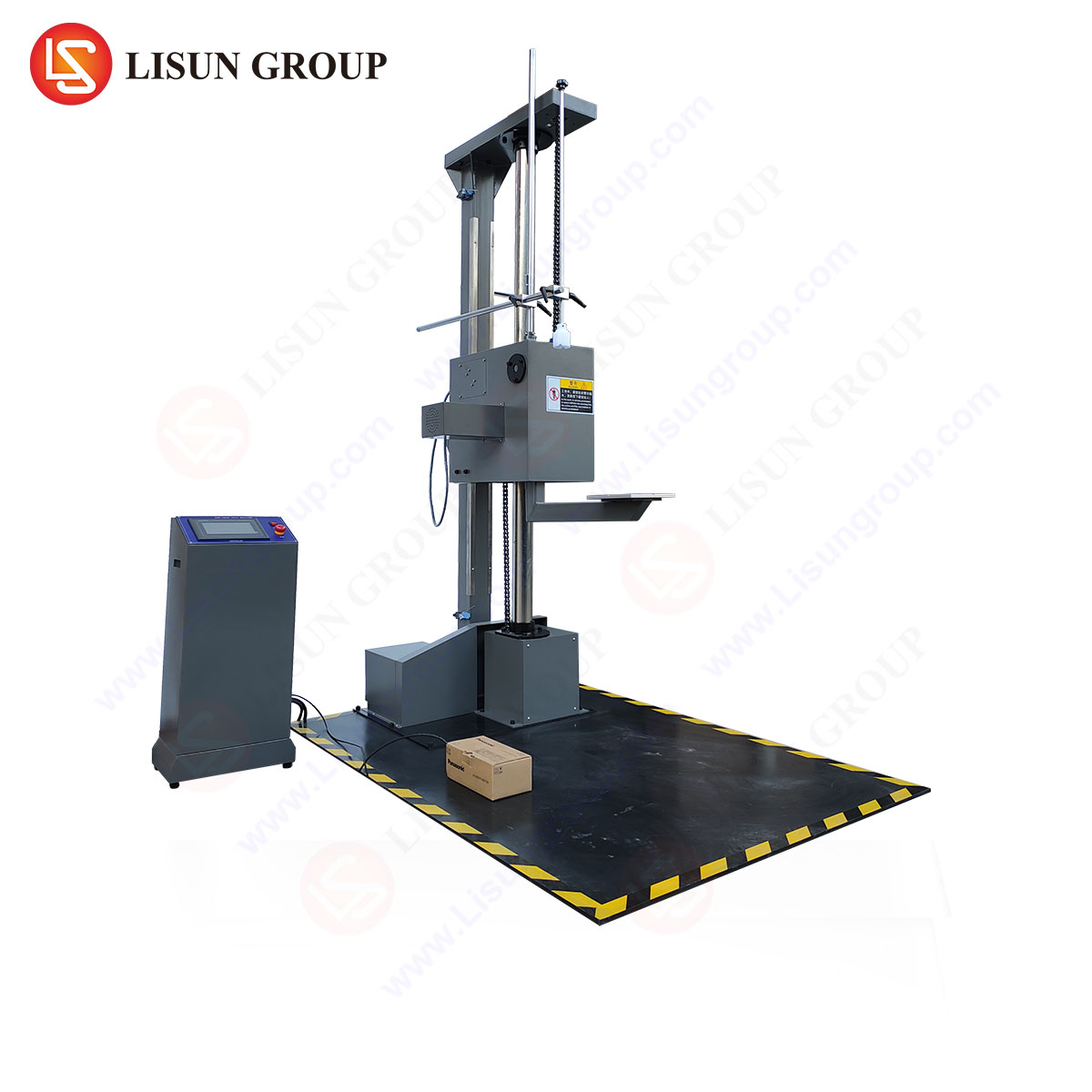
- Drop Test Machine: Provides controlled, repeatable release and impact. Manual drop stands offer basic functionality, but programmable, electromechanical systems deliver superior consistency, safety, and the ability to perform complex sequences.
- Accelerometer: A transducer mounted inside the test package, at the interface between the product and the cushioning, to measure the acceleration pulse during impact.
- Data Acquisition System (DAS): Captures the analog signal from the accelerometer at a high sampling rate, converting it into digital data for analysis.
- Analysis Software: Processes the captured waveform to determine critical metrics: peak acceleration (g-max), velocity change, pulse duration, and shock response spectrum (SRS).
This data-centric approach allows engineers to precisely quantify cushioning performance, identify resonant frequencies that could amplify damage, and iteratively optimize packaging designs with empirical evidence.
The DT-60KG Drop Test System: Engineering Precision for Demanding Applications
For laboratories and quality assurance departments requiring robust, repeatable, and data-rich drop testing, advanced systems like the LISÚN DT-60KG Drop Test provide a comprehensive solution. This electromechanical system is engineered to meet the rigorous demands of international standards while offering the flexibility needed for diverse industrial applications.
Specifications and Operational Principles
The DT-60KG is designed to handle test packages with a maximum mass of 60 kg, accommodating a wide range of products from small Consumer Electronics to substantial Automotive Electronics control units or Telecommunications Equipment. Its key specifications include an adjustable drop height range, typically from 300 to 1500 mm, allowing simulation of drops from pallet height to manual handling levels. The system features a dual-column rigid structure for stability and a pneumatic or electromechanical release mechanism to ensure zero initial velocity and no rotation upon release—a critical factor for standardized testing. The impact base is a thick, rigid steel plate mounted on a solid foundation to meet the “non-resilient” surface requirement of standards like ASTM D5276.
The testing principle is straightforward yet precisely controlled: the test package is secured to a lift table (or directly to the release mechanism). The table is raised to the pre-programmed height. Upon initiation, the release mechanism disengages instantaneously, allowing the package to fall in a guided free-fall onto the impact surface. The programmability of the DT-60KG allows for automated sequential testing of multiple faces, edges, and corners as per ISTA protocols, eliminating operator variability and enhancing test efficiency.
Industry-Specific Use Cases and Applications
The versatility of a 60 kg capacity system makes it applicable across numerous high-stakes industries:
- Electrical & Electronic Equipment / Industrial Control Systems: Validating packaging for sensitive PLCs, servo drives, and HMI panels against impacts encountered in factory logistics.
- Electrónica del automóvil: Testing packaging for engine control units (ECUs), infotainment systems, and ADAS sensor modules, which must survive complex tiered supply chains.
- Productos sanitarios: Ensuring sterile barrier integrity and device functionality for diagnostic equipment, patient monitors, and surgical instrument sets after simulated transit drops.
- Lighting Fixtures & Aerospace Components: Assessing the protection for fragile LED arrays, glass components, and avionics housings. The programmability allows simulation of specific drop sequences identified in hazard analysis.
- Telecommunications Equipment: Verifying packaging for routers, switches, and base station modules that may be handled by multiple technicians in field deployments.
- Household Appliances & Office Equipment: Quantifying the performance of molded foam or corrugated packaging for small appliances, printers, and scanners.
Competitive Advantages in Engineering Design
The DT-60KG system offers several distinct advantages for technical users. Its programmability and automated sequences ensure strict adherence to standard protocols, producing auditable test records. The robust construction minimizes vibrational noise that could interfere with accelerometer data, ensuring high signal fidelity. Integration with external data acquisition systems is facilitated, allowing teams to correlate package dynamics with internal product responses. Furthermore, the system’s safety features, such as protective guarding and emergency stop functions, protect both the operator and the equipment during testing of heavy or irregularly shaped loads. This combination of precision, capacity, and safety makes it a critical tool for failure analysis and design validation cycles.
Methodological Execution and Data Interpretation
A rigorous drop test program extends beyond operating the equipment. The methodology encompasses:
- Test Planning: Selecting the appropriate standard (e.g., ISTA 3A for a packaged product going through a parcel delivery system), defining drop heights based on package weight and distribution environment, and determining the sample size.
- Specimen Preparation: Conditioning packages at standard atmospheric conditions (e.g., 23°C, 50% RH per ASTM D4332) to account for material property variations. Internal packaging (cushioning, blocking, bracing) must replicate production intent.
- Instrumentation: Securely mounting an accelerometer on a mock product or a representative payload block at the center of gravity or at critical component locations.
- Test Execution: Performing the prescribed drop sequence. For a standard like ISTA 1A, this would involve a series of drops: first on the smallest face, then the next smallest, then on the three orthogonal edges, and finally on the three most vulnerable corners.
- Post-Test Evaluation: This includes both quantitative and qualitative analysis.
- Quantitative: Analyzing the acceleration-time history waveform. Key data is often summarized in a table:
| Drop Orientation | Peak Acceleration (g) | Pulse Duration (ms) | Velocity Change (m/s) | Notes |
| :— | :— | :— | :— | :— |
| Face 1 (Bottom) | 85 | 6.2 | 1.52 | Within spec |
| Face 2 (Side) | 110 | 5.1 | 1.48 | Slight overshoot |
| Corner 1 | 210 | 3.8 | 1.50 | High G, review cushion design | - Qualitative: A thorough visual inspection of the outer container for cracks, punctures, or seam failures. This is followed by a functional test of the actual product or a detailed inspection of the internal contents and cushioning for compression, cracking, or deformation.
- Quantitative: Analyzing the acceleration-time history waveform. Key data is often summarized in a table:
Integrating Drop Test Data into the Packaging Development Workflow
Effective packaging engineering is iterative. Drop test data feeds directly into the design process. If transmitted shocks exceed the product’s fragility rating, cushioning material type, thickness, or geometry must be modified. Conversely, if accelerations are significantly lower than the fragility threshold, opportunities for material reduction and cost optimization may exist. This data-driven approach enables the development of right-sized, sustainable, and protective packaging. Furthermore, the data serves as critical evidence for compliance with customer packaging guidelines, carrier requirements, and internal quality objectives.
Conclusión
In an era defined by complex logistics and heightened consumer expectations, the integrity of product packaging is a direct reflection of brand commitment to quality and reliability. Standard drop testing, conducted with precision instrumentation such as the DT-60KG Drop Test system, provides the empirical foundation for this integrity. By simulating the harsh realities of the distribution environment in a controlled laboratory setting, engineers can de-risk the supply chain, reduce waste from damaged goods, and ensure that products ranging from life-saving Medical Devices to everyday Consumer Electronics fulfill their intended function upon arrival. The methodology, governed by international standards and enhanced by quantitative analysis, remains an indispensable practice for any organization dedicated to delivering value and reliability from production to point-of-use.
Sección FAQ
Q1: What is the primary difference between a simple drop stand and a programmable system like the DT-60KG?
A simple drop stand relies on manual height setting and release, introducing variability in drop angle and initial conditions. A programmable electromechanical system ensures perfectly vertical, repeatable drops with zero initial velocity, automates complex multi-orientation sequences per ISTA standards, improves operator safety, and generates consistent, auditable test records essential for formal certification and comparative analysis.
Q2: How do I determine the correct drop height for my product testing?
Drop height is typically prescribed by the chosen test standard and is often a function of package weight. For example, ISTA procedures provide explicit charts: a 20 kg package under ISTA 3A might require a 460 mm drop, while a 10 kg package might require 510 mm. The distribution environment (e.g., parcel vs. palletized freight) also dictates the standard selection, which in turn defines the heights. Always consult the relevant standard first.
Q3: Can the DT-60KG be used to test unpackaged products, like for durability validation?
Yes. While its primary design is for packaged goods testing, the system can be configured to perform product robustness tests, such as those outlined in IEC 60068-2-31. The controlled drop onto a rigid surface can simulate accidental mishandling of finished goods like Household Appliances or Office Equipment. The internal accelerometer data is particularly valuable in these tests to understand the shock loads sustained by the product itself.
Q4: What type of accelerometer and data acquisition system is required to use with this drop tester?
The system is compatible with standard piezoelectric or piezoresistive accelerometers with appropriate mounting. A data acquisition system with a minimum sampling rate of 10 kHz (per the Nyquist criterion for typical shock pulses) and sufficient dynamic range is required. Many modern USB-based DAQ systems with dedicated shock analysis software are suitable. The specific model depends on the required channel count and analysis complexity.
Q5: For a Medical Device, is drop testing on the packaging sufficient for regulatory submission?
While packaging drop testing is a critical part of transit validation, regulatory submissions for Medical Devices (e.g., to the FDA or under ISO 13485) typically require a comprehensive approach. This includes testing the packaged device under simulated distribution conditions (a sequence of vibration, compression, and climate tests, in addition to drop testing) followed by a demonstration that the device itself still meets all its performance and safety specifications, including sterility if applicable. Drop test data forms a vital component of this larger validation dossier.

 ES
ES  EN
EN  RU
RU  PT
PT  TR
TR  AR
AR  DE
DE  PL
PL  IT
IT  FR
FR  KO
KO  JA
JA  ID
ID