




Evaluating Fire Safety: The Critical Role of Flame Propagation Testing for Cable Bunches
The proliferation of cabling within modern engineered systems presents a persistent and complex fire safety challenge. In environments ranging from aircraft avionics bays and automotive wire harnesses to data centers and industrial control panels, cables are invariably installed in bundled configurations. These bunches, while organizationally necessary, fundamentally alter the fire performance characteristics of individual cables. A cable that exhibits acceptable flame retardancy in isolated vertical testing may, when grouped with others, support sustained flame propagation due to thermal feedback, fuel loading, and chimney effects. Consequently, specialized Flame Propagation Tests for Cable Bunches have become a cornerstone of material qualification, product certification, and regulatory compliance across safety-critical industries. This article examines the technical rationale, standardized methodologies, and practical implementation of these tests, with a focus on the instrumental apparatus required for precise and repeatable assessment.
The Thermodynamic Rationale for Bunch Testing
Isolated cable flame tests, such as the widely referenced vertical wire test (e.g., UL 94 VW-1), provide a foundational assessment of a material’s inherent resistance to ignition and its ability to self-extinguish. However, their predictive value diminishes when applied to real-world installation scenarios. The primary physical phenomena necessitating bunch configuration testing are thermal pooling and radiative feedback.
When a single cable within a bunch is ignited, the heat generated is not dissipated freely into the surrounding atmosphere. Instead, adjacent cables absorb and re-radiate this thermal energy, effectively pre-heating neighboring components and pyrolyzing their polymeric insulations and jacketing materials before direct flame contact. This process significantly lowers the ignition energy required for progressive fire spread. Furthermore, the collective mass of combustible material in a dense bunch provides a substantial fuel load, potentially enabling flaming combustion to continue even after the initial ignition source is removed. The geometry of a vertically oriented bunch can also induce a stack effect, drawing in air from the bottom and accelerating combustion updraft, thereby intensifying the fire. These synergistic effects mean that fire risk in bundled installations is not a linear sum of individual cable performances but a non-linear, system-level property that must be evaluated empirically.
Standardized Test Methodologies and Industry Applications
Globally, several standards define the procedures for assessing flame propagation in cable bunches, each tailored to specific industry requirements and failure criteria. Among the most prominent are IEC 60332-3 (and its national derivatives like BS EN 60332-3), which assesses flame spread of vertically-mounted bunched wires or cables, and the NFPA 262 (formerly UL 910) Steiner tunnel test, which is critical for plenum cable classifications in telecommunications and building infrastructure.
The IEC 60332-3 series is particularly comprehensive, specifying different categories (Category A, B, C, and D) based on the volume of non-metallic material per meter of cable and the intensity of the flame source applied. The test apparatus typically involves mounting a specified number of cable lengths vertically on a ladder-type support within a closed test chamber. A propane or air-propane burner delivers a defined flame application (e.g., a 1kW premixed flame for Category A) to the bottom of the sample for a set duration (often 20 or 40 minutes). The key evaluation parameters are the extent of charred or damaged cable length, measured from the lower edge of the burner, and whether flaming droplets ignite a surgical cotton indicator placed below. Passing criteria mandate that the damaged length does not exceed a specified limit, ensuring fire containment.
The applicability of these tests spans virtually every sector utilizing wired power or signal transmission:
- Aerospace and Aviation Components: Adherence to standards like EN 45545-2 for railway or various FAA/ EASA specifications for aircraft is non-negotiable, where cable bunch testing simulates conditions in overhead panels and equipment bays.
- Electrónica del automóvil: As vehicle architectures evolve towards zone-based wiring with higher-density harnesses, tests based on ISO 6722 and LV 112 ensure that flame propagation is limited in engine compartments and passenger cabins.
- Industrial Control Systems & Electrical Components: Control panels, switchgear, and motor control centers house dense cable terminations. Compliance with IEC 60332-3 is often a prerequisite for components used in such assemblies.
- Telecommunications Equipment and Data Centers: NFPA 262 testing is essential for cables installed in air-handling spaces (plenums) without conduit, as rapid flame spread in these hidden pathways would be catastrophic.
- Medical Devices and Household Appliances: Internal wiring harnesses in large imaging systems, therapeutic devices, or major appliances must prevent fire spread between interconnected modules.
- Lighting Fixtures and Office Equipment: Complex luminaires and integrated office systems contain bundled internal wiring where safety standards demand verified flame-retardant performance.
Instrumentation for Precision: The LISÚN RSB-WC Probador de llama de cable
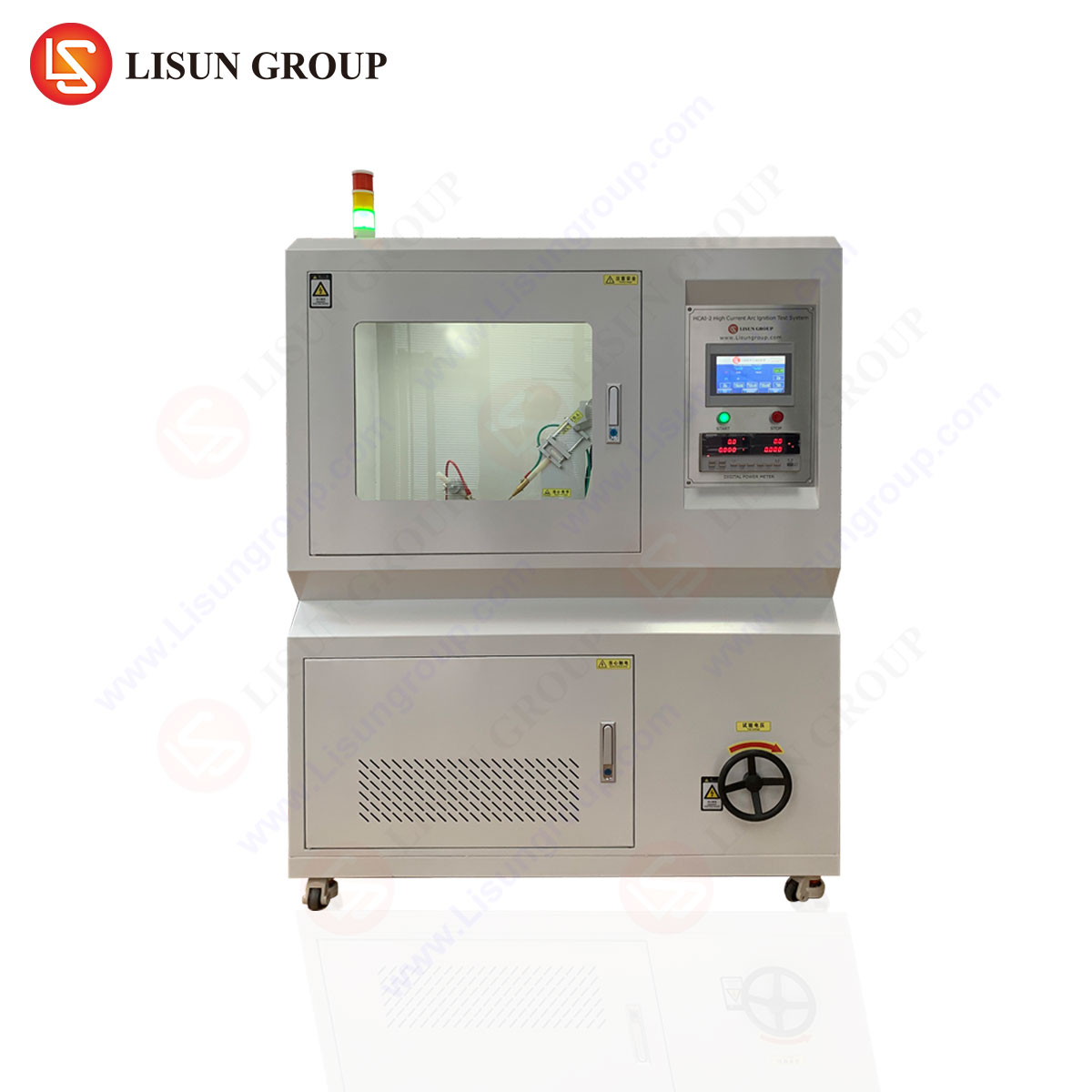
Accurate and reproducible flame propagation testing necessitates instrumentation that provides exacting control over all environmental and flame parameters. The LISUN RSB-WC Wire Cable Flame Tester is engineered specifically to meet the rigorous demands of IEC 60332-3-10, IEC 60332-3-21, IEC 60332-3-22, IEC 60332-3-23, IEC 60332-3-24, IEC 60332-3-25 and related standards for testing bunched wires and cables. Its design philosophy centers on eliminating variables that could compromise test integrity, thereby yielding data that is both reliable and defensible for certification purposes.
The core testing principle of the RSB-WC involves the vertical mounting of a prepared cable bundle on a standardized metal ladder support within a stabilized, draft-free enclosure. A critical component is its high-precision methane or propane gas burner (configurable to standard requirements), which is positioned at a defined angle and distance from the sample. The gas flow is meticulously regulated via mass flow controllers, ensuring a consistent heat flux and flame geometry—a factor paramount to achieving inter-laboratory repeatability. The integrated timer automatically controls the duration of flame application, while the enclosed chamber, constructed from stainless steel and tempered glass, allows for safe observation and prevents external air currents from influencing flame behavior.
Technical Specifications and Competitive Differentiation
The RSB-WC differentiates itself through several key technical attributes that address common pain points in flammability testing:
- Optimized Test Chamber: Constructed from stainless steel with a double-layer tempered glass observation window, it provides durability, corrosion resistance, and clear visibility. The internal dimensions (typically exceeding 1200mm in height) comfortably accommodate standard sample lengths.
- Precision Flame System: The unit employs a high-stability premixed burner with precision needle valves and pressure gauges for fuel and air. This is often supplemented by a calibrated flow meter, allowing operators to dial in the exact flame intensity (e.g., 1kW with a 125mm nominal height) as mandated by the test category.
- Integrated Sample Mounting System: A robust, easily adjustable ladder rack is included, simplifying the precise and repeatable positioning of cable bunches, which can be a labor-intensive process.
- Enhanced Safety and Usability Features: These include flame-out protection, gas leakage monitoring, and an exhaust system to remove combustion products, safeguarding both the operator and the laboratory environment.
From a competitive standpoint, the RSB-WC’s advantage lies in its dedicated design fidelity to the specific standards. Unlike generic vertical flame testers adapted for the purpose, every aspect of the RSB-WC—from chamber volume and burner geometry to the sample holder design—is optimized for cable bunch evaluations. This specialization reduces setup ambiguity, accelerates testing throughput, and increases confidence in the results, which is critical for manufacturers submitting products to Third-Party Certification Bodies (TCPs) like UL, TÜV, or Intertek.
Conducting a Compliant Test: A Procedural Overview
A typical test sequence using an apparatus like the RSB-WC follows a regimented protocol. Initially, cable samples are conditioned at standard temperature and humidity. The required number of lengths (which can range from 3 to 400+ depending on cable diameter and test category) are then bundled and secured to the metal ladder at specified intervals. This assembly is mounted vertically inside the test chamber. A layer of surgical cotton is positioned below to detect flaming droplets.
The operator initiates the test by igniting the pre-adjusted burner and introducing it to the base of the sample for the standard flame application period (e.g., 20 min for Category A). During this period, observations are made regarding flame height, behavior, and any droplet formation. After flame removal, the afterflame and afterglow times are recorded. The final, and most critical, measurement is the extent of char damage. The sample is carefully removed, and the distance from the burner’s lowest point to the highest point of visible charring or material destruction is measured. This “damaged length” must fall below the limit prescribed in the relevant standard (commonly 2.5 meters for many Category A tests) for a passing result.
Data Interpretation and Material Development Implications
The quantitative output—the damaged length—provides a direct metric for comparative material analysis. A shorter damaged length indicates superior performance in a fire scenario, reflecting the efficacy of the cable’s flame-retardant compounds (often based on aluminum trihydrate, magnesium hydroxide, or intumescent systems) and its overall construction. This data is invaluable not only for pass/fail certification but also for Research and Development. Chemists and materials engineers use this feedback iteratively to refine polymer formulations, optimize filler loadings, and develop new composite materials that achieve the necessary fire performance without compromising other critical properties like flexibility, dielectric strength, or durability.
Furthermore, passing these tests is frequently a contractual and regulatory gate. A cable manufacturer cannot market products for use in plenum spaces, mass transit vehicles, or certain industrial controls without the requisite test reports from an accredited laboratory using recognized equipment like the RSB-WC.
Conclusión
Flame propagation testing for cable bunches represents a vital translation of theoretical material science into practical fire safety engineering. By simulating the thermal feedback and fuel loading present in real installations, these tests provide a realistic and severe assessment of a cable system’s ability to inhibit fire spread. The reliability of the assessment is intrinsically linked to the precision and standardization of the test equipment employed. As cable technologies advance and install densities increase across all sectors, the role of dedicated, compliant testing instrumentation will only grow in importance, serving as a key tool in mitigating fire risk and safeguarding lives and infrastructure.
Sección FAQ
Q1: What is the primary difference between testing a single cable (e.g., UL 94 V) and a cable bunch (IEC 60332-3)?
A single cable test evaluates the inherent flame retardancy of the material composition in isolation. The bunch test evaluates the system-level behavior, where thermal feedback between adjacent cables can promote flame propagation that would not occur in a single specimen. The latter is a more severe and application-realistic assessment.
Q2: Can the LISUN RSB-WC tester accommodate all cable diameters and test categories?
The RSB-WC is designed to be configurable for the various categories within the IEC 60332-3 series. This involves adjusting the number of cable samples in the bundle, the burner power, and the test duration according to the standard’s specifications for the cable’s volume of non-metallic material per meter. The apparatus’s flexible ladder holder and calibrated burner system facilitate this range of testing.
Q3: How critical is the calibration of the gas flow and burner positioning?
It is absolutely critical. Variations in flame temperature, heat flux, or impingement angle are significant sources of test result variability. Precise calibration using the instrument’s flow meters and dimensional gauges ensures the applied flame challenge is consistent with the standard’s requirements, making results repeatable and comparable between different laboratories and test dates.
Q4: For a manufacturer, is in-house testing with equipment like the RSB-WC a substitute for third-party certification?
In-house testing is invaluable for quality control, screening, and R&D purposes. It allows for rapid iterative improvement. However, formal product certification or listing for safety standards (like a UL Mark or CE marking under relevant directives) almost always requires testing and audit by an independent, accredited Third-Party Certification Body. Their use of similarly calibrated equipment provides the legally recognized validation.
Q5: What are the key maintenance and safety protocols for operating a cable flame tester?
Regular maintenance includes checking gas lines for leaks, verifying flow meter accuracy, cleaning the burner jet to prevent clogging, and ensuring the exhaust system is functional. Safety protocols mandate operating in a well-ventilated lab, having appropriate fire extinguishers nearby, wearing protective equipment, and never leaving a test in progress unattended. The built-in safety features of the RSB-WC, such as gas leak detection, support but do not replace these fundamental laboratory safety practices.

 ES
ES  EN
EN  RU
RU  PT
PT  TR
TR  AR
AR  DE
DE  PL
PL  IT
IT  FR
FR  KO
KO  JA
JA  ID
ID