




A Comprehensive Analysis of Flame Retardant Cable Standards: Testing Methodologies and Material Performance
Introduction to Flame Propagation in Cable Bundles
The proliferation of electrical and electronic systems across diverse sectors—from aerospace and automotive electronics to household appliances and industrial control systems—has elevated the critical importance of cable safety. Cables, often bundled together within confined spaces, represent a significant fuel load and potential fire propagation pathway. Flame retardant (FR) cables are engineered to inhibit the initiation and spread of fire, limit smoke emission, and reduce the release of toxic and corrosive combustion products. The performance of these cables is not an intrinsic property of the materials alone but is rigorously defined and quantified through a complex framework of international and regional standards. These standards prescribe specific test methodologies to simulate realistic fire scenarios, ensuring that cable installations contribute to overall system safety, protect critical infrastructure, and safeguard human life.
Defining Key Performance Metrics: Flame Spread, Smoke Density, and Acidity
Flame retardancy in cables is a multi-faceted performance characteristic, assessed through several key metrics. Primary among these is the resistance to flame propagation. A cable must not only resist ignition from a small flame but, more critically, must not support the longitudinal spread of fire along its length, especially when installed in vertical trays or bundles that can create a “chimney effect.” Concurrently, smoke obscuration is a vital parameter. Dense smoke impedes escape, complicates firefighting efforts, and is a major cause of fatalities in fires. Standards therefore mandate limits on smoke density, typically measured by the attenuation of a light beam through combustion gases.
Furthermore, the corrosivity and toxicity of fumes are increasingly regulated. Halogenated materials, while historically effective as flame retardants, can produce dense, acidic smoke (containing hydrogen halides like HCl) upon combustion. This corrosive smoke can cause catastrophic secondary damage to sensitive electrical components in telecommunications equipment, medical devices, and data centers, long after the fire is extinguished. Consequently, modern standards often differentiate between halogen-free, low-smoke zero-halogen (LSZH) cables and halogenated FR variants, each with distinct test requirements and application domains.
International Standardization Frameworks: IEC, UL, and EN
The global landscape of cable fire testing is governed by several major standardization bodies, each with its own philosophy and test regimens. The International Electrotechnical Commission (IEC) provides widely adopted benchmarks. IEC 60332 series assesses flame propagation on single vertical wires/cables (IEC 60332-1) and on bunched cables in a vertical tray (IEC 60332-3). For smoke density, IEC 61034 defines the “3-meter cube” test, while corrosivity of fumes may be evaluated via IEC 60754.
In North America, Underwriters Laboratories (UL) standards are predominant. Key standards include UL 1685 (Vertical-Tray Fire-Propagation and Smoke-Release Test), which is broadly analogous to IEC 60332-3 but with additional smoke measurement, and UL 94 for the flammability of polymeric materials. The European Union harmonizes standards under the EN designation, with EN 50399 being a critical standard for fire performance, incorporating heat release and smoke production measurements alongside flame spread.
Compliance is not merely a technical exercise but a regulatory imperative. Building codes, transportation safety regulations (e.g., for automotive electronics or aerospace components), and industry-specific specifications for office equipment or lighting fixtures explicitly reference these standards to define minimum safety thresholds.
The Critical Role of Bundle Testing: Simulating Real-World Installations
Testing single cables, as in IEC 60332-1, provides a foundational assessment. However, it is recognized as insufficient for evaluating real-world risk. In practice, cables are installed in bundles, conduits, or trays. The proximity of multiple cables creates thermal feedback and pooling of flammable pyrolysis gases, which can dramatically accelerate flame spread compared to a single cable. This phenomenon makes large-scale bundle testing, such as that defined in IEC 60332-3 Category A, B, C, or D (with increasing severity based on the volume of non-metallic material per meter), indispensable for applications in industrial control systems, power distribution networks, and telecommunications backbone installations.
The test classifies cables based on the maximum height of flame damage sustained after a defined exposure to a propane burner. A Category A pass, for instance, requires that the charred portion does not reach a point 2.5 meters above the burner, under the most severe fuel load. This large-scale test is resource-intensive but provides the most realistic evaluation of a cable’s performance in a developed fire scenario, directly informing specifications for high-risk or high-value installations.
Instrumentation for Compliance: The RSB-WC Probador de llama de cable
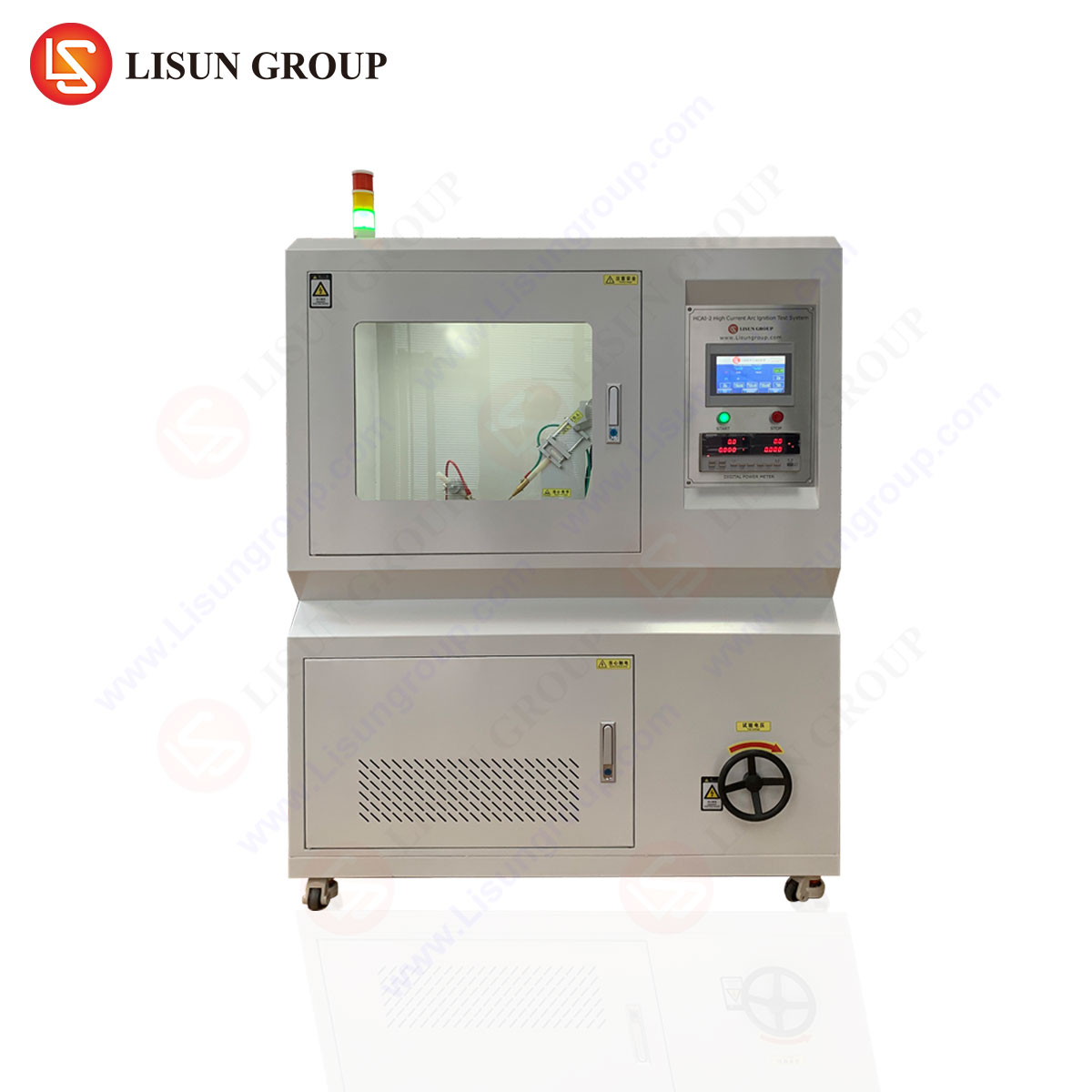
Verifying compliance with standards like IEC 60332-1 and UL 1581 VW-1 requires precise, repeatable, and standardized laboratory instrumentation. The LISÚN RSB-WC Probador de llama de cable de alambre is engineered specifically for this purpose, providing a controlled environment to assess the flame retardancy of insulated wires, cables, and other polymeric materials under vertical burning conditions.
The apparatus operates on a defined testing principle: a specimen of specific length is clamped vertically in a metal frame. A calibrated Bunsen burner with a specified flame height (typically 125mm) and heat output is applied to the specimen at a prescribed angle and duration (e.g., 60 seconds for IEC 60332-1). After flame removal, the afterflame time (the duration the specimen continues to burn) and afterglow time are meticulously recorded. The test also measures the extent of char damage—the length of the specimen consumed or damaged by flame. Pass/fail criteria are strictly dictated by the referenced standard; for example, a common requirement is that the afterflame time does not exceed 60 seconds and the charred length does not exceed a specified limit, often 100mm from the fixed point.
Technical Specifications and Operational Advantages of the RSB-WC System
The RSB-WC system incorporates features designed to ensure testing integrity and operational efficiency. Its specifications typically include a stainless steel test chamber with observation windows, a precision methane or propane flow control system with manometer, and an automated timing mechanism with digital displays for afterflame/afterglow. The specimen holder is designed for secure, vertical fixation, and the burner positioning is adjustable to meet exact geometric requirements of various standards.
Its competitive advantages lie in its construction fidelity and measurement consistency. The use of corrosion-resistant materials ensures long-term stability of the test environment. The integrated gas flow control guarantees a consistent flame profile, a variable that, if not controlled, can invalidate test results. Furthermore, the design often incorporates safety features such as gas leak detection and automatic shut-off protocols. For quality assurance laboratories serving manufacturers of electrical components, automotive electronics, or consumer electronics, such reliability is paramount. It enables comparative material evaluations, formulation optimization for cable compound producers, and routine batch testing for cable manufacturers, ensuring that products destined for household appliances or lighting fixtures consistently meet the mandated safety grades.
Application-Specific Standard Requirements Across Industries
The selection of flame retardant cable standards is highly application-dependent, driven by the operational environment and potential consequences of failure.
En Componentes aeroespaciales y de aviación, standards like AS/EN 60332-3-24 are stringent, considering the catastrophic implications of fire in a confined, pressurized vessel. Cables must exhibit minimal flame spread, very low smoke emission, and low toxicity.
Electrónica del automóvil, particularly in electric and hybrid vehicles, follows ISO 6722 and LV standards, which include flame propagation tests simulating under-hood and passenger compartment exposures. The focus is on preventing fire propagation from a short-circuit event through wire harnesses.
Productos sanitarios y Equipos de telecomunicaciones installed in public buildings or data centers frequently mandate LSZH cables compliant with IEC 60754-2 (low acidity) and IEC 61034-2 (low smoke density), prioritizing the safety of occupants and the integrity of sensitive, expensive equipment.
Industrial Control Systems in factories or power plants may prioritize robustness against flame spread in large cable trays, specifying IEC 60332-3 Category C or A cables, ensuring that a localized fault does not cascade into a widespread cable tray fire.
Material Science and Formulation Challenges for Cable Compounds
Meeting these diverse standards is a challenge in polymer science and compounding. Base polymers like Polyvinyl Chloride (PVC), Polyethylene (PE), or Ethylene-Vinyl Acetate (EVA) are modified with flame retardant additives. Halogenated systems (using bromine or chlorine) often employ antimony trioxide as a synergist but face scrutiny over smoke toxicity. Halogen-free systems typically rely on metal hydroxides, such as Aluminum Trihydroxide (ATH) or Magnesium Dihydroxide (MDH), which act through endothermic decomposition, releasing water vapor and diluting flammable gases. However, these often require high loadings, which can compromise the mechanical and electrical properties of the insulation or jacket. The development of novel synergists, nano-additives, and polymer blends is an ongoing field of research, driven by the need to balance flame retardancy with processability, flexibility, and cost for applications ranging from office equipment cabling to heavy industrial power cables.
Future Trajectories in Fire Safety Standardization
The evolution of flame retardant cable standards is continuous, reflecting technological advancement and deeper understanding of fire dynamics. Trends include a greater emphasis on holistic “fire performance” rather than isolated metrics. Standards like EN 50399 and the NFPA 262 (Steiner Tunnel test) integrate measurements of heat release rate (HRR), a key driver of fire growth, alongside smoke production. There is also a push towards more sophisticated large-scale testing that better replicates installed conditions, including the effects of airflow (draft) and mechanical stress on cables. Furthermore, the rise of the Internet of Things (IoT) and increased power densities in data centers and consumer electronics are driving demand for cables with enhanced fire safety in ever-smaller form factors, ensuring that standardization and testing methodologies will remain a dynamic and critical field.
Sección FAQ
Q1: What is the primary difference between testing a single cable (IEC 60332-1) and a cable bundle (IEC 60332-3)?
A1: Single cable testing evaluates the intrinsic flame resistance of the cable’s construction under a defined flame impingement. Bundle testing assesses the propensity for flame propagation in a simulated real-world installation where thermal feedback between adjacent cables can create a significantly more severe fire hazard. Bundle testing is therefore considered a more rigorous and realistic assessment for most commercial and industrial applications.
Q2: Why is gas flow control so critical in a test apparatus like the RSB-WC?
A2: The flame geometry and temperature are direct functions of the fuel gas flow rate. Even minor deviations can alter the heat flux applied to the test specimen, leading to non-standardized and non-repeatable results. Precise flow control, as mandated by standards, ensures that tests conducted in different laboratories on the same material yield comparable data, which is fundamental for certification and quality control.
Q3: Can the RSB-WC tester be used for both wire and cable samples?
A3: Yes, provided the specimen can be securely mounted in the vertical configuration as per the standard. The apparatus is designed for insulated wires, cables, and other solid or sheathed materials of a diameter that fits within the specified holder. The test methodology (flame application time, pass/fail criteria) is then selected based on the relevant standard for that product type.
Q4: How do low-smoke zero-halogen (LSZH) cables perform in flame retardancy tests compared to halogenated cables?
A4: LSZH cables typically rely on different flame-retardant mechanisms (primarily endothermic cooling and char formation) rather than gas-phase radical quenching used by halogens. They may exhibit different burning characteristics. A well-formulated LSZH cable can achieve equivalent or superior performance in flame spread tests (like IEC 60332-3) while excelling in the ancillary tests for smoke density (IEC 61034) and acidity (IEC 60754-2), which are the primary reasons for their specification.
Q5: What are the key maintenance considerations for ensuring the long-term accuracy of a vertical flame tester?
A5: Regular calibration of the gas flow meter and timer is essential. The burner tip must be kept clean and free of soot to maintain a stable, standard flame shape. The integrity of gas lines and safety valves should be periodically checked. Furthermore, the use of verified reference materials with known burn characteristics is recommended for periodic performance validation of the entire system.

 ES
ES  EN
EN  RU
RU  PT
PT  TR
TR  AR
AR  DE
DE  PL
PL  IT
IT  FR
FR  KO
KO  JA
JA  ID
ID