




A Comprehensive Guide to Flammability Test Methods for Materials and Components
Introduction to Material Flammability Assessment
The propensity of a material to ignite, propagate flame, and release energy when exposed to a heat source constitutes a fundamental safety parameter across innumerable industries. Flammability testing, therefore, is not merely a regulatory hurdle but a critical engineering discipline integral to product design, risk mitigation, and compliance with international safety standards. The consequences of inadequate flammability assessment range from consumer injury and property damage to catastrophic system failures, particularly in sectors where electronics are densely packed or operate in uncontrolled environments. This guide delineates the principal standardized test methodologies for evaluating flammability, with a focused examination on hot wire ignition resistance—a key assessment for electrical components. The objective is to provide engineers, quality assurance professionals, and product specifiers with a technical framework for selecting and interpreting these essential safety evaluations.
The Hot Wire Coil Ignition Principle and Its Standardized Protocols
Among the suite of flammability tests, the hot wire ignition method occupies a specialized niche designed to simulate a specific, high-risk fault condition: the overheating of resistive elements, electrical connections, or current-carrying components. The test principle involves applying a heated nickel-chromium wire, maintained at a predetermined temperature, directly to a test specimen for a specified period. This scenario replicates failures such as poor electrical contacts, overloaded windings, or resistive heating in circuit elements, which can act as sustained ignition sources adjacent to polymeric materials, insulation, or other combustible parts.
The methodology is rigorously defined under international standards, primarily IEC 60695-2-20 (and its national derivatives such as UL 746A, GB/T 5169.21), which stipulate the apparatus specifications, test procedures, and pass/fail criteria. The wire temperature, typically selected from a range including 550°C, 650°, 750°, and 850°C, is calibrated using a pure tin wire of specified diameter. The test specimen, often a molded plaque or a complete component, is subjected to the heated wire for a duration of 30 seconds (±1 second). Post-application, observations are made for ignition, flame persistence, and whether any ignited drips ignite a surgical cotton layer positioned below. A material or component fails if burning persists beyond 30 seconds after removal of the hot wire, or if flaming drips ignite the indicator.
Critical Apparatus Specifications for Reproducible Hot Wire Testing
The integrity of the hot wire test is wholly dependent on the precision and consistency of the testing apparatus. Key apparatus specifications mandated by the standards include:
- Test Wire: A nickel-chromium (NiCr) wire, typically 0.5 mm ± 0.05 mm in diameter, with a nominal resistance of approximately 5.28 Ω/m. The wire must be wound into a coil of specific dimensions.
- Power Supply: A stabilized AC or DC power supply capable of delivering the necessary current to achieve and maintain the required wire temperature with minimal fluctuation (±2°C).
- Temperature Calibration System: A dedicated circuit for calibrating the wire temperature using pure tin (99.9% Sn) wires of 0.5mm diameter. The melting point of tin (232°C) provides a fixed reference point for establishing the current-temperature relationship.
- Portamuestras: A fixture that holds the test specimen in a consistent orientation and applies the hot wire coil under a controlled force of 0.95N ± 0.1N.
- Timing and Control System: An automated timer to control the application period precisely and, in advanced systems, to monitor test parameters.
The RSY-LT Probador de encendido por hilo caliente: Engineered for Precision and Compliance
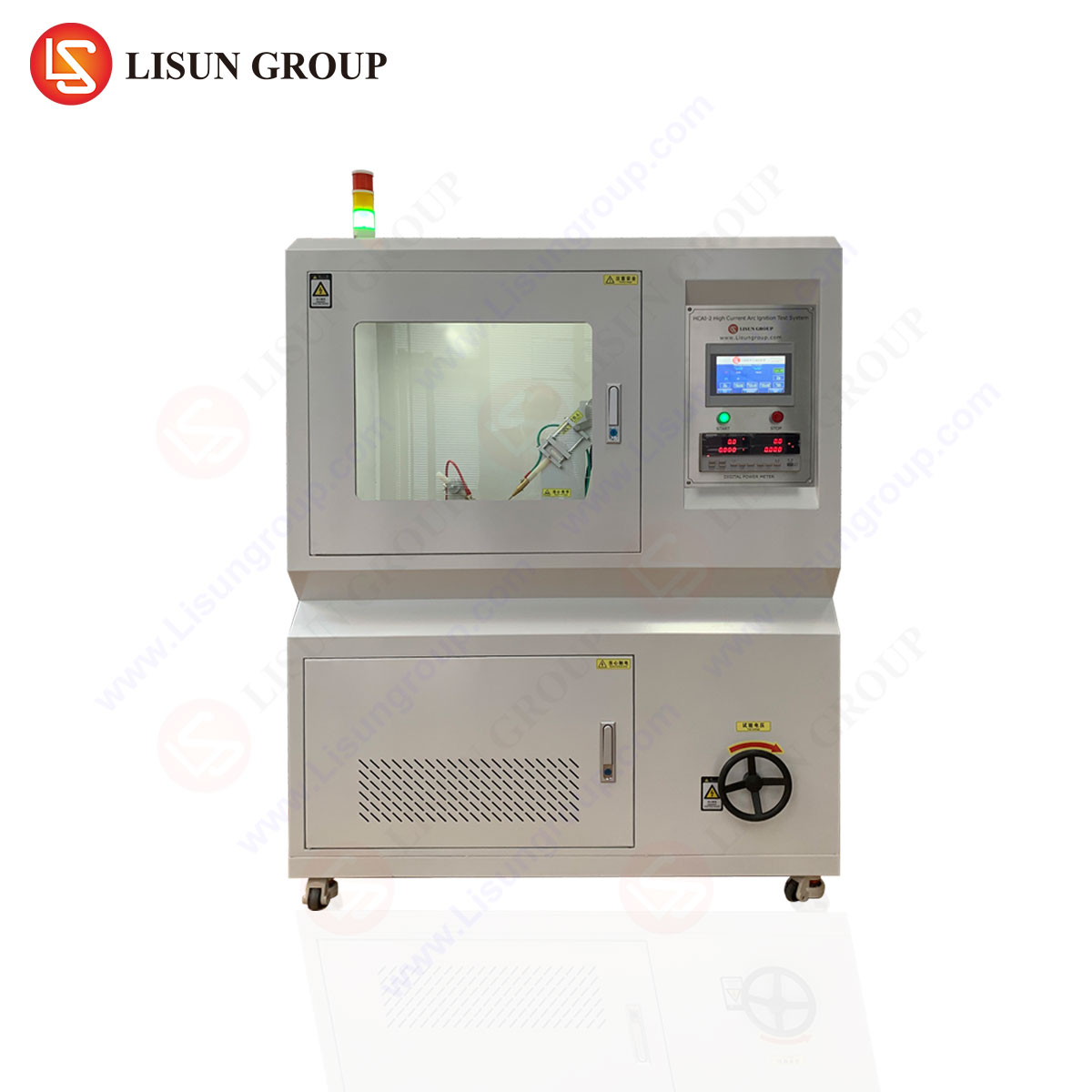
El LISÚN RSY-LT Hot Wire Ignition Tester represents a fully integrated apparatus designed to execute the requirements of IEC 60695-2-20 and related standards with a high degree of automation and accuracy. Its design philosophy centers on eliminating operator variables and ensuring repeatable, auditable test results.
Core Specifications and Operational Advantages:
- Temperature Range and Control: The unit facilitates testing across the full standard spectrum (e.g., 550°C to 960°C+), with a digital current regulator maintaining temperature stability within ±2°C. This precise control is paramount for generating comparable data, especially when testing materials with narrow margins of ignition resistance.
- Automated Test Cycle: The RSY-LT features a fully automated test sequence. Upon initiation, the apparatus applies the hot wire for the exact 30-second duration, after which it automatically retracts and initiates the 30-second post-application observation timer. This automation minimizes timing errors and enhances operator safety.
- Integrated Calibration Function: A dedicated calibration mode simplifies the critical step of establishing the current-temperature curve for each new wire coil, using the tin wire method as per the standard. This built-in functionality ensures the apparatus remains in a state of calibration readiness.
- Specimen Positioning Fixture: The included fixture ensures the hot wire coil is applied to the specimen with the repeatable, standard-specified contact force, a variable often poorly controlled in makeshift setups.
- Safety Enclosure: A transparent polycarbonate viewing chamber contains any potential flames, splashes, or fumes, protecting the operator and laboratory environment.
Aplicaciones y casos de uso específicos del sector
The hot wire test is indispensable in industries where electrical components are in intimate contact with polymeric materials or where internal overheating is a credible fault scenario.
- Electrical Components & Household Appliances: Test subjects include terminal blocks, connector housings, switch enclosures, and internal supports in devices like coffee makers, electric kettles, and power tools. The test verifies that these materials will not readily ignite if a connection loosens, creating a resistive hot spot.
- Automotive Electronics & Aerospace Components: Under-hood automotive components, battery management system housings, and cabin electronics must resist ignition from wire harness faults. Similarly, aerospace components in confined bays are evaluated to ensure a single point of overheating does not lead to a fire.
- Lighting Fixtures & Industrial Control Systems: Sockets for LED drivers, ballast housings, and the enclosures for motor controllers and PLCs are assessed. These applications often involve sustained electrical loads in proximity to thermoplastic materials.
- Telecommunications & Medical Devices: Jacks, plugs, and internal chassis components in servers or routers, as well as housings for patient monitoring equipment, are tested to ensure safety in continuous-operation environments.
- Cable & Wiring Systems: While cables have other primary flammability tests (e.g., vertical flame), components used in cable management, such as cable ties, clips, or conduit, may be subject to hot wire evaluation.
Comparative Analysis with Alternative Flammability Test Methods
The hot wire test complements, rather than replaces, other key flammability assessments. A holistic safety evaluation often requires a battery of tests.
| Test Method (Standard) | Ignition Source | Simulated Hazard | Typical Application Focus |
|---|---|---|---|
| Hot Wire (IEC 60695-2-20) | Glowing NiCr wire | Overheating electrical element | Electrical components, insulating parts |
| Glow-Wire (IEC 60695-2-10/11/12) | Glowing element at 550-960°C | Overheated/glowing parts | Electrotechnical product enclosures, final assembly |
| Needle Flame (IEC 60695-2-2) | Small butane flame (12mm) | Small ignition source from fault | Miniature components, limited material volumes |
| Horizontal/Vertical Flame (UL94, IEC 60707) | Bunsen burner flame | Exposure to open flame | General material screening, plastics classification |
| High Current Arc Ignition (IEC 60950-1 Annex A) | Electric arc | Faulty arc in circuitry | Insulation barriers near high-energy circuits |
The hot wire test is uniquely quantitative in its simulation of resistive overheating. Unlike the glow-wire test, which assesses the effect of an external overheated part, the hot wire test is best suited for evaluating materials that are intrinsically part of the current-carrying system or are in direct, intimate contact with it.
Interpreting Test Results and Material Classification
A “pass” in the hot wire test under a given temperature condition (e.g., 750°C) provides a discrete data point for a material or component. It indicates that under the specific, severe fault condition simulated, the material did not support combustion that could lead to fire propagation. This result is often used to specify materials for particular applications within a Bill of Materials (BOM). For instance, a terminal block housing may be specified to pass at 750°C, while a less critical internal baffle may only be required to pass at 650°C.
It is critical to note that passing a hot wire test does not imply general flame retardancy. A material may pass the hot wire test yet perform poorly in a vertical flame test (UL94 V-2, V-1, V-0), as the ignition mechanisms and heat transfer modes differ substantially. Therefore, specifications must reference the exact test method and conditions.
Integrating Flammability Testing into the Product Development Lifecycle
Effective flammability management requires upstream integration. Material selection during the design phase should be informed by historical test data or preliminary screening tests. Prototype components should undergo formal compliance testing well before production tooling is finalized. The use of precise, automated equipment like the RSY-LT Hot Wire Ignition Tester at this stage provides high-confidence data, preventing costly redesigns or material changes later. Furthermore, maintaining such apparatus for ongoing quality assurance allows for batch-to-batch verification of incoming materials, ensuring consistency in production and safeguarding against supply chain variances that could compromise fire safety.
Conclusión
Flammability testing, and hot wire ignition assessment in particular, forms a non-negotiable pillar of product safety engineering. Its standardized, rigorous application provides a defensible technical basis for certifying that components will not act as the origin point of a fire under defined fault conditions. As electrical and electronic systems grow more complex and pervasive, the demand for precise, reliable, and efficient testing instrumentation will only intensify. Employing dedicated, compliant apparatus is not an exercise in box-ticking but a fundamental investment in risk reduction, product integrity, and regulatory due diligence.
Sección FAQ
Q1: What is the fundamental difference between the Hot Wire test (IEC 60695-2-20) and the Glow-Wire test (IEC 60695-2-10)?
While both use a heated element, their simulation scopes differ. The Hot Wire test specifically simulates an internal fault where the test specimen itself or a part in direct contact becomes a resistive heating element (e.g., an overloaded wire or poor connection). The Glow-Wire test simulates an external thermal stress, such as from an overheated component elsewhere in the product that contacts or radiates heat to the test specimen. The test fixtures, application forces, and pass/fail criteria are distinct between the two standards.
Q2: Why is the tin wire calibration step so critical in hot wire testing?
The nickel-chromium test wire’s resistance and thus its temperature at a given current can vary slightly between coils due to manufacturing tolerances and can change with oxidation over time. The tin wire calibration uses the precise melting point of pure tin (232°C) as a physical constant to establish an accurate baseline. By determining the exact current required to melt the tin wire, the apparatus can then calculate the correct current needed to achieve the higher target test temperatures (550°C, 750°C, etc.) for that specific coil, ensuring temperature accuracy across all tests.
Q3: Can the RSY-LT tester be used for the Glow-Wire test as well?
No, the RSY-LT is designed specifically for the Hot Wire Ignition Test per IEC 60695-2-20. The Glow-Wire test (IEC 60695-2-10/11/12) requires a different apparatus, such as the LISUN RSG-T Glow-Wire Tester. The key differences include the geometry of the heating element (a straight glow-wire vs. a coil), the applied force (1.0N ± 0.2N for glow-wire), the test specimen mounting, and the observation criteria. Using the correct, dedicated apparatus for each standard is essential for compliant testing.
Q4: How should we select the appropriate test temperature (e.g., 550°C vs. 750°C) for our component?
The test temperature is typically dictated by the end-product safety standard applicable to your device. For example, IEC 62368-1 (Audio/Video, Information and Communication Technology Equipment) specifies a hot wire test at 750°C for certain insulating materials. IEC 60335-1 (Household Appliances) may reference other temperatures based on the component’s function and location. The primary reference must always be the ultimate end-product standard, not a generic material datasheet. Consulting the specific clause in the relevant product safety standard is mandatory.

 ES
ES  EN
EN  RU
RU  PT
PT  TR
TR  AR
AR  DE
DE  PL
PL  IT
IT  FR
FR  KO
KO  JA
JA  ID
ID