




Quantitative Haze Measurement: Principles, Standards, and Industrial Applications for Material Transparency
Introduction to Optical Haze as a Critical Material Property
In the realm of material science and quality control, the visual and functional characteristics of transparent and translucent materials are paramount. Among these, optical haze stands as a definitive metric, quantifying the degree of light scattering that occurs as light transmits through a substrate. Formally defined as the percentage of transmitted light that deviates from the incident beam by more than 2.5 degrees, haze directly influences perceived clarity, gloss, and diffusion. Precise measurement of this parameter transcends aesthetic assessment, serving as a non-destructive indicator of surface quality, internal consistency, and manufacturing integrity. The deployment of specialized instrumentation, namely haze meters, has therefore become integral across advanced manufacturing sectors where material transparency impacts product performance, safety, and user experience.
Fundamental Photometric Principles Governing Haze Measurement
The quantification of haze is rooted in established principles of photometry and radiometry, as standardized by organizations such as ASTM (American Society for Testing and Materials) and ISO (International Organization for Standardization). The governing standard, ASTM D1003, prescribes the method for measuring haze and luminous transmittance of transparent plastics. The core principle involves the directional measurement of light flux.
A collimated light beam of known intensity is directed perpendicularly onto the test specimen. The total transmitted light (Tt) is collected by an integrating sphere. Within this sphere, a photodetector first measures the total transmitted flux. A light trap is then employed at the sphere’s opposite port to capture the unscattered, or specular, transmitted light (T2)—defined as light deviating less than 2.5 degrees from the incident direction. The scattered transmitted light (Td) is calculated as the difference: Td = Tt – T2. Haze (H) is subsequently derived as the ratio of scattered light to total transmitted light, expressed as a percentage: H = (Td / Tt) × 100%. Concurrently, total luminous transmittance (Tt) is measured, providing a complementary data point on overall light transmission efficiency. This dual-parameter output is critical for a complete optical characterization.
Instrumentation Architecture: The HM-100 Medidor de neblina/Medidor de turbidez
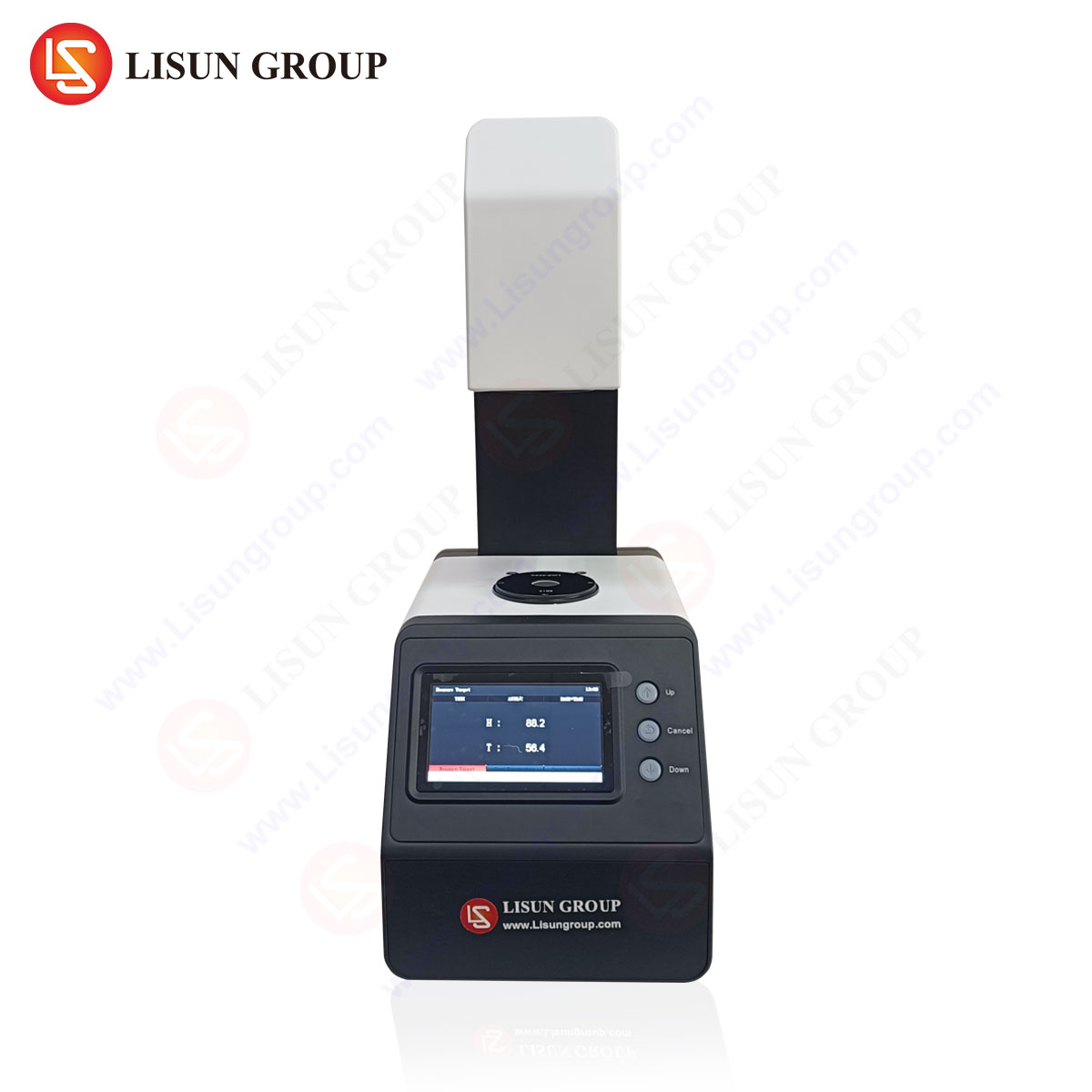
Implementing these principles with high repeatability and accuracy requires robust instrument design. The LISÚN HM-100 Haze Meter/Turbidity Meter exemplifies a modern, dual-purpose apparatus engineered for compliance with ASTM D1003, ISO 13468, and ISO 14782. Its architecture is designed to minimize systematic error and facilitate operator efficiency.
The system employs a stable, CIE standard illuminant A (2856K) light source, ensuring spectral consistency. A high-precision silicon photodetector, coupled with a spectral correction filter, mimics the photopic luminosity function, allowing for accurate luminous flux measurements. The integrating sphere, coated with a highly reflective and spectrally neutral material, is the core component for uniform light collection. The HM-100 automates the sequencing of total and specular transmission measurements, calculating haze and transmittance values directly. Key specifications that define its operational capability include a haze measurement range of 0 to 100% with a resolution of 0.01%, a transmittance range of 0 to 100% with 0.1% resolution, and high repeatability of ≤0.1% for haze and ≤0.2% for transmittance. The instrument’s calibration is traceable to NIST (National Institute of Standards and Technology) standards, ensuring metrological integrity. Its dual functionality as a turbidity meter further extends its utility to liquid sample analysis, though its primary application in industrial contexts is for solid materials.
Critical Applications in Electrical, Electronic, and Component Manufacturing
The control of optical haze is non-negotiable in industries where materials interface with light, vision, or signals. The following sectors demonstrate specific use cases for haze metrology.
Automotive Electronics and Interior Components: Polycarbonate and acrylic are ubiquitous in dashboard displays, touchscreen overlays, and indicator lens covers. Excessive haze on a heads-up display (HUD) combiner or instrument cluster lens can scatter ambient light, severely reducing legibility and creating glare hazards. The HM-100 is used to validate that injection-molded or coated components meet stringent OEM specifications, often requiring haze values below 1.0% for critical optical paths. Similarly, light guides for interior ambient lighting require controlled haze to achieve uniform luminance without visible hotspots.
Lighting Fixtures and Optical Systems: Diffusers for LED panels, streetlights, and architectural luminaires are engineered to specific haze values to optimize light distribution and eliminate glare. A haze meter quantifies the efficacy of surface etching, particle loading, or micro-lens arrays in achieving the target diffusion profile. For example, a high-bay industrial light may utilize a polycarbonate diffuser with 85-90% haze to create a wide, soft beam, whereas a museum spotlight lens may require <5% haze for precise beam control.
Medical Devices and Diagnostic Equipment: Transparency is crucial for viewing chambers, fluidic cell observation windows, and protective shields. In devices like dialysis machines or spectrophotometer cuvettes, haze can interfere with optical sensors and automated vision systems, leading to measurement drift or false readings. Monitoring haze ensures that sterilizable polymers (e.g., cyclic olefin copolymer) maintain their clarity after repeated autoclave cycles, which can induce micro-crazing and increase scatter.
Aerospace and Aviation Components: Cockpit canopies, window laminates, and interior signage must exhibit minimal haze to maintain pilot visibility under high-stress lighting conditions. Furthermore, composite materials used in radomes (radar domes) require precise characterization of electromagnetic transmission properties, which correlate strongly with optical haze measurements of the composite resins, indicating uniformity and void content.
Consumer Electronics and Displays: The proliferation of touch-enabled devices has made the optical quality of cover glass and protective films a key differentiator. Anti-glare (AG) and anti-reflective (AR) coatings are applied to reduce reflections, but improperly formulated coatings can inadvertently increase haze, degrading contrast. Quality assurance labs use instruments like the HM-100 to perform batch testing on incoming cover glass, ensuring AG coatings provide matte finish without exceeding a haze threshold (e.g., 5-10%) that would blur underlying pixels.
Electrical Components and Insulating Materials: While not always optically clear, epoxy resins used for potting or encapsulating sensitive components are often translucent. An increase in haze during cure can indicate crystallization, phase separation, or moisture ingress, which may compromise dielectric strength or thermal conductivity. Haze measurement thus serves as a process control checkpoint.
Haze as a Proxy for Manufacturing Process Control and Failure Analysis
Beyond final inspection, haze measurement is a powerful diagnostic tool. A sudden spike in batch haze can pinpoint upstream process faults. In injection molding, it may indicate excessive shear heating, which degrades polymer chains, or mold temperatures that are too low, causing imperfect surface replication. In coating applications, haze can reveal improper curing, particulate contamination, or inadequate substrate cleaning. For extruded films used in flexible displays or membrane switches, variations in haze across the web width can signal die lip contamination or uneven cooling. By integrating haze testing into statistical process control (SPC) protocols, manufacturers can maintain tighter tolerances, reduce waste, and preemptively address tooling wear.
Standards Compliance and Metrological Traceability
Industrial adoption mandates alignment with international standards. The HM-100’s design directly addresses the apparatus requirements of:
- ASTM D1003: Standard Test Method for Haze and Luminous Transmittance of Transparent Plastics.
- ISO 13468-1 & -2: Determination of the total luminous transmittance of transparent materials.
- ISO 14782: Plastics — Determination of haze for transparent materials.
Compliance ensures that data generated is reproducible and acceptable in global supply chains. Metrological traceability, maintained through calibrated reference standards (e.g., haze calibration plates with certified values), underpins the validity of every measurement, making it defensible in quality audits and supplier agreements.
Comparative Advantages in Precision Instrumentation
When evaluating haze meters, several technical differentiators determine suitability for high-throughput industrial labs. The HM-100 incorporates features that address common pain points. Its automatic specimen positioning and measurement cycle eliminates operator influence on alignment, a critical factor for repeatability. The use of a long-life, thermally stabilized light source reduces drift and calibration frequency. The instrument’s software typically includes pass/fail grading, data logging, and SPC charting functions, streamlining integration into quality management systems. Furthermore, its dual-purpose design for both haze (solids) and turbidity (liquids) offers laboratories a consolidation of testing capabilities, optimizing capital equipment expenditure. The robust construction and simplified calibration routine also contribute to lower total cost of ownership and higher uptime compared to more complex research-grade spectrophotometers.
Conclusión
The precise measurement of optical haze has evolved from a niche laboratory technique to a cornerstone of quality assurance in precision manufacturing. As products across electrical, electronic, automotive, and medical sectors increasingly rely on advanced polymers and coatings with specific optical functions, the ability to quantitatively assess clarity and light scatter becomes indispensable. Instruments engineered to rigorous standards, such as the LISUN HM-100 Haze Meter/Turbidity Meter, provide the reliable, repeatable, and traceable data required to control manufacturing processes, validate material specifications, and ensure end-product performance. By converting the subjective assessment of “clarity” into an objective numerical metric, haze metrology empowers engineers and quality professionals to make informed decisions that enhance product reliability, safety, and user satisfaction.
FAQ: Haze Measurement and the HM-100 Haze Meter
Q1: How does sample thickness affect haze measurement, and does the HM-100 compensate for this?
Sample thickness is a fundamental variable. Thicker samples provide a longer path length for internal scattering, typically resulting in higher measured haze values for the same material. Standards like ASTM D1003 require reporting sample thickness but do not specify a compensation algorithm. The HM-100 does not automatically compensate for thickness; it measures the haze of the sample as presented. For valid comparative analysis, samples must be of identical thickness, or data must be normalized using known scattering coefficients if the material’s intrinsic properties are being characterized.
Q2: Can the HM-100 measure highly diffuse or opaque materials?
Yes, within its specified range of 0-100% haze. For materials approaching 100% haze (perfect diffusers), nearly all transmitted light is scattered, and the measurement remains valid. However, for opaque materials where total luminous transmittance (Tt) is extremely low (e.g., <1%), the signal-to-noise ratio for the photodetector may decrease, potentially affecting measurement precision. The instrument is most accurate and repeatable for materials with sufficient transmitted light to generate a stable detector signal.
Q3: What is the primary cause of measurement drift, and how is it mitigated in the HM-100?
The primary sources of drift are light source intensity fluctuation and photodetector sensitivity changes due to temperature. The HM-100 mitigates this through a thermally regulated light source housing to maintain stable operating temperature and, consequently, stable luminous output. Regular calibration using traceable standard reference materials is still essential to correct for any long-term drift. The instrument’s design emphasizes short warm-up times to reach thermal equilibrium quickly.
Q4: How is the instrument calibrated, and what standards are used?
Calibration is a two-step process. First, a “zero” calibration is performed with no sample, setting the 100% transmittance and 0% haze baseline. Second, a “span” or standard calibration is performed using certified haze and transmittance standard plates, typically made of stable optical glass with precisely known values (e.g., a standard with 10.0% haze and 85.0% transmittance). The HM-100’s software adjusts its internal coefficients to match the certified values of these standards. Calibration should be performed at regular intervals defined by the lab’s quality procedures or after significant environmental changes.
Q5: Can the HM-100 test films and flexible substrates without causing damage?
Yes. The instrument’s sample compartment is designed to accommodate flat specimens. For thin, flexible films, it is recommended to mount the film taut in a dedicated film holder or between two glass plates (provided the glass is of known, high-clarity quality) to prevent sagging or wrinkling, which would scatter light and artifactually increase the haze reading. Care should be taken to avoid scratching the film surface during handling and insertion.

 ES
ES  EN
EN  RU
RU  PT
PT  TR
TR  AR
AR  DE
DE  PL
PL  IT
IT  FR
FR  KO
KO  JA
JA  ID
ID