






Principles of Haze Testing: A Technical Analysis of Optical Clarity Measurement in Industrial Materials
Introducción
The quantification of optical clarity, specifically haze and transmittance, represents a critical yet often underappreciated parameter in the quality assurance of materials and components across a vast spectrum of industries. Haze, defined as the percentage of transmitted light that deviates from the incident beam by more than 2.5 degrees due to forward scattering, directly impacts perceived quality, functional performance, and user safety. This article delineates the fundamental principles of haze testing, examining the underlying optical physics, standardized methodologies, and the pivotal role of precision instrumentation in ensuring material compliance and performance. The discussion will be contextualized within the rigorous demands of modern manufacturing sectors, including automotive electronics, medical devices, and consumer electronics, where precise optical characterization is non-negotiable.
Optical Foundations: Defining Haze and Total Transmittance
Haze and total luminous transmittance are distinct but interrelated photometric quantities governed by the interaction of light with material microstructure. Total transmittance (Tt) measures the fraction of incident light that passes through a specimen, encompassing both unscattered (specular) and scattered (diffuse) components. Haze, conversely, isolates the diffuse portion, quantifying the light-scattering properties that cause a milky, clouded, or glossy appearance.
The physical origin of haze lies in microscopic inhomogeneities within a material. These can include surface irregularities from machining or molding, internal discontinuities such as filler particles or crystallites, and variations in refractive index caused by density fluctuations or phase separation. When light encounters these inhomogeneities, scattering occurs. Wide-angle scattering, captured in the haze measurement, reduces contrast and clarity. The precise quantification of this phenomenon is essential for differentiating between a high-clarity polycarbonate used in an aircraft cockpit display and a light-diffusing lens for an automotive indicator.
The mathematical relationship is defined by standards such as ASTM D1003 and ISO 14782. Haze is calculated as the ratio of the diffuse transmitted light (Td) to the total transmitted light (Tt), expressed as a percentage: Haze (%) = (Td / Tt) × 100%. Accurate measurement therefore necessitates the precise optical separation of the diffuse and specular transmission components, a task requiring sophisticated instrument design.
Instrumentation Architecture for Conformity with International Standards
A haze meter, or turbidity meter for clear solids, must be engineered to meet the exacting geometrical and photometric conditions stipulated by international standards. The core principle involves an integrating sphere, a hollow spherical cavity with a highly reflective, diffuse white coating. The sphere serves to collect and spatially integrate light, enabling the separate measurement of total and diffuse transmission.
In a standard compliant configuration, light from a CIE standard illuminant (typically CIE Illuminant C or D65) is collimated and directed onto the specimen mounted at the sphere’s entrance port. For total transmittance (Tt) measurement, the specimen is placed, and all light entering the sphere is measured by a detector mounted on the sphere’s wall, shielded from direct specular reflection. For diffuse transmittance (Td), a light trap is engaged opposite the specimen port to capture the unscattered, specular beam. The light then measured by the detector originates solely from the diffuse component scattered by the specimen. The instrument’s electronics and software compute Tt, Td, and ultimately haze, from these two readings.
Critical design considerations include the sphere’s diameter and coating reflectance, the precision of the detector’s spectral response matching the CIE photopic luminosity function (V(λ)), and the absolute accuracy of the light trap. Any deviation can introduce significant systematic error, especially for low-haze, high-clarity materials commonly used in optical-grade components.
The HM-100 Medidor de neblina: Precision Engineering for Industrial Metrology
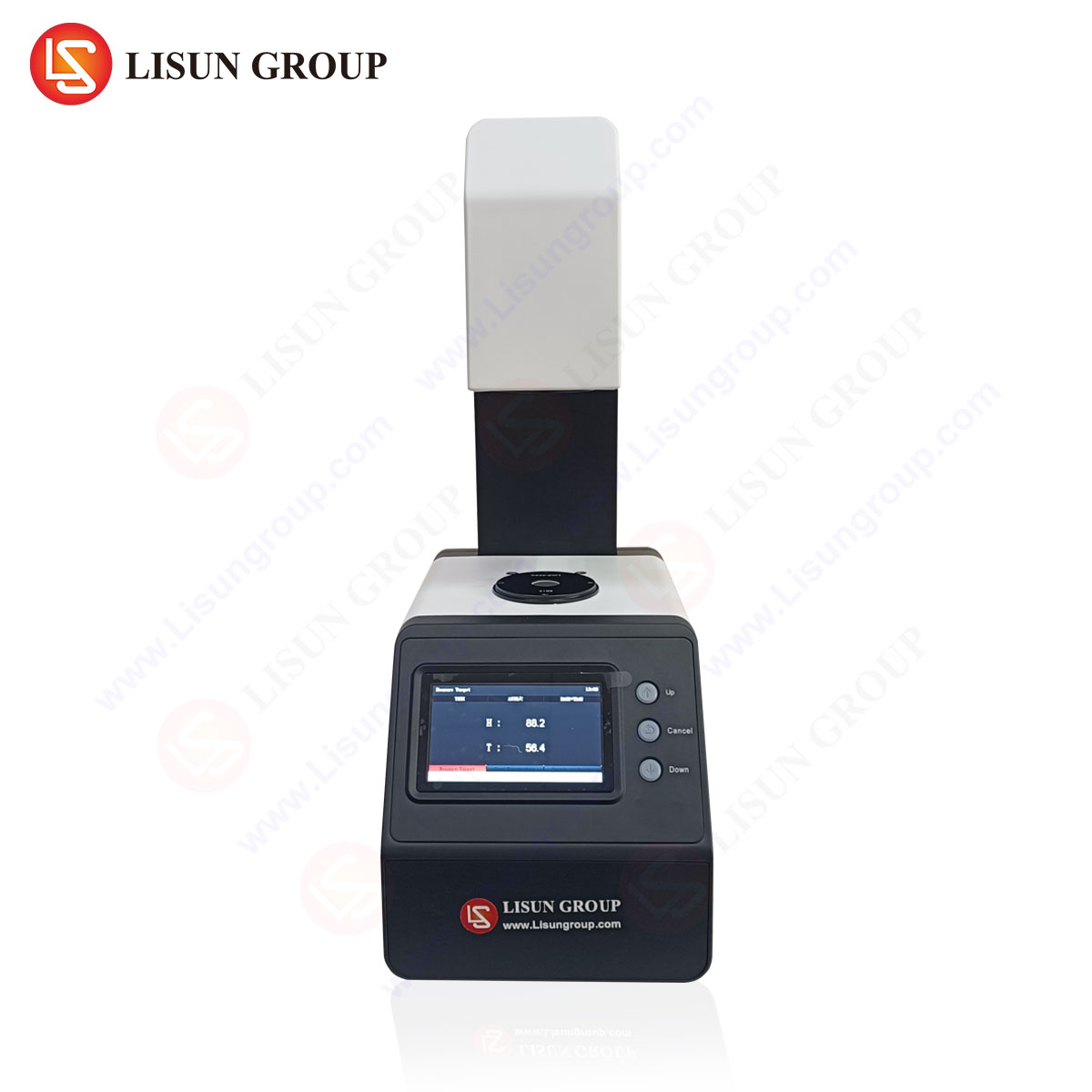
El LISÚN HM-100 Haze Meter exemplifies the application of these principles in a robust industrial instrument. Designed for full compliance with ASTM D1003, ISO 14782, and JIS K 7105, the HM-100 integrates a high-stability LED light source simulating CIE Illuminant C with a silicon photoelectric detector corrected to the V(λ) curve. Its architecture ensures the precise geometrical conditioning required for repeatable measurements.
Key Specifications of the HM-100 Haze Meter:
- Measurement Parameters: Haze, Total Transmittance (Tt), Diffuse Transmittance (Td).
- Light Source: CIE Illuminant C compliant LED.
- Detector: Silicon photoelectric cell, V(λ) corrected.
- Integrating Sphere Diameter: 150mm.
- Rango de medición: 0-100% for Haze and Transmittance.
- Resolution: 0.01% for Haze, 0.1% for Transmittance.
- Precisión: Haze: ±0.1% (for haze <1.0%), ±0.2% (for haze ≥1.0%); Transmittance: ±0.3%.
- Measurement Aperture: Φ25mm / Φ19mm (switchable).
- Data Interface: RS-232, USB, optional printer.
The competitive advantage of the HM-100 lies in its measurement stability and operational reliability. The use of a long-life LED source eliminates the drift and maintenance associated with traditional tungsten lamps. Its dual-aperture design allows for adaptability, enabling the measurement of small components like lens caps or switch covers (Φ19mm) and larger panels (Φ25mm). High accuracy at very low haze levels (<1%) is particularly critical for industries such as medical devices and aerospace, where material purity and clarity are paramount.
Industry-Specific Applications and Material Compliance
The application of haze testing transcends mere aesthetics, serving as a proxy for material consistency, processing integrity, and functional suitability.
- Automotive Electronics & Lighting Fixtures: Interior touchscreen panels and instrument cluster covers require minimal haze (<2%) for legibility and tactile feel. Conversely, LED indicator lens covers and interior ambient lighting diffusers are engineered with specific, controlled haze levels (e.g., 15-40%) to soften point sources and achieve uniform luminance. The HM-100 verifies batch-to-batch consistency for both extremes.
- Productos sanitarios: Transparent fluidic channels in diagnostic equipment, sight glasses on bioreactors, and protective shields must exhibit exceptionally high clarity and low haze to prevent visual obstruction and allow for sterile inspection. Any increase in haze can indicate material degradation, crystallization, or chemical attack.
- Electrical Components & Telecommunications: Polycarbonate and PMMA covers for switches, sockets, and optical fiber connectors are tested for haze to ensure a premium appearance and to confirm that injection molding parameters (temperature, pressure, cooling rate) did not induce internal stresses or micro-voids that scatter light.
- Aerospace and Aviation Components: Canopy polycarbonates, cabin window laminates, and display screen overlays are subject to extreme environmental stress. Haze testing, often performed before and after environmental cycling (temperature, humidity, UV), monitors for delamination, crazing, or coating failure that would manifest as increased light scatter.
- Consumer Electronics & Office Equipment: The anti-glare and anti-fingerprint coatings applied to smartphone screens, tablet displays, and printer control panels are meticulously characterized for their impact on haze. The goal is to achieve the optimal balance between diffuse scattering (to reduce glare) and the preservation of optical clarity and color fidelity.
Correlation Between Haze and Surface/Internal Quality
Haze measurement serves as a sensitive, non-destructive indicator of both surface and bulk material quality. Surface haze is primarily influenced by roughness, polishing quality, and the presence of micro-scratches or coating imperfections. Bulk haze arises from inclusions, porosity, density variations, and filler dispersion. A sudden spike in haze readings on a production line for molded electrical insulator housings could signal contaminated resin, incorrect mold temperature (causing splay or blush), or excessive moisture in the polymer melt.
In cable and wiring systems, the clarity of the PVC or polyethylene insulation, while not a primary electrical property, can indicate plasticizer distribution and extrusion quality. For lighting fixtures, consistent haze across different production runs of a diffuser panel ensures uniform photometric performance, preventing hot spots or uneven illumination. The HM-100’s precision allows quality engineers to trace such process variations back to their root cause.
Methodological Rigor: Calibration, Sample Preparation, and Data Interpretation
Accurate haze measurement is contingent upon strict methodological control. Instrument calibration, using traceable standard reference materials (typically haze and transmittance calibration plates or NIST-traceable standards), is the foundational step. The HM-100 facilitates this with user-friendly calibration routines for both 0% and 100% baselines.
Sample preparation is equally critical. Specimens must be clean, free of fingerprints, dust, and static charge. For films and sheets, ensuring the sample is flat and not wrinkled is essential to avoid air gaps. The measurement area selected must be representative of the whole, avoiding obvious defects unless those are the subject of study. The choice of aperture on the HM-100 should be such that the measured area is fully covered by the sample, preventing edge-light leakage which would corrupt the result.
Data interpretation requires an understanding of the standard’s scope. ASTM D1003, for instance, notes that measurements may be invalid for materials that are fluorescent, highly colored, or exceptionally non-planar. In such cases, supplementary methods or instrument modifications may be required. The reported value should always be an average of multiple measurements taken from different areas of a sample or from multiple samples from a batch.
Integrating Haze Metrics into a Comprehensive Quality Management System
Haze data should not exist in isolation. Within a modern Quality Management System (QMS), haze values become key process control metrics. Statistical Process Control (SPC) charts can track haze over time, with upper and lower control limits defined by product specifications. Correlation studies can link haze data to other test results, such as birefringence (indicating internal stress), gloss measurements (for surface quality), or mechanical property tests.
For industries like medical devices (governed by ISO 13485) and automotive (IATF 16949), the traceability of test data is mandatory. The HM-100’s digital output and connectivity allow for seamless integration of test records into QMS software, ensuring full audit trails. This transforms haze from a simple pass/fail checkpoint into a rich source of data for continuous process improvement, predictive maintenance, and supplier quality validation.
Conclusión
Haze testing is a sophisticated metrological discipline grounded in well-defined optical principles. Its value extends far beyond a simple assessment of appearance, providing critical insights into material homogeneity, manufacturing process stability, and end-product functional performance. The deployment of precision instrumentation, such as the LISUN HM-100 Haze Meter, which adheres rigorously to international standards, is essential for generating reliable, actionable data. As material science advances and consumer expectations for quality escalate, the precise quantification of optical clarity will remain an indispensable tool for engineers and quality professionals across the electrical, electronic, medical, and aerospace industries.
FAQ: Haze Testing and the HM-100 Haze Meter
Q1: Can the HM-100 measure very small components, such as a lens for an LED or a small medical device window?
A1: Yes. The HM-100 features a switchable dual-aperture system (Φ25mm and Φ19mm). The Φ19mm aperture is specifically designed for smaller samples. The component must fully cover the selected aperture to prevent light leakage. For items smaller than 19mm in diameter, a custom-masked fixture or a specialized accessory may be required to ensure only the sample area is measured.
Q2: How often should the haze meter be calibrated, and what is required?
A2: Calibration frequency depends on usage intensity and quality system requirements (e.g., ISO 17025 may dictate annual calibration). For critical applications, monthly or quarterly verification using certified haze and transmittance standards is recommended. The HM-100 requires two-point calibration: first with no sample (100% T calibration), and then with the light trap engaged or using a black calibration plate (0% T calibration). The instrument guides the user through this process.
Q3: Our materials sometimes have a slight tint or color. Does this affect the haze measurement accuracy?
A3: The HM-100 uses a photopic detector corrected to the CIE V(λ) curve, meaning it responds to light as the human eye does. It measures luminous transmittance and haze. While it will provide accurate photometric values for colored samples, the presence of strong color can, in theory, interact with the spectral output of the source. For highly saturated colors, it is important to ensure the instrument’s light source (CIE Illuminant C) is appropriate for your specification. The measurement will be valid for the defined condition, but comparisons to materials of vastly different colors should be made with caution.
Q4: What is the primary cause of high haze in an otherwise clear injection-molded plastic part?
A4: High haze in a molded clear part typically indicates excessive light scattering. The most common root causes are: 1) Internal Scattering: Moisture in the resin (causing micro-voids), thermal degradation (yellowing/burning), contamination, or improper screw speed/pressure leading to unmelted pellets or filler agglomeration. 2) Surface Scattering: A mold temperature that is too low, causing the material skin to solidify against the mold surface before fully replicating its polish (replication failure), resulting in a microscopically rough surface.
Q5: Can haze testing be used on flexible films or curved surfaces?
A5: For flexible films, testing is standard procedure provided the film is held flat and taut in the sample holder without creases. For permanently curved surfaces, standard methods like ASTM D1003 may not be directly applicable, as the geometry alters the light path. In such cases, a comparative test method using the same instrument and fixture for all samples can provide useful relative data. For critical absolute measurements on curved parts (e.g., a taillight lens), specialized fixtures that accommodate the curvature while maintaining standard geometry may be necessary.

 ES
ES  EN
EN  RU
RU  PT
PT  TR
TR  AR
AR  DE
DE  PL
PL  IT
IT  FR
FR  KO
KO  JA
JA  ID
ID