




Understanding Drop Testing Protocols: A Technical Analysis of Methodologies, Standards, and Equipment
Introduction to Mechanical Shock Assessment via Controlled Drop Testing
The evaluation of a product’s resilience to mechanical shock incurred during handling, transportation, and operational life is a critical component of reliability engineering. Among the various methodologies employed, controlled drop testing stands as a fundamental, empirically validated procedure. It simulates the transient, high-acceleration events a product may encounter when dropped from a specified height onto a prescribed surface. The primary objective is not merely to ascertain if a product survives, but to identify design weaknesses, validate packaging solutions, and ensure compliance with international safety and durability standards. This technical analysis delves into the protocols, standards, and instrumentation governing drop testing, with a specific examination of integrated test systems such as the LISÚN DT-60KG Drop Tester, which exemplifies modern implementation of these principles across diverse industrial sectors.
Fundamental Physics and Failure Mechanisms in Drop Impact Events
The physics of a drop impact event involves a complex transfer of kinetic energy into strain energy within the product and its internal components. Upon impact, a high-magnitude, short-duration deceleration pulse is generated. This pulse subjects the product’s structure and internal assemblies to significant inertial forces (F=ma). Failure mechanisms induced by such shocks are multifaceted. They include brittle fracture of casings, plastic deformation of structural members, solder joint fatigue, connector disengagement, printed circuit board (PCB) delamination or trace cracking, and functional disruption of sensitive electromechanical components like hard disk drives or optical assemblies. The severity of the shock pulse is influenced by the drop height, the orientation at impact, the stiffness and mass distribution of the product, and the impedance of the impact surface. A comprehensive testing protocol must therefore control these variables to produce repeatable and representative results.
International Standards Governing Drop Test Procedures
Drop testing is not an arbitrary exercise; it is rigorously defined by a matrix of international and industry-specific standards. These documents prescribe test severities (drop heights, number of drops, orientations), impact surface characteristics, and post-test evaluation criteria. Key standards include:
- IEC 60068-2-31: A foundational standard for environmental testing, detailing procedures for free fall and repeated free fall, widely referenced for electrical and electronic equipment.
- ISTA (International Safe Transit Association) Series: Particularly procedures like ISTA 1A, 2A, and 3A, which simulate transportation hazards for packaged products.
- MIL-STD-810G, Method 516.8: The U.S. military standard for shock testing, encompassing both packaged and unpackaged item procedures.
- ASTM D5276: Standard test method for drop testing of loaded containers.
- ISO 2248: Packaging — Complete, filled transport packages — Vertical impact test by dropping.
Compliance with these standards is often a contractual or regulatory requirement for market access, particularly in sectors like medical devices, aerospace, and telecommunications.
Architectural Components of a Modern Drop Test System
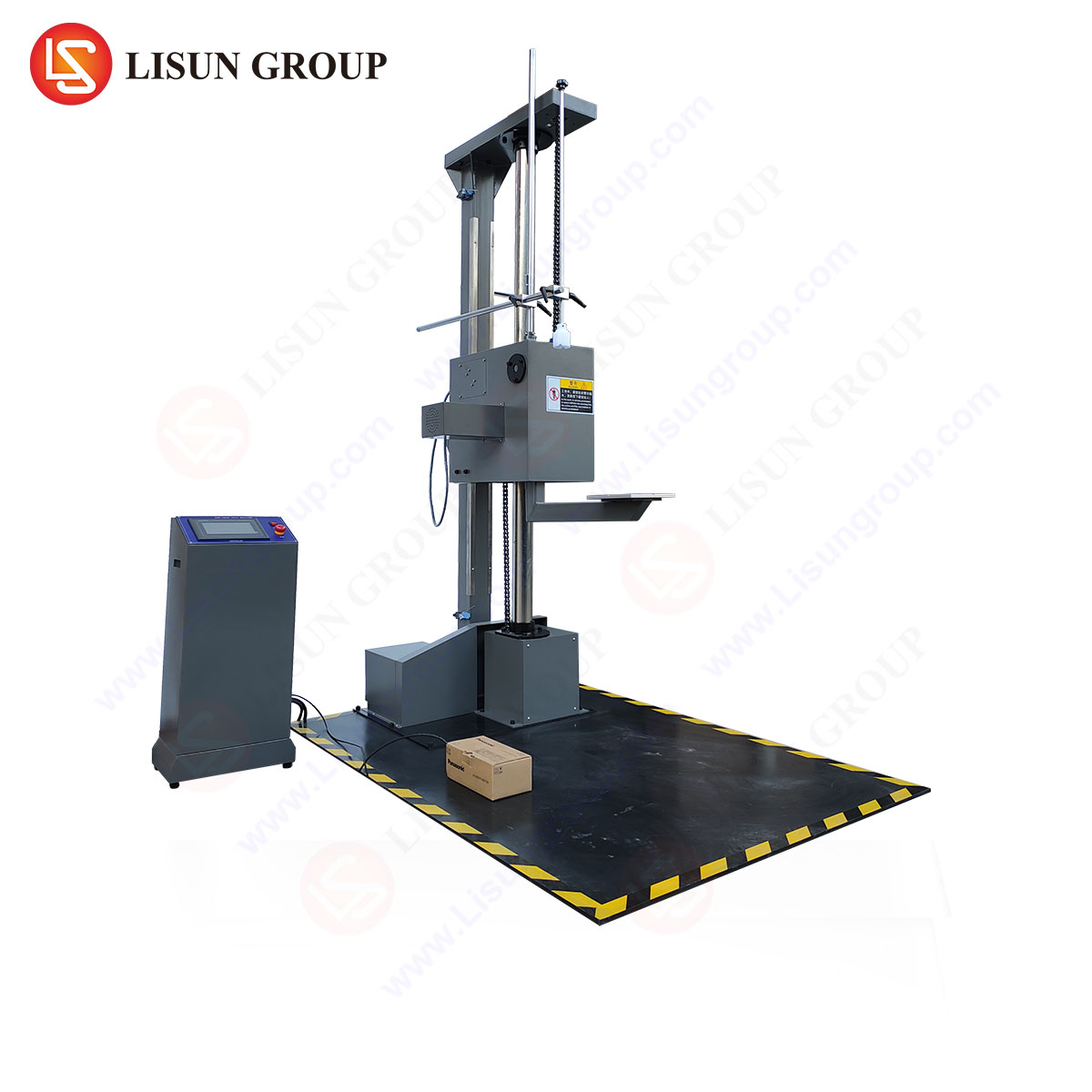
A standardized prueba de caída system integrates several key subsystems to ensure precision and repeatability. The core assembly typically consists of a rigid, vertical dual-column or single-column structure providing a guided path for the drop. A release mechanism—whether electromagnetic, pneumatic, or mechanical—allows for precise, hands-free operation to ensure consistent initial conditions and operator safety. The test platform or table, to which the specimen is affixed, is designed to be released and fall freely. Crucially, the impact surface, often a hardened steel or granite baseplate, must meet standard specifications for mass and stiffness to ensure consistent energy transfer. Advanced systems incorporate an arrestor mechanism to prevent secondary impacts. The integration of these components into a single, calibrated instrument, such as the LISUN DT-60KG, eliminates variables introduced by improvised setups, ensuring laboratory-grade data integrity.
Operational Methodology: Defining Test Parameters and Sequences
A formal test sequence begins with the definition of critical parameters derived from the relevant standard and the product’s lifecycle profile. The drop height is paramount, often categorized by product weight or intended handling severity (e.g., portable consumer electronics versus fixed industrial controls). Product orientation must be systematically addressed; standards typically require impacts on faces, edges, and corners to evaluate the most vulnerable geometries. The number of drops per orientation is specified to simulate repeated mishandling. The impact surface is defined, with common specifications calling for a horizontal plane of steel or concrete. The specimen, whether a bare product or a packaged unit, is secured to the drop platform in the defined orientation. After release and impact, the specimen is inspected for cosmetic, structural, and functional integrity. This inspection may involve dimensional checks, electrical continuity testing, and full operational verification.
The LISUN DT-60KG Drop Tester: Specifications and Integrated Testing Principles
The LISUN DT-60KG Drop Tester embodies a fully integrated approach to standardized drop testing. Designed for specimens up to 60 kilograms, it accommodates a broad range of products from small electronic components to larger assemblies. Its specifications are engineered for compliance and precision:
- Max Test Load: 60 kg
- Drop Height Range: Typically 300-1500 mm (adjustable to meet various standards)
- Height Control: Precision scale or encoder-based measurement system.
- Release Mechanism: Electromagnetic or pneumatic, allowing for instantaneous, shock-free release to prevent pre-impact motion artifacts.
- Impact Base: A heavy-duty, hardened steel plate mounted on a solid foundation to meet the impedance requirements of major standards.
- Sistema de control: Microprocessor-based controller for setting height, counting drops, and managing test sequences, often with safety interlocks.
The testing principle leveraged by the DT-60KG is one of controlled, repeatable free-fall. Its dual-column design ensures minimal friction and a true vertical drop. The electromagnetic release eliminates the lateral forces or rotation that can be introduced by manual or simple mechanical releases, a critical factor when testing asymmetrical products. This level of control transforms subjective “pass/fail” assessments into objective, reproducible engineering data.
Industry-Specific Applications and Use Case Scenarios
The universality of mechanical shock makes drop testing relevant across a vast industrial landscape.
- Consumer Electronics & Telecommunications Equipment: Smartphones, tablets, routers, and set-top boxes are tested per IEC standards to ensure durability against everyday drops from hand height. The DT-60KG can simulate these scenarios for a wide size and weight range.
- Electrical Components & Automotive Electronics: Switches, sockets, connectors, and engine control units (ECUs) must withstand shocks during assembly line handling and vehicle operation. Testing validates the robustness of housings and internal connections.
- Lighting Fixtures & Household Appliances: LED luminaires, power tools, and small appliances are subject to drops during installation or use. Testing evaluates glass/plastic diffuser integrity and internal electrical safety.
- Medical Devices & Aerospace Components: Portable diagnostic devices, surgical tool cases, and avionics black boxes have stringent reliability requirements. Drop testing here is often part of a broader qualification suite per MIL-STD or FDA guidance, where the precision of equipment like the DT-60KG is non-negotiable.
- Industrial Control Systems & Office Equipment: PLCs, HMIs, and printers may experience mishandling in warehouse or office environments. Testing ensures operational continuity in industrial and commercial settings.
- Packaged Product Validation: Across all sectors, the DT-60KG is employed for transit package testing per ISTA procedures, evaluating the protective efficacy of corrugated, foam, or other packaging materials.
Analytical Advantages of Precision Drop Testing Instrumentation
Utilizing a dedicated, calibrated drop tester like the DT-60KG confers significant analytical advantages over ad-hoc methods. Data Reproducibility is enhanced, as all mechanical variables are fixed, allowing for direct comparison between design iterations or manufacturing batches. Operator Safety is improved by removing the need to manually lift and drop heavy or awkward products. Test Efficiency increases through programmable height settings and automated release mechanisms, enabling higher throughput in quality assurance labs. Most importantly, it elevates the test from a qualitative check to a quantitative engineering tool. When integrated with a high-G accelerometer mounted on the test specimen, the system can capture the actual shock pulse experienced, providing data for finite element analysis (FEA) correlation and predictive modeling.
Correlation Between Laboratory Testing and Real-World Performance
The ultimate validation of any laboratory test is its correlation to field failure rates. A well-constructed drop test protocol, executed on precise equipment, provides this correlation by focusing on the root cause of failure rather than a simple simulation of the event. By testing multiple orientations, engineers identify not just if a product fails, but how y why. A failure at a particular corner may indicate a need for increased ribbing or a change in material. A functional failure after an edge drop may point to a poorly supported internal battery connector. This forensic insight allows for targeted design improvements that directly enhance real-world durability, reducing warranty claims and strengthening brand reputation for reliability.
Integrating Drop Test Data into the Product Development Lifecycle
Effective drop testing is not a final gatekeeping activity but an integrated element of the development lifecycle. In the design phase, early prototype testing identifies critical weaknesses before tooling is committed. During design verification, testing against formal standards confirms compliance. In production, periodic audit testing monitors manufacturing consistency. The data derived, especially when using instrumented tests, feeds back into computer-aided engineering (CAE) models, improving the accuracy of virtual simulation for future products. This closed-loop process, facilitated by reliable test equipment, fosters a culture of continuous improvement and design-for-reliability.
Conclusión
Drop testing protocols represent a critical nexus between theoretical design, empirical validation, and field reliability. The discipline demanded by international standards requires a corresponding level of precision in test equipment. Integrated systems like the LISUN DT-60KG Drop Tester provide the controlled, repeatable, and safe environment necessary to generate actionable engineering data. By applying these rigorous protocols across industries—from miniature electronic components to substantial industrial assemblies—manufacturers can systematically de-risk their products against the inevitable shocks of the real world, ensuring safety, functionality, and commercial longevity.
Sección FAQ
Q1: What is the primary difference between a “free fall” test per IEC 60068-2-31 and a “package drop” test per ISTA?
A: The fundamental distinction lies in the test specimen and objective. IEC 60068-2-31 typically tests the unpackaged product itself (the “item”) to assess its inherent robustness to handling during use or service. ISTA procedures test the packaged product (the “shipping unit”) to evaluate the protective performance of the packaging system during the distribution cycle. The same equipment, like the DT-60KG, can often be configured for both by adapting how the specimen is mounted to the drop platform.
Q2: Why is the stiffness and mass of the impact baseplate so critical in drop testing?
A: The baseplate acts as the reactive mass during impact. A low-mass or compliant baseplate will absorb a portion of the impact energy, resulting in a less severe shock pulse delivered to the test specimen. This would produce a non-conservative, invalid test. Standards specify a massive, rigid surface (e.g., steel or granite) to ensure nearly all kinetic energy is transferred through the specimen, creating a repeatable and standardized severity.
Q3: For a product like an automotive ECU weighing 1.5kg, how would the drop height be determined using the DT-60KG?
A: The drop height is not determined by the tester but by the applicable standard or the product’s specific requirement. For an ECU, one might reference IEC 60068-2-31, which may suggest a height based on product mass/portability, or an automotive OEM-specific standard like LV 124 (German automotive). The engineer would select the mandated height—for example, 100 cm for portable electronic assemblies—and precisely set this height on the DT-60KG’s scale or digital controller before testing.
Q4: Can the LISUN DT-60KG be used for corner and edge drops, or only flat surface drops?
A: Yes, it is designed for all orientations. The product is securely fastened to the drop platform in the desired orientation (face, edge, or corner pointing downward). The platform is then raised and released. The guided dual-column system ensures it falls straight down without rotation, maintaining the critical orientation until impact. Specialized fixtures may be used to hold the product at precise angles for consistent edge and corner tests.
Q5: What are the key safety features to look for in a drop tester like the DT-60KG?
A: Essential safety features include: 1) A secure release mechanism that prevents accidental drops, 2) Physical guarding or an safety interlock system that prevents operator access to the drop zone when the platform is elevated, 3) An arrestor or brake system to safely stop the platform after the first impact and prevent dangerous rebound or multiple hits, and 4) Emergency stop buttons within easy reach of the operator.

 ES
ES  EN
EN  RU
RU  PT
PT  TR
TR  AR
AR  DE
DE  PL
PL  IT
IT  FR
FR  KO
KO  JA
JA  ID
ID