






Understanding Haze and Turbidity: Measurement, Standards, and Industrial Applications
Introduction to Optical Clarity Metrics
In the realm of material science and quality assurance for transparent and translucent media, the quantitative assessment of optical clarity is paramount. Two intrinsically linked, yet distinct, photometric phenomena—haze and turbidity—serve as critical indicators of material quality, process consistency, and end-product performance. While often discussed in tandem, haze and turbidity describe different light-scattering events. Haze refers specifically to the wide-angle scattering of light as it passes through a material, causing a reduction in contrast and a milky or cloudy appearance. Turbidity, conversely, is a measure of the cloudiness or opacity of a fluid caused by suspended particles that scatter and absorb light. Precise measurement of these parameters is not merely an academic exercise; it is a fundamental requirement across a diverse spectrum of industries where material purity, visual aesthetics, and functional integrity are non-negotiable.
The imperative for accurate, repeatable measurement is driven by international standards, including ASTM D1003 for haze and transmittance of plastics, and ISO 7027 for water quality determination of turbidity. Compliance with these standards ensures product reliability, facilitates global trade, and underpins safety in critical applications. This article delineates the technical principles underlying haze and turbidity measurement, explores their significance in advanced manufacturing sectors, and examines the instrumental solutions required for rigorous compliance testing.
Fundamental Photometric Principles: Scattering, Transmission, and Diffusion
At its core, the measurement of haze and turbidity is an exercise in applied optics, governed by the interaction of light with matter. When a collimated light beam encounters a material, several phenomena occur: specular transmission, forward scattering, wide-angle scattering, and absorption. Total transmittance (Tt) is the sum of all light that passes through the specimen. The key differentiator lies in the angular distribution of this transmitted light.
Haze is formally defined as the percentage of transmitted light that deviates from the incident beam by more than a specified angle, typically 2.5 degrees. This wide-angle scattering is predominantly caused by surface imperfections, internal inhomogeneities, crystallinity variations, or embedded particulates within a solid material. A material with high haze will diffuse light, impairing the clarity of viewed objects.
Turbidity measurement operates on a similar scattering principle but is applied to fluids. Suspended particles—such as silt, microorganisms, or chemical precipitates—scatter incident light. The intensity of light scattered at a defined angle (commonly 90 degrees in nephelometric methods) is proportional to the concentration of suspended matter. Formazin polymer solutions are established as primary calibration standards, with results reported in Nephelometric Turbidity Units (NTU) or Formazin Nephelometric Units (FNU).
Industrial Imperatives: Where Clarity Dictates Performance
The implications of uncontrolled haze or turbidity extend far beyond cosmetic defects, directly influencing safety, efficiency, and functionality.
- Electrical and Electronic Equipment & Automotive Electronics: In displays, touchscreen interfaces, and instrument panel lenses, excessive haze can degrade readability, cause glare under ambient lighting, and reduce contrast ratios. For encapsulants and potting compounds used in semiconductor packaging or under-hood control units, clarity is necessary for visual inspection of components and wire bonds. Turbidity in dielectric cooling fluids can indicate contamination that compromises insulating properties.
- Lighting Fixtures and Consumer Electronics: Light guides, diffusers, and lenses require precise haze levels to achieve desired illumination uniformity and efficiency. A deviation from specified haze can lead to hot spots, reduced luminous efficacy, or an undesirable visual appearance in products ranging from automotive headlamps to smartphone displays.
- Medical Devices and Aerospace Components: For diagnostic device windows, surgical instrument lenses, and aircraft canopy transparencies, optical clarity is critical. Haze can obscure vision or interfere with optical sensor readings. Turbidity monitoring is vital in pharmaceutical process water, dialysis fluids, and in-line filtration integrity testing, where particulate contamination poses direct patient risks or indicates system failure.
- Telecommunications Equipment and Cable Systems: Optical fiber cladding materials and connector interfaces must exhibit minimal haze to prevent signal attenuation due to scattering. Turbidity in cleaning solutions for fiber optic end-faces can introduce microscopic contaminants that cause backscatter and insertion loss.
- Household Appliances and Office Equipment: The clarity of glass oven doors, refrigerator panels, and photocopier scanner plates affects user experience and functional performance. Haze measurements ensure consistency in molded plastic components and coated glass.
Instrumentation for Conformity Assessment: The HM-100 Medidor de neblina/Medidor de turbidez
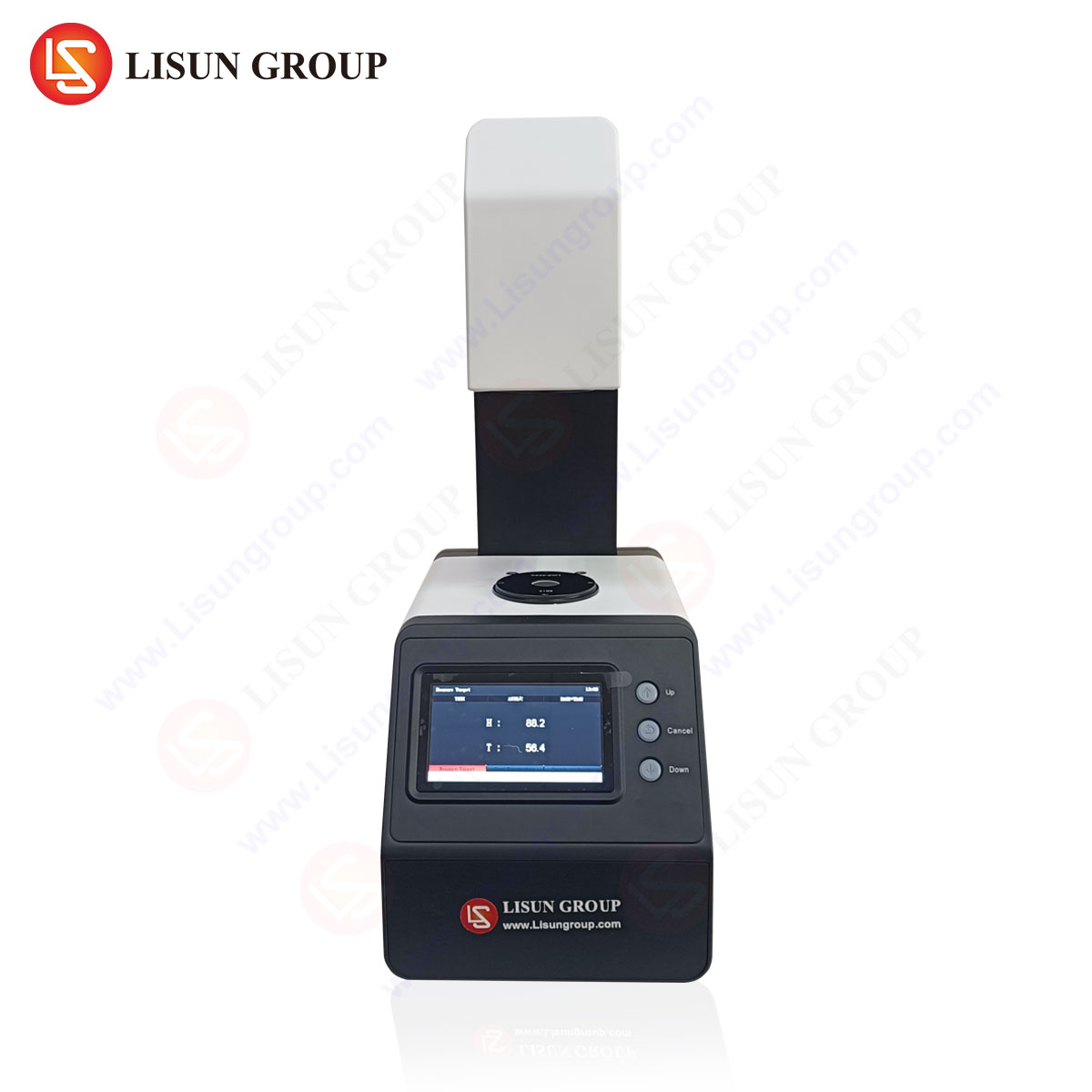
Meeting the exacting requirements of these diverse applications necessitates instrumentation engineered for precision, compliance, and operational robustness. The LISÚN HM-100 Haze Meter/Turbidity Meter exemplifies a dual-purpose instrument designed to address both ASTM D1003 and ISO 7027 measurement paradigms within a single integrated platform.
The HM-100 employs a CIE-standard illuminant A (2856K) light source and a silicon photodetector, configured with an integrating sphere, to decompose the total transmitted light into its constituent parts. For haze measurement on solid specimens, the instrument mechanically separates the measurement of total transmittance (Tt) and diffuse transmittance (Td). Haze is then calculated as (Td / Tt) * 100%. This method ensures adherence to the strict geometric conditions stipulated by ASTM D1003.
For fluid turbidity analysis, the instrument switches to a nephelometric mode, measuring the intensity of light scattered at 90 degrees by suspended particles in the sample. Calibration traceable to formazin standards ensures reporting in NTU. The dual functionality provides laboratories with a consolidated solution for material and fluid testing.
Technical Specifications and Operational Advantages
The HM-100 is characterized by specifications that cater to high-precision quality control environments:
- Haze Measurement Range: 0 to 100% with a resolution of 0.01%.
- Turbidity Measurement Range: 0 to 1000 NTU, with extended capability to 2000 NTU.
- Light Source: Long-life, pre-calibrated tungsten lamp meeting CIE Illuminant A.
- Cumplimiento de normas: Conforms to ASTM D1003, ISO 7027, JIS K7105, and JIS K7136.
- Data Management: Integrated storage, statistical analysis, and PC connectivity for data export and report generation.
Competitive advantages stem from its integrated design and measurement integrity. The use of a stable tungsten source, as opposed to LEDs, provides a broad spectral output that aligns precisely with standard requirements, reducing inter-instrument correlation errors. The automated measurement cycle and proprietary sphere design minimize operator influence and enhance repeatability. For industries managing supply chains for polymers, optical components, or process fluids, this level of reproducibility is essential for supplier qualification and incoming inspection protocols.
Case Studies in Applied Metrology
In a practical scenario, a manufacturer of polycarbonate lenses for industrial control system displays must guarantee a haze value of <1.5% per customer specification. Using the HM-100, quality technicians can routinely test injection-molded samples. The instrument’s high resolution detects subtle batch-to-batch variations caused by moisture content, mold temperature, or regrind ratios, enabling process correction before non-conforming material proceeds to assembly.
Similarly, a producer of dielectric fluid for high-voltage transformers implements the HM-100’s turbidity function for in-process quality checks. An increase in NTU reading from a baseline of 2.0 NTU signals possible particulate ingress or degradation, triggering filtration or batch rejection to prevent dielectric breakdown in the field.
Conclusión
The quantitative measurement of haze and turbidity transcends basic quality checking; it is a sophisticated form of non-destructive analysis that reveals intrinsic material properties and process stability. As industries from medical devices to aerospace continue to demand higher performance from polymeric materials and ultra-pure fluids, the role of compliant, precise, and reliable instrumentation becomes increasingly critical. Implementing a rigorous testing regimen based on internationally recognized standards, supported by capable instrumentation like the dual-purpose HM-100, provides manufacturers with the empirical data necessary to ensure product excellence, regulatory compliance, and market competitiveness.
Sección FAQ
Q1: Can the HM-100 measure both the haze of a plastic film and the turbidity of a liquid sample?
Yes, the HM-100 is a fully integrated dual-function instrument. It is equipped with specific measurement modes and sample holders for each application. For haze, a solid specimen holder is used in compliance with ASTM D1003 geometry. For turbidity, a sealed glass cuvette is used for fluid analysis per ISO 7027 nephelometric principles.
Q2: How often does the instrument require calibration, and what standards are needed?
Regular calibration is essential for measurement traceability. For haze, calibration should be performed using certified haze reference standards (typically with values of approximately 0% and a known high value, e.g., 30%). For turbidity, calibration is performed using traceable formazin standard solutions at multiple points (e.g., 0, 20, 100, 800 NTU). The frequency depends on usage and quality system requirements, but quarterly or semi-annual calibration is typical for critical applications.
Q3: What is the most critical factor in preparing a solid sample for accurate haze measurement?
Sample surface condition is paramount. Scratches, fingerprints, dust, or static charge can significantly increase measured haze by introducing surface scattering. Samples must be meticulously cleaned with appropriate solvents and handled with lint-free gloves. The test specimen should also be of uniform thickness and free of internal stresses or bubbles, as specified in the relevant material standard.
Q4: Our application involves testing very low-haze optical materials (below 0.5%). Is the HM-100 suitable?
Yes. With a haze resolution of 0.01% and a stable optical system, the HM-100 is capable of reliably differentiating between very low haze values. Accurate measurement at this level requires exceptional care in sample preparation, a controlled environment to avoid dust, and the use of high-quality, certified zero haze calibration standards to establish a precise baseline.
Q5: How does temperature affect turbidity measurements, and does the HM-100 compensate for this?
Temperature can affect fluid viscosity and the refractive index contrast between particles and the suspending medium, influencing scattering intensity. While the HM-100 itself does not have active temperature control, standard methods require samples and standards to be measured at the same, stable temperature. Best practice is to allow all fluids to equilibrate to the laboratory ambient temperature (noted in the test record) before measurement to ensure comparability.

 ES
ES  EN
EN  RU
RU  PT
PT  TR
TR  AR
AR  DE
DE  PL
PL  IT
IT  FR
FR  KO
KO  JA
JA  ID
ID