




Understanding IEC 60332 Standards: A Framework for Evaluating Flame Propagation in Cables
The proliferation of electrical and electronic equipment across diverse sectors has necessitated the development of rigorous safety standards to mitigate fire risks. Among these, the IEC 60332 series of standards, established by the International Electrotechnical Commission, provides a critical framework for assessing the flame propagation characteristics of insulated wires and cables. These standards are not mere guidelines but fundamental technical documents that define test methodologies to quantify a cable’s ability to resist the spread of flame under defined conditions. Compliance is often a mandatory prerequisite for product certification and market access, influencing design, material selection, and manufacturing processes from telecommunications equipment and automotive electronics to aerospace components and medical devices.
The Hierarchical Structure of IEC 60332 Test Categories
The IEC 60332 standard is not monolithic; it is a family of tests with escalating severity, designed to simulate different fire scenarios. Understanding this hierarchy is essential for specifying the correct cable for a given application.
IEC 60332-1: Flame Test for a Single Vertical Insulated Wire or Cable
This is the foundational test for small-diameter cables. A single vertically mounted specimen is exposed to a specified propane burner flame for 60 seconds. After the flame source is removed, the extent of charred or damaged material must not exceed a defined distance from the lower fixing point. This test is commonly referenced for internal wiring within office equipment, consumer electronics, and certain electrical components like switches and sockets, where the risk is limited to a single cable igniting.
IEC 60332-2: Flame Test for a Single Small Vertical Insulated Wire or Cable
A more severe variant for small-diameter cables, this test employs a higher-energy flame from a propane/air mixture for 20 seconds. The pass/fail criterion is similar but under more intense conditions, targeting applications requiring a higher degree of assurance against flame spread.
IEC 60332-3: Flame Propagation Testing for Bunched Cables
This is the most comprehensive and widely applicable series, simulating the real-world hazard of multiple cables installed in bundles, trays, or conduits. The test evaluates whether fire will propagate within a grouped installation. It is subdivided into categories (e.g., IEC 60332-3-10, -21, -22, -23, -24, -25) that define the arrangement of cables (e.g., ladder, tray), the flame source intensity (e.g., 20kW, 40kW, 60kW, 80kW, 120kW), and the duration of flame application. Performance is measured by the extent of flame spread (damaged length) and, in higher categories, by the heat release and smoke production. Compliance with specific parts of IEC 60332-3 is routinely required for cables used in industrial control systems, power distribution within household appliances, backbone cabling for telecommunications equipment, and wiring harnesses in automotive and aviation applications.
Material Science and Performance Criteria in Flame Retardancy
The ability of a cable to meet IEC 60332 criteria is intrinsically linked to its material composition. Insulation and sheathing compounds are engineered with flame-retardant additives that interrupt the combustion cycle. Common mechanisms include endothermic decomposition (cooling the material), char formation (creating a protective barrier), and gas phase radical quenching (interrupting flame chemistry). Halogen-free, low-smoke zero-halogen (LSZH/LSF0H) compounds are increasingly specified, particularly in enclosed public spaces like aircraft, trains, and medical facilities, as they minimize the emission of corrosive and opaque smoke—a significant cause of collateral damage and hindered evacuation during a fire.
Performance is quantified through precise measurements. The primary criterion is the damaged length, the vertical distance of charred or destroyed material above the original point of flame application. For tests like IEC 60332-3-24, the total heat released and peak heat release rate are also critical metrics, measured via oxygen consumption calorimetry. A cable passing a Category A test (e.g., IEC 60332-3-24) demonstrates a higher level of fire safety than one passing a Category C test (e.g., IEC 60332-3-23), directly influencing its permissible installation environments.
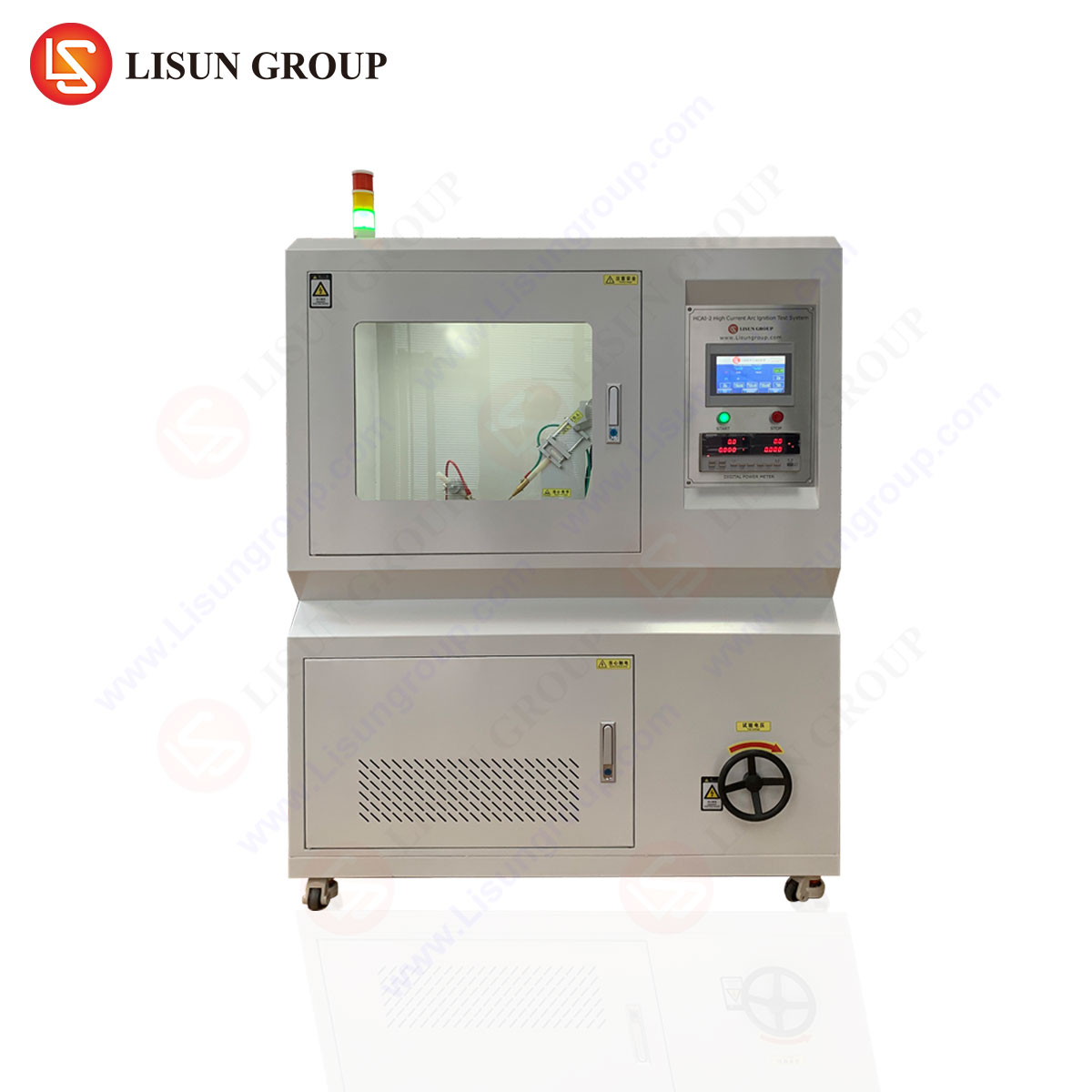
El RSB-WC Probador de llama de cable: Enabling Precise Standard Conformance
Verification of cable performance against the IEC 60332 series demands laboratory apparatus of exceptional accuracy, repeatability, and compliance with the stringent geometrical and procedural stipulations of the standards. The LISÚN RSB-WC Wire Cable Flame Tester is engineered specifically for this purpose, facilitating rigorous testing in accordance with IEC 60332-1, -2, and -3 (including parts -21, -22, -23, -24, -25), as well as analogous standards like EN 50399 and GB/T 18380.
The testing principle of the RSB-WC is based on the controlled application of a calibrated flame to a vertically mounted cable specimen. For bunched cable tests (IEC 60332-3), the apparatus includes a substantial steel ladder or tray support structure upon which multiple cable lengths are mounted in a specified configuration. A high-precision methane or propane burner system, with automated gas flow control, delivers the required flame power (e.g., 20.5kW ± 0.5kW) for the prescribed duration. The unit integrates advanced instrumentation, including thermocouples for temperature monitoring, a calibrated air flow system for tests requiring forced air induction, and provisions for connecting to external heat release measurement systems (e.g., oxygen analyzers) for full Category A testing.
Key Specifications and Competitive Advantages:
- Modular Test Chamber: Constructed from stainless steel and refractory board, it accommodates all major test configurations (single wire, bundled, ladder, tray) within a single, robust platform.
- Automated Burner Control: Microprocessor-controlled solenoid valves and flow meters ensure precise, repeatable flame application, eliminating manual timing errors and ensuring consistent gas mixture.
- Integrated Data Acquisition: High-quality thermocouples and sensor interfaces allow for real-time monitoring of back-wall temperature, flame temperature, and other critical parameters, with data output for detailed analysis.
- Enhanced Safety Systems: Features include flame-out automatic re-ignition, gas leakage detection and alarm, and exhaust fume treatment, protecting both the operator and the laboratory environment.
- Broad Standard Compliance: Its design covers not only IEC 60332 but also related clauses from UL, BS, JIS, and GB standards, making it a versatile asset for manufacturers serving global markets.
Aplicaciones específicas de la industria e imperativos de cumplimiento
The application of IEC 60332 testing via equipment like the RSB-WC Tester is pervasive across the industrial landscape.
En Componentes aeroespaciales y de aviación, cables must meet the most stringent flame, smoke, and toxicity requirements. Testing per IEC 60332-3 (high category) is a baseline, often supplemented by specific aerospace standards. For Electrónica del automóvil, particularly in hybrid and electric vehicles where high-voltage cabling is present, flame retardancy per IEC 60332 is crucial for passenger compartment safety and to prevent thermal runaway events. Productos sanitarios and their internal wiring require predictable flame behavior to ensure life-support equipment does not become a fire initiator within oxygen-rich environments.
Electrodomésticos y Iluminación incorporate internal wiring and external power cords that must self-extinguish to prevent a small electrical fault from engulfing the appliance. Industrial Control Systems y Equipos de telecomunicaciones involve dense cable routing in control panels and data centers; here, IEC 60332-3 Category A or B testing is frequently mandated to prevent catastrophic fire spread through cable trays. Even within Componentes eléctricos such as modular wiring systems for sockets, the connecting cables must demonstrate compliance to ensure safety at the point of use.
The Integral Role of Testing in Product Development and Certification
For cable manufacturers and integrators, conformance testing is not an endpoint but an integral phase of the product development lifecycle. The data derived from precise testing with instruments like the RSB-WC informs material science research, enabling the formulation of new compounds that balance flame retardancy with other critical properties like flexibility, durability, and electrical performance. Furthermore, during quality assurance audits and third-party certification processes (by bodies such as UL, TÜV, or CSA), the ability to produce consistent, standard-compliant test reports is indispensable. A reliable tester minimizes inter-laboratory variation, providing defensible data that accelerates time-to-market and builds trust with specifiers—from architects designing a building’s cable infrastructure to engineers sourcing wiring for a new model of office equipment or consumer electronics.
Preguntas más frecuentes (FAQ)
Q1: What is the fundamental difference between testing a single cable (IEC 60332-1) and a bunched cable (IEC 60332-3)?
A1: The single vertical flame test assesses the innate flame retardancy of the cable material in isolation. The bunched cable test evaluates a more critical real-world scenario: the propensity for flame to propagate vertically through a group of cables, where radiant heat and melting droplets from one cable can ignite others. The latter is a significantly more severe test and is required for most installed cable systems.
Q2: For a cable to be rated for use in a plenum space, which IEC 60332 test category is typically required?
A2: Cables installed in air-handling plenums, where smoke and fire could rapidly spread through a building, generally require the highest level of performance. This typically necessitates compliance with IEC 60332-3-24 (Category A), which includes measurement of total heat release (THR) and peak heat release rate (HRR), in addition to the standard flame spread criteria.
Q3: How does the RSB-WC Tester ensure accurate flame calibration for different test categories?
A3: The RSB-WC employs a precision burner system with microprocessor-controlled gas flow valves and calibrated flow meters. For each test standard (e.g., 20kW vs. 40kW flame), the operator selects the predefined program, and the controller automatically adjusts the gas flow rates to achieve the exact thermal output specified in the standard, verified by a calibrated thermocouple positioned in the flame.
Q4: Can the same cable sample be tested multiple times on the RSB-WC?
A4: No. Testing is destructive. Each test requires a fresh specimen prepared and mounted according to the standard’s precise instructions (length, conditioning, bundling method). The results from a single test are used for that specific sample’s certification.
Q5: Why is automated data acquisition important in flame testing?
A5: Manual observation and measurement introduce subjectivity and potential error. Integrated data acquisition, as found in the RSB-WC, provides an objective, timestamped record of temperatures, flame application time, and other variables. This creates an auditable trail for certification reports and allows for more sophisticated analysis of the cable’s behavior during the test, such as the rate of temperature rise on the back wall of the test chamber.

 ES
ES  EN
EN  RU
RU  PT
PT  TR
TR  AR
AR  DE
DE  PL
PL  IT
IT  FR
FR  KO
KO  JA
JA  ID
ID