




Understanding IEC 60598: The Essential Standard for Luminaire Safety
The design, manufacture, and global distribution of lighting fixtures—or luminaires—are governed by a complex framework of safety and performance standards. Paramount among these is the IEC 60598 series, a comprehensive set of specifications developed by the International Electrotechnical Commission. This standard is not a singular document but an extensive, multi-part publication that establishes the essential safety requirements for luminaires operating with electric light sources. Its adoption, either directly or through harmonized national versions like EN 60598 in Europe, forms the non-negotiable foundation for product compliance, risk mitigation, and market access across a vast spectrum of industries.
Foundational Principles and Scope of IEC 60598
IEC 60598-1, “Luminaires – Part 1: General requirements and tests,” serves as the core document. It outlines the fundamental safety principles applicable to most luminaires, covering aspects such as protection against electric shock, insulation requirements, grounding provisions, thermal management, and resistance to dust and moisture as defined by IP (Ingress Protection) codes. Crucially, it establishes a classification system for luminaires based on protection against electric shock (Class I, II, or III) and the degree of protection against ingress of solid objects and moisture.
The general requirements are then supplemented by a suite of Part 2 documents (e.g., IEC 60598-2-1 for fixed general purpose luminaires, -2-2 for recessed luminaires, -2-3 for road and street lighting), which detail specific requirements for particular luminaire types or applications. This modular structure allows the standard to address the unique hazards presented by a portable desk lamp, a submerged swimming pool light, or a high-bay industrial fixture with equal technical rigor. Compliance is not merely a legal formality; it is a systematic engineering process that ensures a luminaire will not, under normal use or foreseeable single-fault conditions, create a fire hazard, cause electric shock, or inflict physical injury.
Mechanical Robustness: The Critical Role of IK Code Testing
While electrical and thermal safety are often the primary focus, the mechanical integrity of a luminaire is equally critical for its safe and reliable lifetime performance. A luminaire with inadequate mechanical protection can suffer compromised electrical insulation, damaged live parts, or failed components, leading to latent hazards. This is where the IK code, as defined in IEC 60598-1 (referencing IEC 62262 and IEC 60068-2-75), becomes a decisive parameter.
The IK rating, or “Impact Protection” code, quantifies a luminaire enclosure’s resistance to external mechanical impacts. It is expressed as IK followed by a two-digit number (e.g., IK07, IK10), where the number corresponds to a specific impact energy, measured in joules. The test involves subjecting the enclosure to strikes from a calibrated pendulum hammer or spring hammer at defined positions. The IK scale is logarithmic, with IK00 offering no protection and IK10 representing the highest defined resistance, capable of withstanding a 20-joule impact—equivalent to a 5 kg mass dropped from 400 mm.
Specifying and verifying the correct IK rating is essential across numerous applications. A streetlight (IK08+) must withstand vandalism and incidental vehicle contact. Industrial luminaires in factories (IK07-10) need protection from tool drops and moving equipment. Lighting in automotive assembly plants, telecommunications cabinets, or airport tarmac areas faces similar risks. Even in consumer electronics or medical devices, internal LED modules or indicator lights may require defined IK ratings to ensure they survive handling, shipping, and use. Consequently, precise and repeatable IK testing is a mandatory step in the compliance workflow for a vast array of products beyond traditional lighting, including electrical enclosures, control system housings, and appliance exteriors.
Instrumentation for Compliance: The LISÚN IK07-10VT IK Test Apparatus
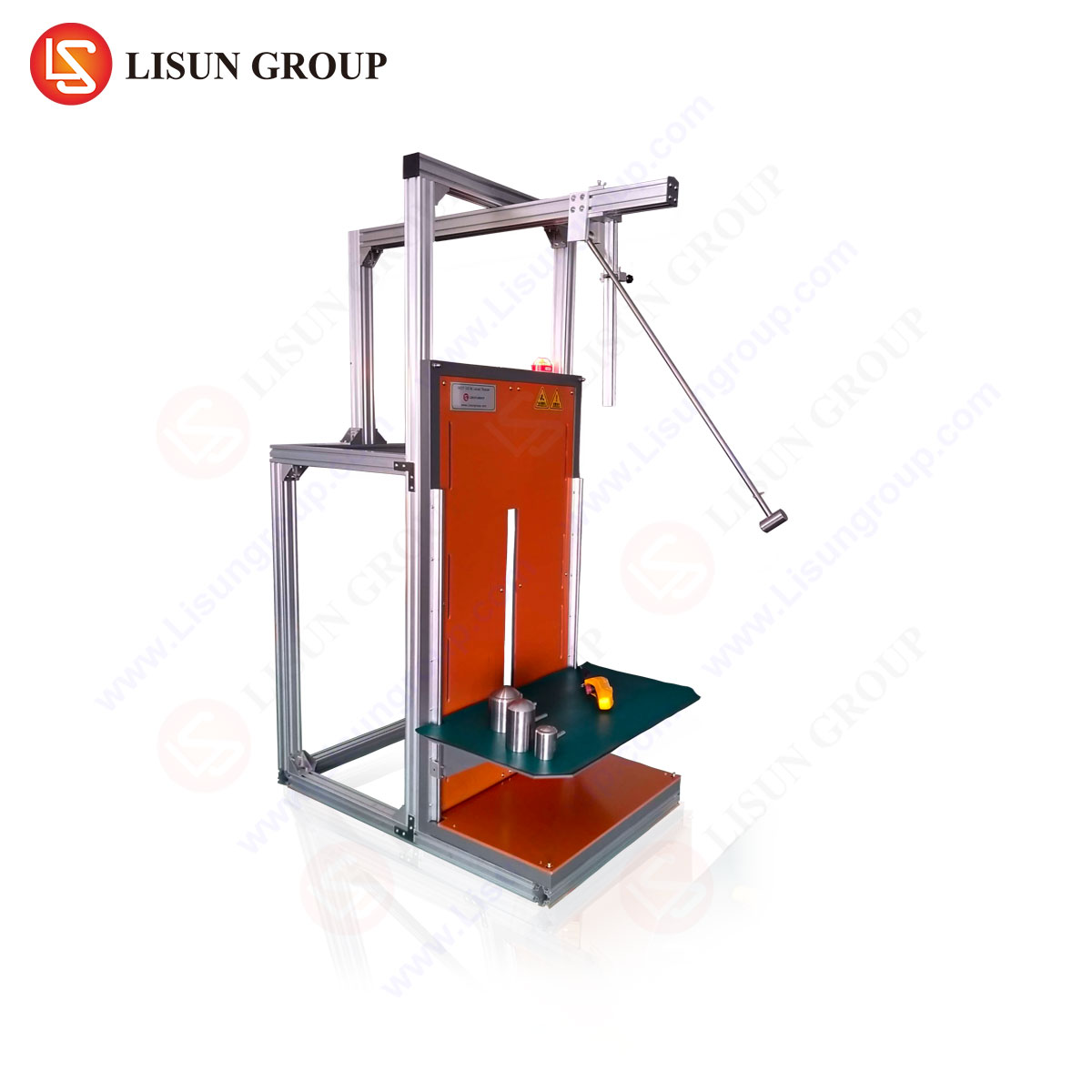
To generate reliable, auditable data for IK code verification, testing laboratories and quality assurance departments require instrumentation that adheres strictly to the methodologies prescribed in IEC 60068-2-75. The LISUN IK07-10VT IK Test Apparatus is engineered specifically for this purpose, providing a complete, integrated solution for conducting impact tests from IK07 through IK10.
The apparatus operates on the pendulum hammer principle. It consists of a rigid vertical support structure, a pendulum arm of defined length, and interchangeable hammer heads of specified radii and masses (e.g., 0.25 kg for IK07, 1.7 kg for IK10). The hammer is released from a predetermined height to strike the test sample mounted on a rigid base. The impact energy is precisely controlled by the mass of the hammer and the release angle, ensuring conformity to the standard’s energy requirements (2 joules for IK07, 20 joules for IK10).
Technical Specifications and Operational Fidelity
The design of the LISUN IK07-10VT emphasizes metrological accuracy and operational repeatability. Key specifications include:
- Test Range: Covers IK07 (2 J), IK08 (5 J), IK09 (10 J), and IK10 (20 J) through the use of calibrated, interchangeable hammers.
- Pendulum Release: Features a precise release mechanism to ensure the hammer strikes the sample with the specified energy without parasitic lateral forces.
- Sample Mounting: Incorporates a robust, adjustable sample table that can be positioned to ensure the impact point aligns with the most vulnerable areas of the test specimen as per standard requirements.
- Construcción: Built from high-strength materials to maintain structural integrity during high-energy impacts, preventing flex or absorption that would invalidate the energy transfer to the sample.
- Safety: Includes integrated safety guards or interlocks to protect the operator from moving parts and flying debris during testing.
The testing principle is straightforward but demands rigorous execution. The sample, in its operational state, is mounted. The appropriate hammer is selected and attached. The pendulum is raised to the precise height corresponding to the target impact energy. Upon release, the hammer strikes the enclosure. Following the test series (typically multiple impacts at different points), the sample is inspected for damage. Compliance is assessed based on criteria including continued provision of protection against electric shock, absence of live part exposure, and maintenance of specified IP ratings. The apparatus may also include a “VT” (Vertical Test) capability, allowing for alternative test configurations as permitted by the standard for certain sample geometries.
Industry Applications and Competitive Advantages
The utility of the LISUN IK07-10VT extends far beyond the lighting fixture industry. Its application is vital in any sector where the mechanical resilience of an enclosure is a safety or reliability factor:
- Industrial Control Systems & Automotive Electronics: Enclosures for PLCs, sensors, and vehicle control units mounted in machinery or on factory floors require IK08-10 ratings to withstand incidental impacts.
- Telecommunications Equipment: Outdoor cabinets, junction boxes, and fiber optic terminal housings must be rated to resist environmental and human-induced mechanical stress.
- Electrical Components & Household Appliances: Switches, sockets, and the external casings of white goods are tested for impact resistance to ensure safety during installation and use.
- Aerospace & Medical Devices: While often subject to more specialized standards, components within these fields may reference IK tests for ground-support equipment or portable device durability.
The competitive advantage of a dedicated apparatus like the IK07-10VT lies in its specialization and reliability. Compared to improvised or multi-purpose test setups, it offers:
- Standard Compliance Guarantee: Its design is intrinsically linked to the test parameters of IEC 60068-2-75, reducing calibration uncertainty and audit risk.
- Test Repeatability: The rigid structure and precise release mechanism minimize variance between tests and operators, producing consistent, comparable data.
- Operational Efficiency: The integrated design, with clear energy settings and sample mounting, streamlines the testing process, increasing laboratory throughput.
- Integridad de los datos: By controlling the test variables precisely, it ensures that results are a true reflection of the sample’s properties, not artifacts of the test equipment.
Integration into a Comprehensive Safety Testing Regime
IK testing is not performed in isolation. For a luminaire, it is one element in a battery of tests mandated by IEC 60598. A typical compliance sequence might involve:
- Dielectric Strength Test (Electric Shock Protection)
- IP Rating Test (Dust/Water Ingress)
- IK Impact Test (Mechanical Robustness)
- Thermal Test (Temperature and Endurance)
- Photobiological Safety Assessment (IEC 62471)
The results from the IK07-10VT directly inform the luminaire’s suitability for its intended environment. A high IK rating may allow for the use of thinner, more cost-effective internal insulation if the enclosure is proven to be a reliable mechanical barrier. Conversely, a failed IK test necessitates a redesign before any other safety certifications can be considered valid, as the fundamental protective enclosure has been compromised.
Conclusión
IEC 60598 represents the definitive international benchmark for luminaire safety, a technical synthesis of decades of engineering knowledge and hazard analysis. Its thorough treatment of mechanical impact resistance through the IK code underscores the holistic nature of product safety, where electrical, thermal, and mechanical risks are interdependent. As luminaires and electronic enclosures become more integrated into demanding environments—from smart factories to public infrastructure—the role of precise, standards-compliant verification tools like the LISUN IK07-10VT IK Test Apparatus becomes increasingly critical. They provide the empirical foundation upon which manufacturers can confidently assert compliance, engineers can validate designs, and certification bodies can uphold the integrity of the safety standards that protect end-users globally.
Sección FAQ
Q1: Can the LISUN IK07-10VT apparatus be used to test for IK ratings below IK07?
A1: The apparatus is specifically configured and calibrated for the impact energy range of IK07 (2 J) to IK10 (20 J). Testing for lower IK ratings (IK01 to IK06) requires different hammer masses and potentially a different test apparatus configuration, such as the LISUN IK01-06 model, which is designed for lower-energy impacts.
Q2: How often does the IK07-10VT apparatus require calibration, and what does the process involve?
A2: Calibration frequency should follow laboratory accreditation guidelines (typically annual) or after any event that could affect accuracy. The process involves verifying the pendulum’s release mechanism, the mass and geometry of the hammer heads, and the drop height/angle to confirm the delivered impact energy is within the tolerances specified by IEC 60068-2-75. Calibration should be performed by a qualified metrology service.
Q3: For a luminaire with a complex shape, how are impact points determined during testing?
A3: IEC 60068-2-75 and IEC 60598-1 provide guidance. Generally, impacts are applied to the most vulnerable areas deemed likely to be struck in service. This includes prominent surfaces, joints, seams, viewing windows, and actuator openings. The test standard often requires a minimum number of impacts (e.g., five) distributed across these points. The laboratory test plan must justify the selected impact locations based on the standard and the product’s intended use.
Q4: Does a passing IK test result guarantee the luminaire will survive any real-world impact?
A4: No. The IK test is a standardized, repeatable laboratory test designed to provide a comparative rating. It uses a specific hammer geometry and energy on a rigidly mounted sample. Real-world impacts may involve different shapes, energies, or angles. The IK rating is a reliable indicator of relative robustness and a essential compliance marker, but it is not an absolute warranty against all physical damage.
Q5: In the context of IEC 60598, what is the consequence if a luminaire’s enclosure cracks during an IK test but the internal live parts remain inaccessible?
A5: The assessment is multifaceted. The primary criteria are the maintenance of protection against electric shock and the preservation of required IP ratings. If the crack does not expose live parts or compromise creepage/clearance distances, and if it does not allow the ingress of moisture or dust to a degree that violates the declared IP rating, the luminaire may still be deemed to have passed the specific impact test. However, the damage must be documented, and any sharp edges created would also be assessed against relevant safety requirements.

 ES
ES  EN
EN  RU
RU  PT
PT  TR
TR  AR
AR  DE
DE  PL
PL  IT
IT  FR
FR  KO
KO  JA
JA  ID
ID