




Understanding LISUN Drop Tester Compliance with ISTA 3A Standards: A Technical Analysis
The global supply chain presents a rigorous environment for packaged products, where the hazards of transportation—from shock impacts during handling to resonant vibrations within containerized freight—can compromise product integrity before reaching the end user. For manufacturers across critical sectors, pre-shipment package testing is not merely a quality check but a fundamental component of risk mitigation and design validation. The International Safe Transit Association (ISTA) 3A standard stands as a preeminent protocol for packaged-products shipped through parcel delivery systems. Compliance with this standard necessitates precise, repeatable simulation of these hazards, a task for which specialized equipment like the LISUN DT-60KG Drop Tester is engineered. This technical analysis examines the principles of drop testing within the ISTA 3A framework, the operational and design parameters of the DT-60KG system, and its application across diverse industrial sectors.
The ISTA 3A Standard: A Framework for Parcel Shipment Simulation
ISTA 3A, formally titled “Packaged-Products for Parcel Delivery System Shipment,” is a generalized simulation test for individual packaged products weighing 150 lb (70 kg) or less. Its objective is to evaluate the capability of a packaged product to withstand the distribution environment without incurring damage that would render it unacceptable to the consumer. The standard is a composite sequence, integrating multiple test types to replicate a typical parcel delivery journey. Key elements include atmospheric preconditioning, shock and drop testing, vibration testing (both random and fixed displacement), and in some cases, compression testing.
Le test de chute sequence within ISTA 3A is particularly critical, as it directly simulates the free-fall drops and impacts that occur during manual and mechanical handling. The standard prescribes a specific number of drops—typically ten—from a defined height based on the packaged product’s weight. The drop orientations are not random; they are strategically mandated to include corners, edges, and faces. This methodology ensures that the most vulnerable points of the package and product are subjected to impact forces. The test’s outcome validates both the cushioning design of the interior packaging and the structural robustness of the product itself and its exterior container.
Operational Mechanics of the LISUN DT-60KG Drop Tester
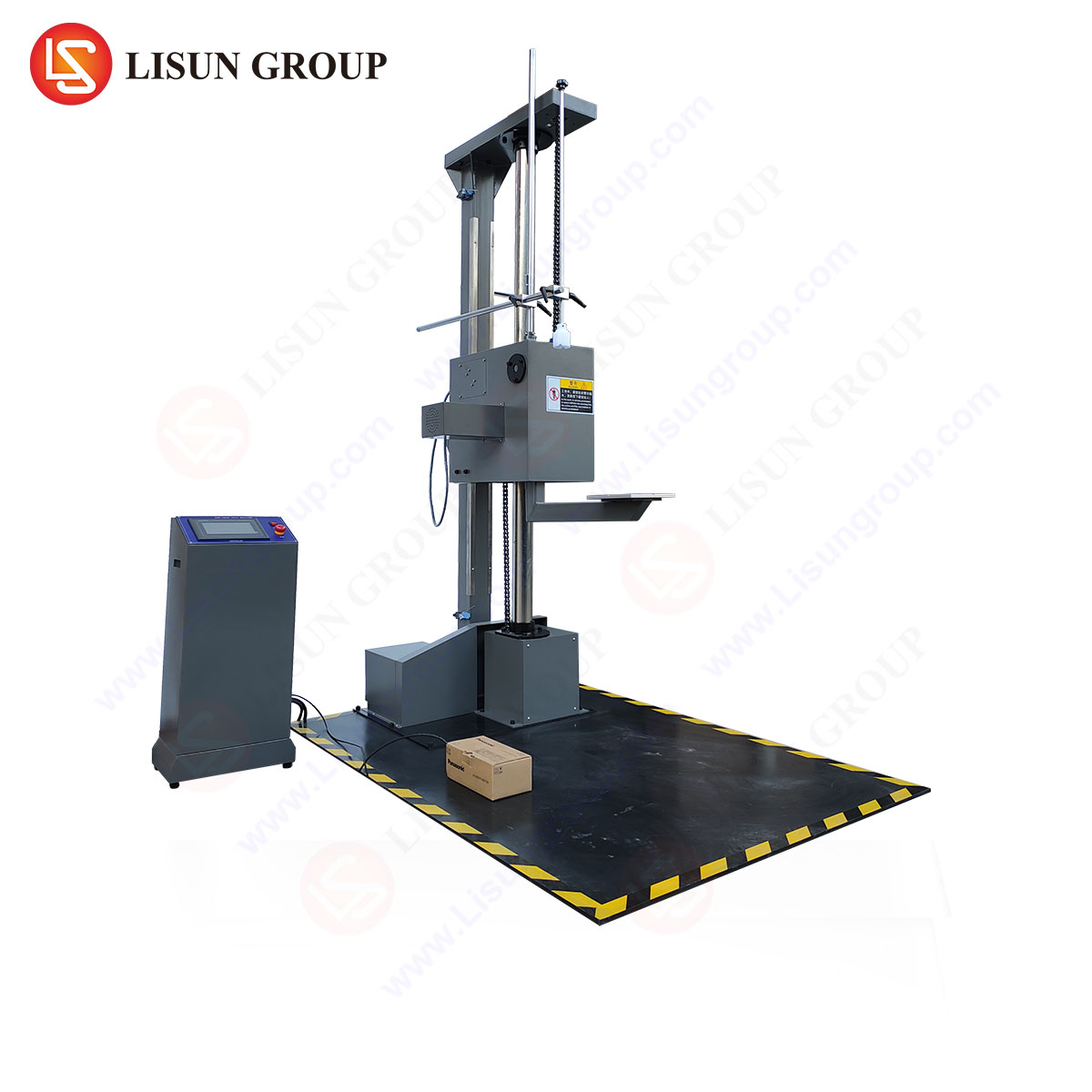
The LISUN DT-60KG Drop Tester is a monopedal, electro-mechanical system designed to execute the controlled drop sequences mandated by standards such as ISTA 3A. Its nomenclature denotes a maximum test load capacity of 60 kilograms, situating it within the core weight range of the ISTA 3A standard. The system’s architecture is predicated on delivering high repeatability and user-defined test parameters to ensure laboratory-grade accuracy.
The testing principle employs a double-column structure with an electromagnetic release mechanism. The test specimen is secured to a drop table, which is then hoisted to a pre-programmed height via a motorized lifting system. Height calibration is precise, typically with a resolution of ±10mm or finer, which is essential for generating consistent impact velocities. The release mechanism is a pivotal component; it must disengage cleanly and instantaneously to ensure a true free-fall condition without imparting lateral motion or rotation. The DT-60KG utilizes an electromagnetic clutch that, upon command, releases the table, allowing it to fall along guided columns onto a rigid, heavy-duty baseplate. This baseplate is constructed from high-strength steel or cast iron to provide a non-yielding impact surface, a requirement of ISTA procedures to ensure energy transfer is not absorbed by the test equipment.
Specifications of the DT-60KG system typically include a variable drop height range from 300 to 1500 mm (or broader), accommodating not only ISTA but other standards like ASTM D5276. The drop table dimensions are sufficient for most parcel-sized packages. Control is managed via a programmable logic controller (PLC) and human-machine interface (HMI), allowing operators to preset the number of drops, height for each drop, and interval between drops. Advanced models may include safety interlocks, automatic height positioning, and data logging capabilities to record test parameters for audit trails.
Industry-Specific Applications and Test Scenarios
The universality of the parcel shipment model makes ISTA 3A compliance relevant to a vast array of industries. The DT-60KG facilitates this validation across sectors where product functionality is sensitive to mechanical shock.
Electrical and Electronic Equipment & Industrial Control Systems: Printed circuit board assemblies (PCBAs), server modules, and programmable logic controller (PLC) housings are susceptible to solder joint fractures, component dislodgement, and connector failure. A drop test sequence validates the effectiveness of foam-in-place cushioning or molded pulp trays in isolating these sensitive assemblies from impact G-forces.
Appareils électroménagers et électroniques grand public : Products such as coffee makers, smart home hubs, or gaming consoles contain glass components, plastic housings with snap-fit joints, and internal mechanical assemblies. Drop testing assesses whether packaging prevents cosmetic damage (scratches, dents) and functional damage (cracked screens, broken internal mounts).
Automotive Electronics and Aerospace Components: Engine control units (ECUs), in-vehicle infotainment systems, and avionics black boxes must survive handling after manufacture and during service part logistics. The test verifies that transit does not induce latent defects, such as micro-cracks in ceramic substrates or misalignment in sensor modules, which could lead to field failures.
Lighting Fixtures and Electrical Components: LED luminaires, switches, and sockets often have fragile diffusers, glass elements, and brittle thermoplastic bodies. The prescribed corner and edge drops are especially telling, revealing weaknesses in package design that allow concentrated stress points to contact the product.
Telecommunications Equipment and Medical Devices: Routers, optical network terminals, portable diagnostic devices, and infusion pump modules require high reliability. Testing ensures that critical calibrations are not shifted and that enclosures remain sealed against moisture ingress after impact.
Cable and Wiring Systems: While seemingly robust, reels of coaxial cable or fiber optic lines can have connectors damaged or spools deformed, causing tangling and performance degradation. Drop testing evaluates the crush resistance of the reel flanges and the security of the connector protective caps.
Technical Advantages in Compliance Verification
The DT-60KG system offers several distinct advantages that translate to more reliable and standards-compliant testing outcomes. A primary advantage is the elimination of operator-induced variability. Manual drop testing is inherently inconsistent due to variations in release angle, height, and throwing motion. The automated release and guided fall of the DT-60KG ensure that each impact is perpendicular and true to the intended orientation, a fundamental requirement for valid ISTA 3A data.
The programmability of the test sequence enhances both accuracy and laboratory efficiency. Operators can input the exact sequence of drops (e.g., Corner 1, Edge 2, Face 5, etc.), minimizing setup error between specimens. This is crucial for comparative testing, such as evaluating different cushioning materials or box designs. The system’s robust construction ensures long-term calibration stability; the impact surface does not deform over time, which would alter the deceleration pulse and invalidate comparative results.
Furthermore, the system’s design often incorporates safety features that exceed basic requirements. Protective guarding, two-hand operation controls, and emergency stop functions protect operators during the hoisting and release cycles. This allows technicians to focus on specimen preparation and post-test analysis rather than procedural safety, reducing the potential for workflow interruption.
Correlating Test Results to Real-World Performance
The ultimate value of ISTA 3A testing lies in the correlation between laboratory results and field performance. A successful test sequence, executed on equipment like the DT-60KG, indicates a high probability of survival in the distribution environment. Post-test evaluation is as critical as the test itself. This involves a full functional test of the product—powering up an electronic device, checking all switch functions on a socket, verifying optical output on a laser module—and a thorough visual inspection for cracks, deformations, or compromised seals.
For example, a medical device manufacturer may subject a packaged blood glucose monitor to the ISTA 3A sequence. After testing on the DT-60KG, the device undergoes calibration verification against a standard. Any drift beyond specification would indicate that the packaging failed to adequately protect the internal sensor and circuitry from shock, necessitating a redesign of the foam insert or corrugated sleeve.
Data logging capabilities, when available, create an immutable record for compliance certification. This documentation is frequently required by large retailers, automotive OEMs, and aerospace contractors as part of their supplier qualification process. It demonstrates a commitment to quantified quality assurance rather than assumptive design.
Integration into a Comprehensive Quality Assurance Protocol
While the drop test is a cornerstone, it is most effective as part of an integrated testing regimen. ISTA 3A itself combines atmospheric conditioning, vibration, and shock. The DT-60KG is therefore one node in a broader laboratory ecosystem. Preconditioning the package at a specified temperature and humidity, per the standard, can significantly alter material properties; plastic becomes more brittle, corrugated board may lose stacking strength. The subsequent drop test results are thus more representative of real-world winter or summer shipping conditions.
Following the drop sequence with random vibration testing simulates the prolonged road or air freight segment, which can work loose components already stressed by the initial impacts. A product that survives the drops may still fail during vibration if internal fasteners were weakened. Therefore, the data derived from the precise drops administered by the DT-60KG provides the first critical dataset in a multi-stage failure analysis, informing not only packaging engineers but also product design teams about structural vulnerabilities.
Foire aux questions (FAQ)
Q1: How does the DT-60KG ensure the required “free-fall” condition specified in ISTA 3A?
The tester employs an electromagnetic release mechanism coupled with low-friction guide columns. Upon activation, the electromagnetic force disengages instantaneously, allowing the drop table and specimen to accelerate under gravity alone without lateral restraint or initial velocity, thereby satisfying the “free-fall” criterion essential for standardized impact energy calculation.
Q2: Our product has an irregular shape. How do we determine which protrusion is “Corner 1” for the test sequence?
ISTA 3A provides a specific methodology for numbering corners, edges, and faces. Generally, the package is oriented in its intended shipping position. The corner farthest from the center of the top face is designated Corner 1. The three edges meeting at that corner are Edges 1-2, 1-3, and 1-4. The faces adjacent to Corner 1 are then identified. The DT-60KG’s programmable controller allows you to assign a drop height to each of these pre-defined orientations.
Q3: Can the DT-60KG be used for standards other than ISTA 3A?
Yes. The system’s adjustable height (300-1500mm typical) and programmability make it suitable for a range of standards including ISTA Series 1 and 2 procedures, ASTM D5276, MIL-STD-810G Method 516.8, and various commercial retail standards from Amazon, Walmart, or Target, which often derive their protocols from ISTA bases.
Q4: What is the typical calibration interval for maintaining the accuracy of the drop tester?
Metrological calibration of the height measurement system and verification of the release mechanism’s consistency are recommended annually, or more frequently under high-use conditions. Calibration should be traceable to national standards and involve checking the actual drop height versus the displayed value and ensuring the drop table does not bind during release.
Q5: After a failed ISTA 3A test on the DT-60KG, what are the primary packaging elements to reconsider?
Failure analysis should focus sequentially on: 1) Cushioning Material: Is the static loading correct? Does the cushion bottom out (over-compress) on impact? 2) Blocking and Bracing: Is the product prevented from moving inside the box and impacting the interior walls? 3) Container Strength: Does the outer corrugated box lose integrity (crease, burst) on a face drop, transferring excessive force to the product? The test’s repeatability allows for iterative redesign and validation.

 FR
FR  EN
EN  ES
ES  RU
RU  PT
PT  TR
TR  AR
AR  DE
DE  PL
PL  IT
IT  KO
KO  JA
JA  ID
ID