




A Comprehensive Analysis of IK Rating Impact Resistance Testing: Methodologies, Standards, and Advanced Instrumentation
Introduction to Mechanical Impact Resistance in Product Design
The operational lifespan and functional reliability of equipment across a diverse spectrum of industries are inexorably linked to their ability to withstand mechanical shocks. Environmental hazards, accidental impacts during handling, installation, or service, and even deliberate vandalism pose significant threats to product integrity. Consequently, quantifying and validating a product’s resilience to such forces is a critical component of the design, certification, and quality assurance processes. The IK rating system, defined under the international standard IEC 62262 (aligned with European Standard EN 62262), provides a codified, reproducible methodology for evaluating the degree of protection provided by enclosures against external mechanical impacts. This technical article delineates the principles of IK testing, explores its application across key industrial sectors, and examines the role of sophisticated testing apparatus, with a particular focus on the LISUN IK07-10VT IK Test System, in ensuring rigorous compliance and product robustness.
Deciphering the IK Code: Energy Levels and Impactor Specifications
The IK code is expressed as “IK” followed by a two-digit number ranging from 00 to 10. This numerical designation corresponds to a specific impact energy, measured in joules (J), which the enclosure is tested to withstand without sustaining damage that would compromise its safety or primary functions. It is crucial to distinguish IK ratings from IP (Ingress Protection) codes, which address protection against solid objects and liquids. While related, they are separate classifications; a product may possess a high IP rating for dust and water resistance yet a low IK rating for physical impact.
The IK scale is logarithmic in nature, with each increment representing a substantial increase in impact energy. For instance, IK06 corresponds to a 1 J impact, while IK08 represents 5 J, and IK10 signifies a robust 20 J impact. The standard meticulously defines not only the energy but also the physical characteristics of the impactor tools—typically a pendulum hammer, spring hammer, or vertical hammer—for each energy level. These tools feature standardized radii, materials (such as polyamide or steel), and masses to ensure consistent, repeatable impact conditions globally. The test mandates impacts at the most vulnerable points of the enclosure, with a prescribed number of strikes per point, to simulate real-world abuse scenarios effectively.
The LISUN IK07-10VT IK Test System: Architecture and Operational Principles
To administer tests from IK07 (2 J) through IK10 (20 J) with precision and repeatability, advanced calibrated equipment is mandatory. The LISUN IK07-10VT IK Test System embodies such an instrument, engineered to fulfill the stringent requirements of IEC 62262 and related standards. Its core design principle is the controlled conversion of potential energy into kinetic energy at the point of impact, with minimal frictional or aerodynamic losses that could skew results.
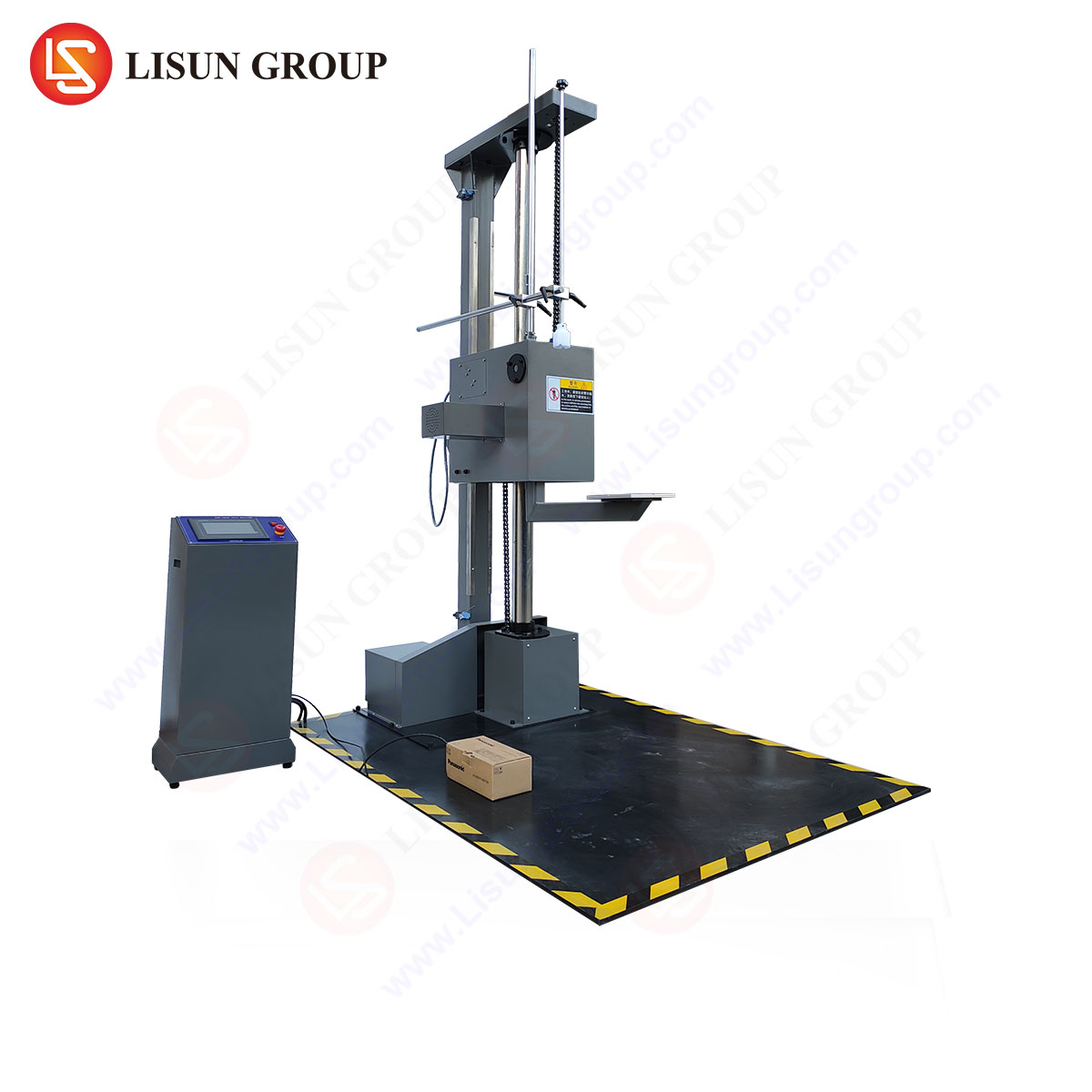
The system’s architecture is built around a vertical guide tube with a calibrated release mechanism. Test impactors, whose masses are precisely defined for each target energy level (e.g., 1.5 kg for 5 J, 5 kg for 20 J), are raised to a calculated height within this tube. The potential energy (mgh) is thus set accurately. Upon release, the impactor falls freely, striking the sample mounted on a rigid base. The “VT” designation highlights the Vertical Test configuration, which is particularly suited for higher-energy tests where pendulum systems may become impractical or less accurate due to their larger footprint and arc trajectory complexities.
Key specifications of the LISUN IK07-10VT system include a digitally controlled electromagnetic release mechanism to eliminate manual release variance, a high-precision height adjustment system, and a robust anvil base with sample clamping fixtures to prevent energy-absorbing movement during impact. The system typically covers the full spectrum from 2 J to 20 J, with interchangeable impactors and easily configurable drop heights to span the IK07 to IK10 range. This flexibility allows laboratories to service a wide variety of product certifications with a single, calibrated apparatus.
Cross-Industry Applications of High-Impact Resistance Testing
The imperative for IK07-10 level protection is driven by the operational environments and safety requirements of numerous industries.
- Electrical and Electronic Equipment & Industrial Control Systems: Enclosures for programmable logic controllers (PLCs), motor drives, and power distribution units in factory settings are subject to tools being dropped, carts bumping into them, or debris strikes. An IK08 or IK09 rating ensures these critical control nodes remain operational despite such incidents.
- Luminárias: Public area lighting, industrial high-bay lights, and roadway luminaires are vulnerable to vandalism and accidental impact from equipment or falling objects. IK08/IK09 ratings are frequently specified by municipal and industrial contracts to reduce maintenance costs and ensure public safety.
- Eletrónica automóvel: Components mounted in vehicle doors, undercarriages, or engine bays, such as sensors, control modules, and junction boxes, must endure stone chips, kick impacts, and wrench strikes during servicing. IK08 protection is often a minimum requirement for these harsh environments.
- Equipamentos de telecomunicações: Outdoor cabinets, fiber optic terminal enclosures, and base station hardware installed at street level or on poles require IK09/IK10 ratings to resist deliberate vandalism and environmental knocks, ensuring network integrity.
- Dispositivos médicos: Equipment used in ambulances, emergency departments, or mobile clinics, like portable monitors or defibrillator casings, must withstand the rigors of transport and urgent handling. An IK08 rating provides confidence in the device’s resilience during critical care scenarios.
- Componentes aeroespaciais e de aviação: While weight is at a premium, ground support equipment casings and certain external access panel components require known impact resistance for safety and maintenance. Testing to IK standards provides quantifiable data for material and design choices.
Methodological Rigor: The Testing Protocol and Pass/Fail Criteria
Executing a compliant IK test is a systematic procedure beyond merely striking an enclosure. The sample must be mounted in a manner representative of its final installation—rigidly fixed to the test base. The standard specifies the exact number of impacts (typically five per point) and the selection of impact points: these include the most prominent, vulnerable surfaces, seams, and viewing windows if present. For each IK level, the appropriate impactor is selected, calibrated, and released from the precisely calculated height.
The post-test evaluation is as critical as the test itself. The pass/fail criteria are functionally oriented. The enclosure is not required to be free of cosmetic damage like dents or scuffs. Rather, it must continue to provide its intended degree of protection against ingress (its IP rating must not be degraded) and any safety-critical functions must remain operational. For example, a lighting fixture’s lens may crack, but if live parts become exposed or the fixture ceases to function, it fails. Similarly, a medical device enclosure may dent, but if the seal integrity is broken, allowing fluid ingress, the test is not passed. This functional focus aligns the test directly with real-world performance and safety outcomes.
Competitive Advantages of Automated Vertical Test Systems
Utilizing a dedicated system like the LISUN IK07-10VT confers several technical and operational advantages over improvised or less sophisticated test setups. First is calibration traceability: the system is designed to be calibrated against national standards, ensuring the impact energy delivered is accurate and auditable, a fundamental requirement for certified testing laboratories (e.g., ISO/IEC 17025 accredited labs).
Second is repeatability and reproducibility: the electromagnetic release and vertical free-fall design minimize human-induced variables. The impactor strikes the sample consistently perpendicularly, with no lateral or arcing motion that could alter the effective energy transfer. This allows for reliable comparison of results across different batches of products or between design iterations.
Third is operator safety and efficiency: Testing high-energy impacts manually is hazardous. The IK07-10VT system contains the impact event, protecting the operator. Furthermore, its adjustable features allow for rapid changeover between different IK test levels, increasing laboratory throughput and reducing configuration errors.
Finally, it provides comprehensive data integrity: While the standard does not require force measurement, the precision in energy delivery forms the bedrock of the test’s validity. Using such a system generates defensible data for compliance reports, essential for product certification (CE, UL, etc.), liability mitigation, and quality assurance documentation.
Integrating Impact Test Data into the Product Development Lifecycle
Proactive IK testing should not be merely a final compliance checkpoint but an integrated element of the design and validation process. Early-stage testing on prototype enclosures using a system like the IK07-10VT can reveal design weaknesses—such as thin sections, unsupported spans, or brittle material choices—before tooling is committed. This enables iterative design improvement, potentially leading to material optimization that meets the required IK rating at a lower weight or cost.
Furthermore, the quantitative nature of the test supports failure analysis and benchmarking. By understanding at exactly what energy level a design fails and the mode of failure (cracking, deformation, fastener shearing), engineers can make targeted enhancements. This data-driven approach is superior to anecdotal assessments of “ruggedness” and provides a clear engineering specification for the product’s mechanical robustness.
Conclusão
The IK rating system furnishes a vital, standardized metric for mechanical impact resistance, translating subjective notions of durability into objective, comparable data. As products across electrical, industrial, automotive, and consumer sectors face increasingly demanding physical environments, validation to IK07-10 levels becomes a significant marker of quality and reliability. Precision instrumentation, such as the LISUN IK07-10VT IK Test System, is indispensable in this endeavor, providing the controlled, repeatable, and safe means to generate the compliance evidence required by standards, regulators, and discerning customers. By embedding rigorous IK testing into the product development lifecycle, manufacturers can enhance product resilience, reduce field failures, and substantiate their claims of durability with empirical authority.
Secção FAQ
Q1: Can the LISUN IK07-10VT system test ratings below IK07?
A1: The IK07-10VT is specifically engineered and optimized for the higher-energy spectrum from IK07 (2 J) to IK10 (20 J). Testing for lower IK ratings (IK00 to IK06) typically requires different, lighter impactors and often employs pendulum-based test apparatus. For comprehensive coverage across all IK levels, a laboratory would typically utilize both a pendulum hammer tester for IK00-06 and a vertical drop tester like the IK07-10VT for the higher energies.
Q2: How often does the test equipment require calibration, and what does it involve?
A2: Calibration frequency is typically annual for accredited laboratories, following ISO/IEC 17025 guidelines. The calibration process for a vertical drop tester involves verifying the mass of each impactor to a high precision and confirming the accuracy of the height measurement scale. This ensures the calculated potential energy (mgh) is correct. A calibration certificate from an accredited body provides traceability to national standards.
Q3: For a product with a curved or uneven surface, how is the impact point determined?
A3: The IEC 62262 standard provides guidance for such scenarios. The fundamental rule is to test the most vulnerable points that are accessible under normal conditions of use. If the surface is curved, the impactor should contact the surface at a tangent, as it would in a real impact. The standard often requires testing on the most prominent points of the enclosure, regardless of geometry, to simulate a worst-case strike.
Q4: If an enclosure has a transparent window (like a display), are there special test considerations?
A4: Yes. Transparent covers or windows are explicitly considered within the standard. They must be tested with the same energy level as the rest of the enclosure. The impactor strikes the center of the window or its most vulnerable point. The pass/fail criterion remains functional: the window can crack, but it must not shatter in a way that allows the ingress of objects or liquids to a degree that violates its IP rating or creates a safety hazard from exposed parts or sharp edges.
Q5: Does achieving a high IK rating (e.g., IK10) automatically ensure a product is “vandal-proof”?
A5: While IK10 represents significant resistance to a 20 J impact (equivalent to a 5 kg mass dropped from 400mm), the term “vandal-proof” is subjective and encompasses a wider range of potential attacks (e.g., cutting, prying, sustained force). An IK10 rating provides a quantified measure of resistance to blunt mechanical impacts as defined by the standard. It is a critical component of vandal resistance but should be considered alongside other design features such as material toughness, locking mechanisms, and resistance to other forms of tampering for a complete assessment.

 PT
PT  EN
EN  ES
ES  RU
RU  TR
TR  AR
AR  DE
DE  PL
PL  IT
IT  FR
FR  KO
KO  JA
JA  ID
ID