




Advanced Methodologies for Validating Package Integrity in High-Reliability Supply Chains
The global distribution of sensitive and high-value components across industries such as aerospace, medical devices, and automotive electronics necessitates an uncompromising approach to packaging validation. Package integrity is not merely a logistical concern; it is a critical determinant of product reliability, safety, and total cost of ownership. Failure modes induced by inadequate packaging—including latent damage, functional degradation, and complete operational failure—can precipitate severe financial, reputational, and regulatory consequences. Consequently, advanced package integrity testing has evolved from a passive quality checkpoint to a proactive, data-driven engineering discipline. This article delineates the sophisticated methodologies underpinning modern package integrity assurance, with a particular focus on standardized shock and impact simulation as a cornerstone of comprehensive testing protocols.
The Multiphysics of Package Failure During Distribution
Understanding package integrity demands a holistic analysis of the distribution environment as a system of interrelated stress vectors. These include static compression from stacking, resonant vibration from transport vehicles, shock from handling transitions, and environmental fluctuations in temperature and humidity. Among these, transient shock events—characterized by high acceleration over short durations—are particularly insidious. They often induce failure mechanisms not detectable through visual inspection, such as cracked solder joints in electronic assemblies, dislodged connectors in automotive control units, or microfractures in aerospace composite components. The physics of such events are modeled through shock response spectra, where the fragility of the product-packaging system is evaluated against the input pulse shapes (e.g., half-sine, trapezoidal, sawtooth) representative of real-world drops, kicks, and conveyor transfers.
A robust testing regimen must, therefore, accurately replicate these transient conditions in a controlled laboratory setting. This replication allows for the empirical derivation of a product’s fragility profile, enabling the design of packaging that attenuates transmitted forces below critical thresholds. The scientific objective is to move beyond simple pass/fail metrics and instead generate actionable data on the product’s behavior at its operational limits, facilitating both packaging optimization and, where necessary, product design for resilience.
Controlled Shock Simulation as a Foundational Test Modality
Standardized drop testing remains the most direct and empirically validated method for assessing a package’s ability to mitigate shock. The principle involves subjecting a packaged product to a series of controlled impacts from specified heights and orientations, as defined by international standards such as ISTA (International Safe Transit Association) Series, ASTM D5276, and MIL-STD-810. The sophistication of modern ensaio de queda apparatus lies in its programmability, measurement accuracy, and repeatability. Key controlled parameters include drop height, impact velocity, orientation (flat, edge, corner), and the characteristics of the impact surface (typically steel or concrete).
Advanced systems transcend basic free-fall designs by incorporating double-guiding columns and pneumatic release mechanisms to ensure a truly vertical, frictionless drop without initial velocity or rotation. This eliminates parasitic variables, guaranteeing that the kinetic energy at impact is precisely consistent with the programmed height. The data acquisition system is equally critical, integrating high-sample-rate triaxial accelerometers mounted at the product’s center of gravity or critical subassemblies. This allows engineers to capture the transmitted shock pulse in detail, analyzing peak G-forces, velocity change, and pulse duration to calculate the shock response spectrum experienced by the product itself.
The DT-60KG Drop Test System: Engineering Precision for Compliance and Beyond
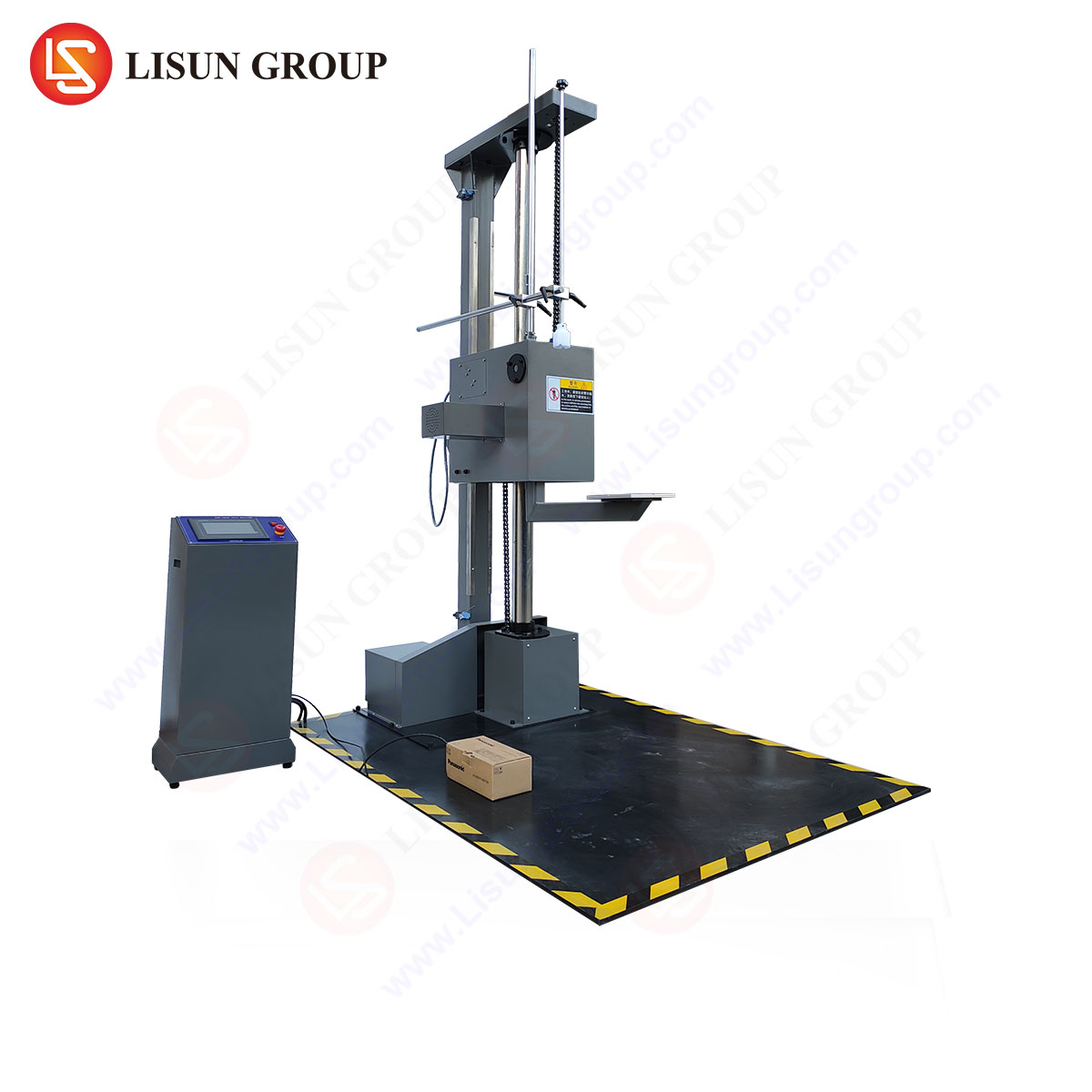
O LISUN DT-60KG Drop Test System exemplifies the engineering precision required for advanced package integrity validation. Designed to accommodate test specimens up to 60 kilograms, its robust construction addresses the needs of industries packaging dense electronic systems, industrial controls, and assembled appliances. The system’s core specifications are engineered for compliance and research-grade analysis.
Key Specifications and Principles:
- Test Payload: 0–60 kg.
- Drop Height Adjustment: 300–1500 mm (or customizable per client requirements), with a precision scale for accurate setting.
- Mecanismo de Liberação: Pneumatic clamping and release ensures a clean, repeatable drop without imparting spin or horizontal motion.
- Guiding System: Two high-precision, chromed columns provide minimal-friction guidance for the drop table.
- Impact Surface: A rigid, heavy-duty baseplate with a removable impact panel, allowing for surface material changes as per ISTA or other standards (e.g., steel, concrete replicate).
- Sistema de controlo: A microprocessor-based controller allows for programmable testing sequences, including automatic multi-orientation cycling and drop count.
The operational principle of the DT-60KG is centered on controlled kinetic energy transfer. By precisely setting the mass (product + packaging) and the drop height, the potential energy at the release point is defined. This energy is converted into kinetic energy at impact. The system’s design ensures that this energy is transferred to the specimen through the intended impact face onto the standardized surface, allowing for consistent measurement of the packaging’s cushioning efficiency and the product’s fragility.
Industry-Specific Applications and Validation Protocols
The utility of a system like the DT-60KG is demonstrated across the spectrum of modern manufacturing, where electronics integration is ubiquitous.
- Automotive Electronics & Industrial Control Systems: Electronic Control Units (ECUs), infotainment systems, and programmable logic controllers (PLCs) contain surface-mount technology (SMT) components and ball grid array (BGA) packages sensitive to board flexure. Drop testing validates that packaging prevents shock pulses from exceeding the solder joint fracture strength. Testing often follows ISTA 3A or manufacturer-specific standards simulating warehouse handling and last-mile delivery.
- Medical Devices & Aerospace Components: For patient monitors, diagnostic equipment, or avionics black boxes, functional integrity is paramount. Testing here is frequently aligned with MIL-STD-810 Method 516.8, employing specific shock pulses. The DT-60KG’s capacity accommodates the over-packaging often required for these high-value items.
- Telecommunications Equipment & Electrical Components: Routers, switches, and modular power supplies undergo repetitive handling during installation. Corner and edge drop sequences are critical to test the robustness of external casings and internal mounting points. The system’s ability to securely manipulate and release heavy, irregularly shaped items is essential.
- Lighting Fixtures & Household Appliances: LED luminaires with delicate heat sinks or glass elements, and appliances with ceramic or glass components, are tested for both structural integrity and safety (e.g., preventing exposure to live parts). Tests often simulate drops from a pallet or a handling cart.
- Cable and Wiring Systems: Large reels of industrial cable or pre-terminated wiring harnesses are evaluated for damage to connectors or insulation. The 60kg capacity is pertinent for these dense, heavy packages.
Competitive Advantages in Data-Driven Package Design
The competitive advantage conferred by advanced systems lies not merely in compliance certification but in enabling a superior, iterative design process. The precision and repeatability of the DT-60KG facilitate comparative testing between packaging prototypes—foam densities, corrugated structures, suspension systems—yielding quantifiable data on performance differentials. This allows for material optimization, potentially reducing packaging waste and logistics costs while improving protection. Furthermore, the data captured can be used to calibrate finite element analysis (FEA) models of the package-product system, creating a digital twin for virtual testing that accelerates development cycles.
In regulatory and supply chain contexts, the ability to generate auditable, standard-compliant test reports with high-fidelity data strengthens a manufacturer’s position. It provides objective evidence of due diligence in product stewardship, a factor increasingly critical in contracts with major OEMs across automotive, aerospace, and medical industries.
Integrating Drop Testing into a Holistic Integrity Testing Regimen
While shock testing is foundational, it is most powerful when its data is correlated with other environmental stress screening results. A comprehensive integrity testing regimen typically follows a sequential or combined approach:
- Compression Testing: To validate stacking strength.
- Vibration Testing: To simulate transport resonance and provoke fatigue failures.
- Climate Testing: To assess material performance under temperature/humidity cycles.
- Shock/Drop Testing: To simulate discrete handling impacts.
- Combined Stress Testing: Where vibration and climate stresses are applied concurrently or sequentially with shock events, revealing synergistic failure modes.
In this framework, the drop test provides the critical shock input data. The failures or performance deviations observed post-drop sequence often inform the focus of subsequent vibration or life-cycle tests, creating a closed-loop validation process.
Conclusion: Toward Predictive Package Engineering
The frontier of package integrity testing is shifting from reactive validation to predictive engineering. The integration of precise, instrumented systems like advanced drop testers with digital modeling tools represents this evolution. The consistent, high-quality data generated forms the empirical backbone for machine learning algorithms that can predict failure probabilities across novel distribution scenarios. For industries where product integrity is synonymous with brand integrity and operational safety, investment in advanced testing solutions is not an operational cost but a strategic imperative for risk mitigation and market leadership. The continuous refinement of standards and testing technologies ensures that package engineering keeps pace with the increasing complexity and sensitivity of the global goods it is designed to protect.
Secção FAQ
Q1: How does the DT-60KG ensure a true free-fall drop without initial rotation or drag?
The system employs a pneumatically actuated release mechanism that disengages instantly and symmetrically. Coupled with low-friction, precision-ground guiding columns, this design ensures the drop table and specimen accelerate under gravity alone, eliminating parasitic forces that could skew impact orientation and invalidate test results according to ISTA and ASTM standards.
Q2: For a medical device weighing 15kg, what drop height standards are typically applicable?
The applicable standard is dictated by the device’s classification and distribution channel. ISTA 3A is a common general simulation for parcel delivery, which may prescribe drop heights based on package weight (e.g., for 15kg, a height of 380mm). However, for critical devices, MIL-STD-810 or specific FDA guidance may apply, which could mandate tailored shock pulses with equivalent energy rather than a simple drop height. Always consult the relevant regulatory and customer-specific requirements.
Q3: Can the DT-60KG simulate corner and edge drops automatically?
While the core function provides precise flat-face drops, comprehensive corner and edge testing requires a complementary fixture or manual re-orientation of the test specimen between programmed drops. The system’s controller can be programmed to execute a sequence of drops, pausing for the operator to reposition the package to the next specified orientation, thereby standardizing the test sequence.
Q4: What type of data output does the system provide, and how is it used?
The primary output is a test report log detailing drop parameters. When integrated with an optional data acquisition system and accelerometer, it generates time-history waveforms of acceleration (G) versus time. Engineers use this waveform to calculate peak G, velocity change, and pulse duration. This data is plotted on a shock response spectrum to identify the product’s resonant frequencies and fragility levels, informing both packaging design and product hardening efforts.
Q5: How does testing for automotive electronics differ from testing for consumer electronics?
Automotive electronics testing is often more severe and closely tied to OEM-specific standards that simulate harsh plant handling and in-vehicle shock environments. It may involve higher drop heights, multiple impacts per orientation, and testing across extreme temperature ranges. Consumer electronics testing, while still rigorous (e.g., following ISTA procedures), is typically focused on parcel shipping and retail handling environments. The capacity and durability of a system like the DT-60KG cater to the heavier, often more robustly constructed assemblies common in automotive and industrial applications.

 PT
PT  EN
EN  ES
ES  RU
RU  TR
TR  AR
AR  DE
DE  PL
PL  IT
IT  FR
FR  KO
KO  JA
JA  ID
ID