




A Comprehensive Examination of ASTM D5276: Standard Test Method for Drop Test of Loaded Containers by Free Fall
Introduction to Package Integrity Assessment Through Controlled Impact
The evaluation of packaging system performance under dynamic impact conditions constitutes a critical phase in the product development and quality assurance lifecycle for a vast array of industries. The primary objective is to simulate the hazards encountered during handling, transportation, and distribution, thereby ensuring that products arrive at their destination without functional compromise or safety degradation. Among the suite of standardized methodologies designed to replicate these hazards, the ensaio de queda stands as a fundamental and highly revealing procedure. ASTM D5276, “Standard Test Method for Drop Test of Loaded Containers by Free Fall,” provides the definitive framework for conducting such assessments in a controlled, repeatable, and scientifically valid manner. This technical article delineates the standard’s scope, procedural mandates, and analytical significance, while contextualizing its application through modern testing apparatus such as the LISUN DT-60KG Drop Tester.
Scope and Application of ASTM D5276 in Industrial Contexts
ASTM D5276 is explicitly designed to determine the ability of a filled shipping container to withstand the effects of vertical impact resulting from a free fall onto a rigid, unyielding horizontal surface. Its applicability spans unit loads, individual packaging containers, and palletized loads, provided the test specimen’s mass and dimensions are compatible with the testing equipment. The standard is not intended to evaluate the performance of the interior packaging or the product itself in isolation, but rather the integrated system’s resilience. Its relevance is particularly acute for industries where products contain sensitive components susceptible to mechanical shock.
Para Equipamento elétrico e eletrónico e Eletrónica de consumo, a drop test validates that solder joints, printed circuit board assemblies, and display elements remain intact. Eletrónica automóvel modules, such as engine control units (ECUs) or infotainment systems, must endure shocks from mishandling prior to installation. Dispositivos médicos, especially portable diagnostic equipment, rely on packaging that protects calibrated sensors and delicate mechanisms. Componentes para o sector aeroespacial e da aviação, often shipped as high-value, low-volume items, require assurance against damage from accidental drops during logistics. Similarly, Luminárias with fragile glass or LED arrays, Industrial Control Systems housing sensitive instrumentation, and Equipamento de telecomunicações like routers and switches all mandate rigorous package testing per ASTM D5276 to mitigate field failure rates and associated warranty costs.
Fundamental Principles and Definitions Governing the Test Method
The core principle of ASTM D5276 is the conversion of potential energy into kinetic energy upon release, culminating in an inelastic collision with a prescribed impact surface. The standard meticulously defines key parameters to eliminate ambiguity. The “drop height” is specified as the vertical distance from the lowest point of the test specimen to the uppermost surface of the impact plane at the moment of release. The “impact surface” is defined as a rigid, massive block of concrete or granite, with a minimum mass 50 times that of the heaviest test specimen and a surface hardness not less than 70 Shore D durometer. This ensures the surface does not absorb significant energy, directing the shock into the test package.
The standard recognizes different “drop orientations,” typically including flat drops on faces, edges, and corners. The selection of orientation is based on the package’s geometry and its most probable attitudes during real-world handling. The “test specimen” is always a fully packaged product, prepared identically to units intended for commercial distribution, including all blocking, bracing, cushioning, and interior packaging materials.
Procedural Protocol: Preparation, Execution, and Data Acquisition
The test procedure is sequential and prescriptive. Initial conditioning of the test specimen, as relevant to the material (e.g., cardboard, plastic) under specified temperature and humidity atmospheres, may be required per other referenced standards like ASTM D4332. The specimen is then weighed and measured to confirm it falls within the equipment’s capacity.
The critical act of release must be performed in a manner that prevents imparting spin, drag, or additional velocity. The standard explicitly prohibits methods that could alter the specimen’s attitude during descent. Following the controlled drop, a post-impact inspection is conducted. This inspection is tiered: first, an immediate assessment of the external container for gross damage; second, a detailed examination of the interior packaging; and finally, a functional and cosmetic evaluation of the product itself. This triage is essential for root-cause analysis, distinguishing between container failure, cushioning compromise, and product fragility.
The number of drops and the sequence of orientations are often dictated by the distribution environment being simulated. Common sequences, such as the “five-drop sequence” (one face, one edge, three corners), are derived from historical data on package handling probabilities. Data acquisition, while not always mandated to be electronic, increasingly involves instrumentation. Advanced systems measure parameters like velocity at impact, peak G-force (deceleration), and pulse duration, providing a quantitative shock response spectrum for engineering analysis.
Instrumentation and Modern Test Apparatus: The LISUN DT-60KG Drop Tester
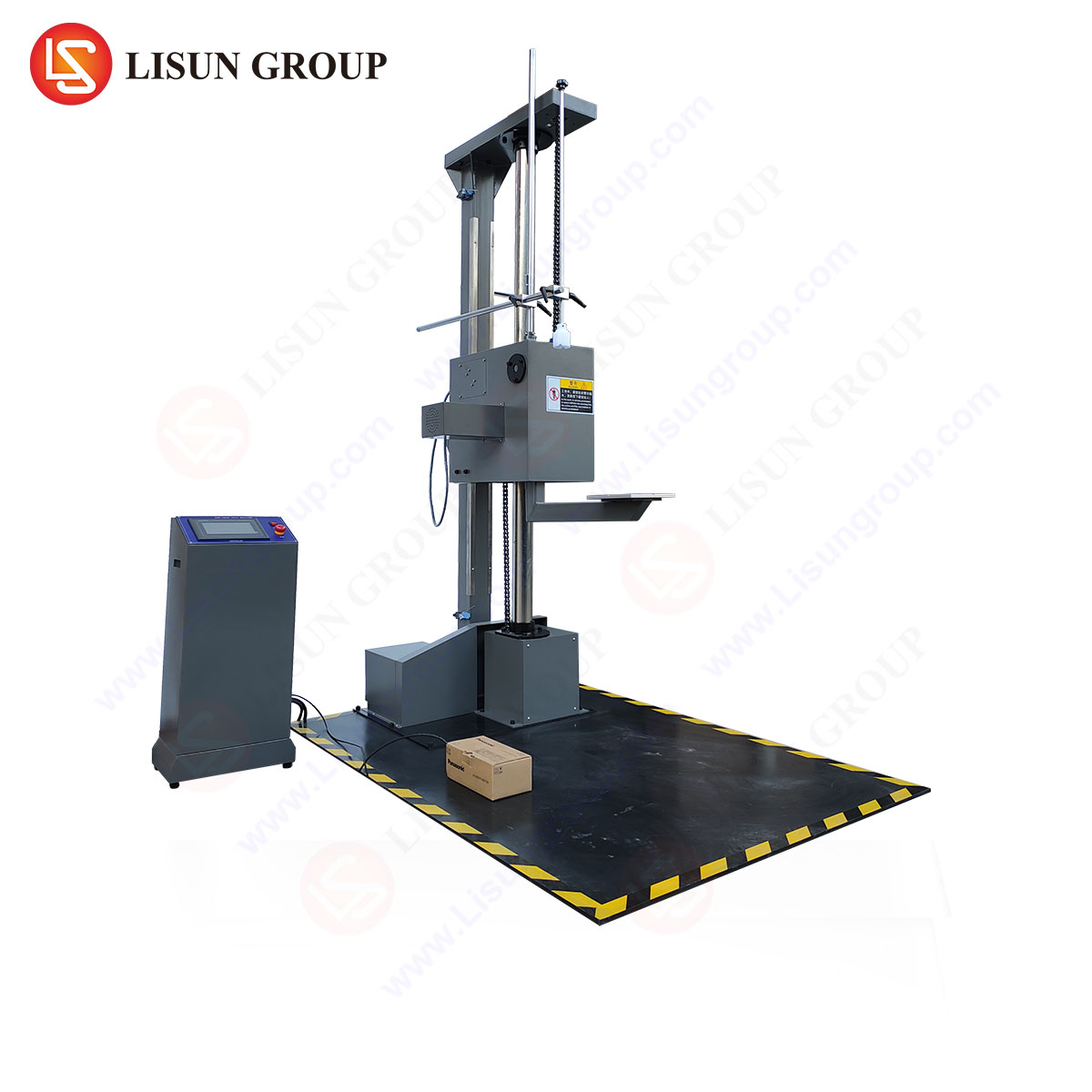
The fidelity and repeatability of ASTM D5276 testing are intrinsically linked to the precision of the equipment employed. Manual drop methods introduce unacceptable variability. Electromechanical drop testers, such as the LISUN DT-60KG Drop Tester, are engineered to deliver the high degree of control and consistency demanded by the standard.
The LISUN DT-60KG is a monorail-guided free-fall drop tester with a maximum load capacity of 60 kilograms. Its design incorporates a dual-column structure with precision-machined guide rails to ensure a truly vertical, friction-minimized descent without rotation or wobble. The release mechanism is a critical component; the DT-60KG utilizes an electromagnetic or pneumatic release system that disengages instantaneously and cleanly, satisfying the standard’s requirement for a non-influential release. The impact base is a solid steel plate mounted on a massive concrete block, fulfilling the “rigid surface” specification.
Specifications and Testing Principles of the DT-60KG:
- Load Capacity: 60 kg (132 lbs).
- Drop Height Adjustment: Typically ranging from 300mm to 1500mm, adjustable via a motorized or manual hoist with a digital height readout, ensuring accurate and repeatable height setting.
- Test Platform: A large, rigid plate that can accommodate palletized loads or large individual containers.
- Mecanismo de Liberação: Electromagnetic, ensuring a sudden, unbiased release.
- Caraterísticas de segurança: Include protective cages, emergency stop buttons, and electrical interlocks to protect the operator.
- Data Acquisition Compatibility: The unit is often outfitted with mounting points for an optional accelerometer (piezoelectric or MEMS-based) and data logger system. This allows for the capture of shock pulses, with software calculating peak acceleration, velocity change, and pulse waveform.
The competitive advantages of such a system in executing ASTM D5276 are multifold. First, it guarantees procedural compliance, eliminating human error in drop height measurement and release technique. Second, its repeatability allows for direct A/B comparison between different packaging designs. Third, when integrated with accelerometry, it transitions the test from a pass/fail checklist to a diagnostic engineering tool. For an Componentes eléctricos manufacturer testing switches and sockets, quantifying the G-force transmitted through the package informs cushioning material selection. An Office Equipment producer can correlate specific shock pulses with hard disk drive failure in all-in-one printers.
Interpretation of Results and Correlation to Real-World Performance
The outcome of an ASTM D5276 test series is not merely a binary determination of “passed” or “failed.” The standard provides a structured methodology for failure analysis. Acceptance criteria are typically established by the product manufacturer or relevant regulatory body and may include: no rupture of the exterior container, no compromise of the product’s cosmetic surfaces, and full retention of product functionality.
Para Cable and Wiring Systems, functional testing post-drop may involve continuity checks and insulation resistance tests. A Household Appliance like a coffee maker would be inspected for casing cracks and then operated to ensure heating and pumping functions remain unaffected. The real value lies in failure mode analysis. If a drop on a corner causes a Medical Device’s housing latch to fracture, the design can be modified or the corner reinforced. This predictive capability reduces the incidence of “no trouble found” returns and enhances brand reputation for durability.
Integration with Broaster Package Testing Regimens
ASTM D5276 is rarely employed in isolation. It is a core element within a broader package testing protocol that may include vibration (ASTM D999), compression (ASTM D642), and atmospheric conditioning (ASTM D4332) tests. A comprehensive testing sequence might involve compression to simulate stacking, followed by vibration for transportation stresses, culminating in a drop test to replicate the final handling shock. This integrated approach provides a holistic assessment of the distribution package’s performance throughout the entire supply chain.
Conclusion: The Role of Standardized Drop Testing in Product Assurance
In conclusion, ASTM D5276 establishes a critical, non-negotiable benchmark for assessing the robustness of packaged goods against vertical impact. Its rigorous, methodical approach transforms the unpredictable event of a drop into a controlled laboratory experiment, yielding actionable data for design improvement. The deployment of precision instrumentation, exemplified by systems like the LISUN DT-60KG Drop Tester, elevates the execution of this standard from a qualitative check to a quantitative science. For industries ranging from Aeroespacial e aviação to Eletrónica de consumo, adherence to this methodology is a fundamental component of risk mitigation, quality assurance, and ultimately, the delivery of reliable products to the end user.
Secção FAQ
Q1: What is the maximum drop height achievable with the LISUN DT-60KG tester, and how is it calibrated?
The DT-60KG typically offers a drop height range from 300mm to 1500mm, though this can vary by specific model configuration. Calibration involves verifying the height measurement system (e.g., digital encoder or scale) against a traceable standard, such as a calibrated laser distance meter. The release mechanism is also checked to ensure it does not impart any initial velocity or rotation to the test specimen.
Q2: For testing a small, lightweight product like a telecommunications router, is the 60kg capacity of the DT-60KG excessive?
Not necessarily. The test specimen includes the product, all interior packaging, and the shipping container. Furthermore, the capacity allows for testing multiple units in a single master carton, which is a common shipping configuration. The high capacity also provides flexibility for testing a wide range of products within a single lab, from small Componentes eléctricos to larger Industrial Control Systems enclosures.
Q3: Can the DT-60KG be used for corner and edge drops as per ASTM D5276 sequences?
Yes. The tester includes adjustable fixtures or specialized test platform designs that allow the operator to securely position the package in the desired orientation—be it flat on a face, balanced on an edge, or precisely on a corner—prior to release. This ensures accurate and repeatable impact on the designated surface.
Q4: How does the data from an integrated accelerometer help beyond visual inspection after a drop?
Visual inspection only reveals macroscopic damage. An accelerometer mounted on the product or a dummy load inside the package records the precise shock pulse (deceleration vs. time) transmitted through the packaging. This data allows engineers to calculate the shock response spectrum, identify if the pulse exceeds the product’s fragility level, and precisely tune the cushioning material’s thickness and density to attenuate the shock to acceptable levels.
Q5: Is the concrete impact base included with the DT-60KG, and does it meet ASTM D5276 requirements?
The DT-60KG is typically supplied with a heavy-duty steel impact plate mounted on a robust base. To fully comply with ASTM D5276, this base must be installed on, or itself constitute, a mass of concrete or granite meeting the minimum mass and hardness specifications outlined in the standard. Installation instructions will detail the necessary foundation requirements to achieve compliance.

 PT
PT  EN
EN  ES
ES  RU
RU  TR
TR  AR
AR  DE
DE  PL
PL  IT
IT  FR
FR  KO
KO  JA
JA  ID
ID