




Ensuring Cable Safety: A Comprehensive Analysis of Fire Performance Testing and Compliance
The proliferation of electrical and electronic systems across modern industries has rendered cable and wiring safety a paramount concern. These components form the circulatory network of everything from household appliances to aerospace avionics, and their failure, particularly under fire conditions, can lead to catastrophic outcomes including system failure, property damage, and life safety hazards. Consequently, rigorous evaluation of a cable’s flame-retardant properties is not merely a regulatory formality but a critical engineering imperative. This article examines the methodologies, standards, and technological apparatus essential for validating cable safety, with a specific focus on the controlled laboratory testing that defines industry compliance.
The Combustion Dynamics of Cable Insulation and Sheathing Materials
Cable construction typically involves polymeric insulation and jacketing materials—such as polyvinyl chloride (PVC), polyethylene (PE), fluoropolymers, and various low-smoke zero-halogen (LSZH) compounds. These materials possess inherent chemical and physical properties that dictate their behavior when exposed to an ignition source. Combustion is a complex exothermic process involving thermal decomposition (pyrolysis) of the polymer, producing volatile flammable gases that mix with atmospheric oxygen and ignite, sustaining the fire through feedback of heat to the fuel source.
The flammability of a cable is influenced by multiple factors: the material’s Limiting Oxygen Index (LOI), its heat release rate, the propensity for flame propagation along its length, and the density and toxicity of emitted smoke. Additives like flame retardants (e.g., aluminum trihydrate, magnesium hydroxide) work through mechanisms such as endothermic decomposition, dilution of flammable gases, or formation of a protective char layer. The efficacy of these formulations must be quantitatively assessed under reproducible conditions to predict real-world performance. Failure to control flame spread in bundled cables, a common scenario in control panels, telecommunications racks, or automotive wire looms, can result in a conflagration that compromises an entire system.
Regulatory Frameworks and International Standards for Flame Retardancy
A global patchwork of standards governs cable fire testing, though harmonization efforts are ongoing. These standards prescribe specific test apparatus, sample preparation, flame application, and pass/fail criteria. Key among them are:
- IEC 60332-1: This standard details a test for a single vertical insulated wire or cable. A defined flame is applied to a vertically mounted sample for a fixed duration. The pass criterion mandates that the burnt portion of the sample does not exceed a specified distance from the lower edge of the top clamp.
- IEC 60332-2: This addresses testing for small, single insulated wires or cables, using a similar but tailored methodology.
- IEC 60332-3: This is a critical series for assessing flame propagation on bunched cables. It simulates realistic installation conditions (e.g., in ladder, tray, or conduit) and subjects vertical bundles of cables to a large propane burner. Categories (e.g., Category A, B, C) define the bundle size and the severity of the test, with criteria evaluating the extent of charred length.
- UL 1581 (VW-1): A widely recognized standard in North America, the Vertical Wire Flame test is similar in principle to IEC 60332-1 but with distinct procedural nuances, including the use of a cotton indicator and specific flame application times.
- Other Regional Standards: Standards like EN 50399, BS, and GB/T also provide stringent frameworks, often incorporating additional measurements for heat release and smoke production.
Compliance with these standards is a non-negotiable requirement for market access across industries. For instance, automotive electronics (governed by ISO 6722) and aerospace components (under FAA regulations or Airbus/ Boeing specifications) demand even more specialized and severe testing protocols.
O RSB-WC Verificador de chama de cabo de aço: Apparatus and Operational Principles
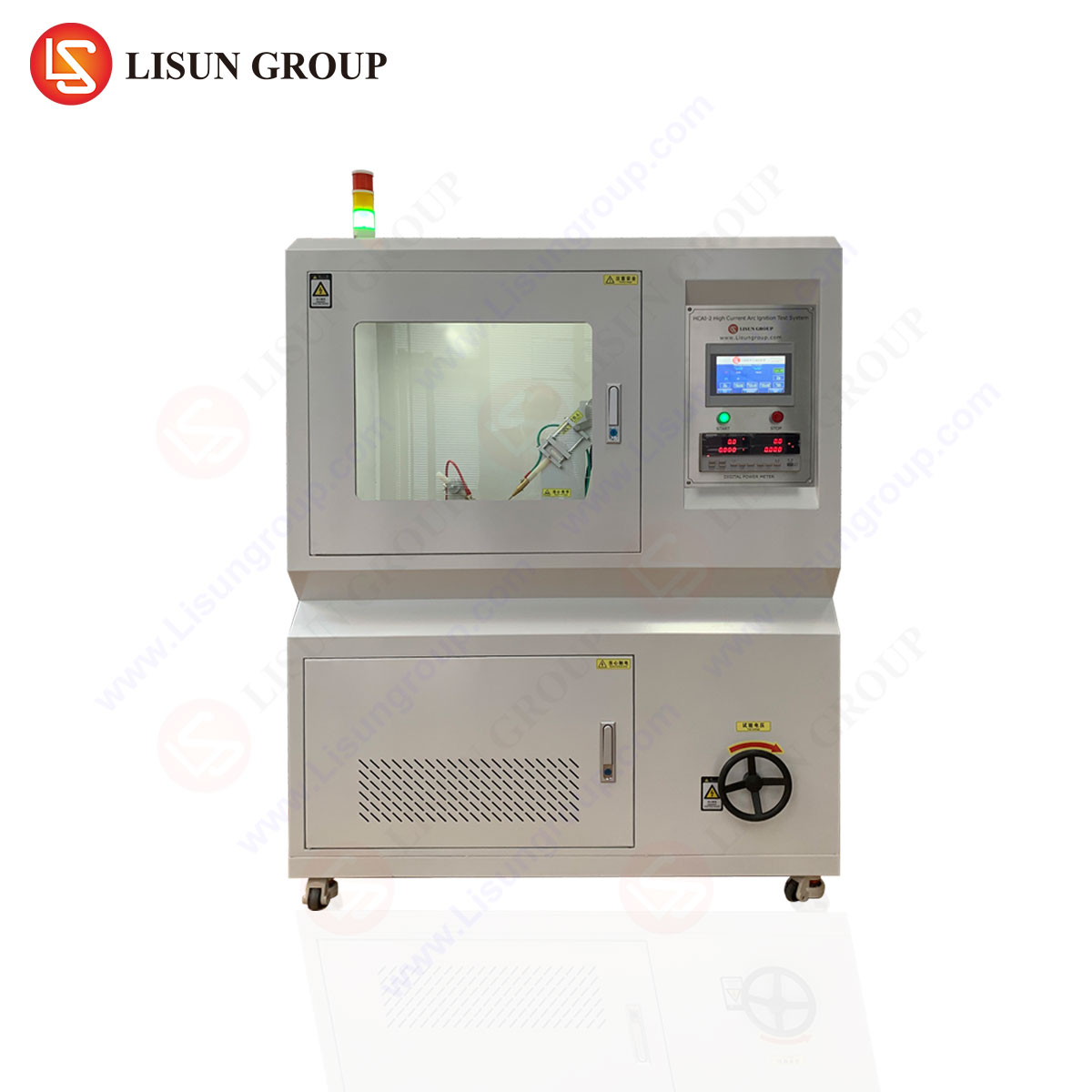
To conduct the tests mandated by standards such as IEC 60332-1 and UL 1581, specialized, calibrated equipment is essential. The LISUN RSB-WC Wire Cable Flame Tester is engineered to meet these exacting requirements. This apparatus provides a controlled, repeatable environment to apply a standardized flame to a cable sample and precisely measure its response.
The core testing principle involves vertically mounting a cable specimen (typically 60-75 cm in length) within a metal chamber. A laboratory-grade methane or propane burner, positioned at a 45-degree angle, delivers a calibrated flame (nominal temperature of approximately 815°C) to the lower portion of the sample for a prescribed period, usually 60 seconds. Following flame removal, the after-flame and after-glow times are automatically recorded. The primary pass/fail criterion is the extent of char damage: the burned portion of the sample must not reach a marker located a specified distance (e.g., 50-125 mm, depending on the standard) above the burner’s top edge.
Key Specifications of the RSB-WC Tester:
- Burner System: Precision 45° angled burner meeting dimensional specifications of relevant standards. Gas flow is regulated via a high-accuracy pressure regulator and flow meter.
- Test Chamber: Constructed from stainless steel and painted steel, featuring a transparent observation window for safe monitoring.
- Sample Mounting: Adjustable clamps to securely hold cables of varying diameters in a true vertical orientation.
- Timing System: Digital automatic timer with accuracy of ±0.1 seconds for controlling flame application and measuring after-flame/glow.
- Caraterísticas de segurança: Integrated gas leak detection, automatic gas shut-off, and robust chamber construction.
- Conformidade: Designed to satisfy IEC 60332-1-2, IEC 60332-2-2, BS, GB/T 18380.1, and UL 1581 (VW-1) test requirements.
Competitive Advantages in Industrial Application:
The RSB-WC system distinguishes itself through several engineering features. Its calibration stability ensures long-term reproducibility of results, a critical factor for quality assurance laboratories. The integration of high-precision timing and gas flow controls minimizes operator-induced variables, enhancing the reliability of compliance data. Furthermore, its robust construction and safety interlocks make it suitable for high-throughput testing environments common in cable manufacturing plants and third-party certification labs.
Industry-Specific Use Cases and Material Validation
The application of vertical flame testing is ubiquitous across sectors where electrical integrity and fire safety intersect.
- Electrical Components & Wiring Systems: This is the primary domain. Manufacturers of building wire, data cables, and coaxial cables use the RSB-WC to certify products to national and international building codes.
- Household Appliances & Consumer Electronics: Internal wiring harnesses in washing machines, refrigerators, and televisions must resist ignition from potential internal faults. Testing ensures that a failure in one component does not propagate via its wiring.
- Eletrónica automóvel: While automotive wiring often undergoes more severe tests (e.g., salt spray, abrasion), flame retardancy for passenger compartment wiring is vital. The RSB-WC provides a baseline qualification for materials.
- Luminárias: The wiring and internal leads within luminaires, especially those operating at high temperatures, are subject to flame tests to prevent fixture-induced fires.
- Industrial Control Systems & Telecommunications Equipment: Control panels and server racks contain dense bundles of signal and power cables. Testing individual cable types with the RSB-WC is the first step before larger-scale bundle testing (IEC 60332-3).
- Medical Devices & Office Equipment: For patient-connected devices or equipment in commercial settings, flame-retardant cables mitigate fire risk from electrical faults.
- Aerospace & Aviation Components: Although subject to more extreme protocols, material screening often involves foundational tests like the vertical flame test to down-select candidate insulation materials.
Interpreting Test Data and Correlating to Real-World Performance
A pass/fail result from a vertical flame test is a binary data point, but sophisticated analysis involves deeper scrutiny. The recorded after-flame time is a direct indicator of a material’s self-extinguishing properties. A shorter after-flame time signifies a more effective flame-retardant formulation. The physical characteristics of the char—its height, integrity, and adhesion—provide qualitative insights into the retardant mechanism. A cohesive, intumescent char layer is typically indicative of a system that will perform well under more demanding conditions.
It is crucial to understand the limitations of the test. The IEC 60332-1 is a small-scale test. It does not evaluate smoke density, toxicity, or corrosivity of combustion gases—factors critically important in confined spaces like aircraft cabins or subway tunnels. Nor does it assess flame spread in large, energized cable bundles. Therefore, it is typically part of a hierarchical testing regimen, not a standalone assessment. However, its value as a cost-effective, rapid, and reproducible quality control and material development tool is immense. It allows formulators to iterate on compound recipes and gives procurement engineers a verified baseline for component selection.
Methodological Rigor and the Elimination of Test Artifacts
Achieving consistent, standards-compliant results demands strict adherence to protocol. Sample preparation is paramount: cables must be conditioned at standard atmospheric temperature and humidity (e.g., 23°C ± 2°C, 50% ± 5% RH) for a minimum period (often 24 hours) prior to testing to eliminate moisture as a variable. The burner must be meticulously calibrated using a thermocouple to ensure the flame temperature is within the specified range. The distance from the burner tip to the sample surface is a critical dimension and must be verified before each test series.
Even subtle deviations can introduce artifacts. An uncalibrated gas flow can produce a flame that is too oxidizing or too fuel-rich, altering the heat flux to the sample. Improper vertical alignment can cause uneven flame impingement. Contamination on the sample surface from handling can affect ignition characteristics. The RSB-WC tester’s design, with its fixed geometry and precision controls, inherently minimizes these operational variances, ensuring that the data generated reflects the material’s properties, not apparatus inconsistency.
The Future Trajectory of Cable Safety Testing
The evolution of cable safety testing is moving towards more holistic assessments. The industry is placing greater emphasis on:
- Fire Scenario Complexity: Tests that better simulate real-fire conditions, such as those involving thermal radiation and forced ventilation.
- Total Fire Hazard Assessment: Concurrent measurement of flame spread, heat release rate (using cone calorimetry principles), smoke opacity, and gas toxicity.
- Material Sustainability: Developing flame-retardant systems that are effective yet environmentally benign, requiring new test methods to validate their performance.
While advanced tests emerge, the fundamental vertical flame test, as executed by apparatus like the RSB-WC, will remain a cornerstone of material qualification. Its simplicity, speed, and direct correlation to a material’s inherent resistance to ignition ensure its enduring role in the safety ecosystem. For engineers and specifiers across the electrical, electronic, and manufacturing industries, understanding and utilizing this foundational test is the first critical step in designing systems where cable safety is assured.
Secção FAQ
Q1: What is the fundamental difference between the IEC 60332-1 and UL 1581 (VW-1) tests performed on the RSB-WC?
While both tests assess the vertical flame propagation of a single insulated wire or cable, procedural differences exist. Key distinctions include the type of burner, the exact flame application time (60 seconds for IEC, repeated 15-second applications for VW-1), the use of a cotton indicator pad in VW-1 to catch molten drips, and slightly different criteria for char length. The RSB-WC is configurable to meet the specific mechanical and procedural requirements of both standards.
Q2: Can the RSB-WC tester be used for very large-diameter cables or small-gauge wires?
The apparatus is designed for the sample dimensions specified in the relevant standards, typically covering a wide range of common cable diameters. For very large power cables, the test method itself (IEC 60332-1) may not be applicable; such cables are usually evaluated under the bunched cable test (IEC 60332-3). For extremely fine wires, proper clamping and alignment are crucial, which the adjustable fixtures of the RSB-WC facilitate. The applicable standard should always be consulted for explicit dimensional limits.
Q3: How often should the burner and gas flow system on the RSB-WC be calibrated?
Calibration frequency depends on usage intensity and quality assurance protocols. As a best practice, a full calibration—verifying flame temperature using a calibrated thermocouple and checking gas flow rates—should be performed at least annually. For high-volume testing laboratories, quarterly or even monthly verification checks are recommended. Calibration should also be performed after any maintenance on the gas delivery system or if the gas source is changed.
Q4: Why is sample conditioning so important prior to testing?
Polymeric materials can absorb moisture from the atmosphere, which can significantly alter their burning characteristics. Water can act as a heat sink, delaying ignition, or it can vaporize and potentially affect flame stability. Conditioning samples in a standard atmosphere (e.g., 23°C/50% RH) ensures all samples are in a consistent moisture equilibrium, eliminating this variable and ensuring test results are reproducible and comparable across different batches or laboratories.
Q5: Does a passing result on the IEC 60332-1 test guarantee the cable is safe for use in a plenum air handling space?
No, it does not. Plenum-rated cables are required to have significantly higher fire performance, including very low flame spread and smoke production. They are tested under entirely different and more severe conditions, such as the Steiner Tunnel test (UL 910 / NFPA 262). The vertical flame test is a baseline requirement; specialized environments like plenums, risers, or hazardous locations require cables tested and certified for those specific applications.

 PT
PT  EN
EN  ES
ES  RU
RU  TR
TR  AR
AR  DE
DE  PL
PL  IT
IT  FR
FR  KO
KO  JA
JA  ID
ID