




Hot Wire Test Explained: Principles and Applications in Electrical Safety Compliance
Introduction to Thermal Stress Evaluation in Electrical Insulation
The integrity of electrical insulation under sustained thermal stress constitutes a fundamental pillar of product safety and reliability. Among the suite of tests designed to evaluate this characteristic, the Hot Wire Test, formally standardized as the Glow-Wire Test in the IEC 60695-2 series, serves as a critical assessment. This test simulates thermal stresses that may result from overloaded or glowing connections, malfunctioning components, or other heat sources that insulation materials might encounter in service. The objective is not to replicate a specific real-world scenario precisely, but to provide a reproducible, severe thermal challenge that evaluates the material’s resistance to ignition and its ability to limit flame propagation. This article delineates the underlying principles, procedural methodology, applicable standards, and practical implementation of the Hot Wire Test, with particular emphasis on its role across diverse industries and the instrumentation required for its execution.
Fundamental Principles of the Glow-Wire Simulation
The core principle of the Hot Wire Test is the application of a specified thermal energy input to a test specimen via a resistively heated element, the “glow-wire,” shaped to a prescribed geometry. The test apparatus heats the wire, typically composed of a nickel/chromium (Ni/Cr) alloy, to a precisely controlled temperature, which can range from 550°C to 960°C depending on the required severity level. This heated wire is then pressed against the test specimen with a defined force for a set duration, usually 30 seconds.
The interaction initiates a complex thermal transfer process. The material under test absorbs heat through conduction and radiation, leading to pyrolysis—the thermal decomposition of the insulating material. This pyrolysis releases volatile combustible gases. The test evaluates two primary failure modes: ignition e flame persistence. Ignition occurs if the pyrolyzed gases mix with ambient air at a sufficient temperature to sustain combustion, either via a pilot flame (in some test variants) or auto-ignition. The test further assesses whether any resulting flames extinguish within a specified time after removal of the glow-wire and whether dripping particles ignite a underlying tissue paper layer, indicating a secondary fire hazard.
The temperature of the glow-wire is the key independent variable. It is calibrated not by direct contact measurement during the test, but through a prior calibration procedure using a reference solder alloy with a known melting point, ensuring traceability and repeatability. This method accounts for heat losses and ensures the applied thermal insult is consistent across laboratories and testing cycles.
Standardization Framework and Severity Classifications
The Hot Wire Test is governed by an extensive international standardization framework, primarily the IEC 60695-2 series, which is harmonized with other regional standards such as UL 746A and GB/T 5169.10-2017. These standards define not only the apparatus and procedure but also the Glow-Wire Flammability Index (GWFI) and the Glow-Wire Ignition Temperature (GWIT).
O GWFI is the highest temperature at which a material, of a specified thickness, does not ignite or, if it does ignite, extinguishes within 30 seconds after removal of the glow-wire and does not ignite the tissue paper. It is expressed as a temperature (e.g., 850°C). Conversely, the GWIT is the temperature 25°C above the maximum test temperature at which the material does not ignite, with ignition defined as a flame persisting for longer than 5 seconds. The GWIT, therefore, represents a margin of safety against ignition.
Severity levels are stratified by the glow-wire application temperature. Common benchmark temperatures include 550°C, 650°C, 750°C, 850°C, and 960°C. The selection of the appropriate test temperature is dictated by the end-product standard. For instance, IEC 60335-1 for household appliances often mandates a 750°C or 850°C test for parts that may carry fault currents, while IEC 60950-1 for IT equipment (now superseded but illustrative) specified 550°C, 650°C, 750°C, or 850°C depending on the current-carrying capacity and function of the part.
Apparatus Specification and Critical Instrumentation
Accurate and reliable test execution demands instrumentation that exceeds mere functional compliance. The apparatus must ensure precise control, stability, and measurement integrity. Key subsystems include:
- Glow-Wire Assembly: A U-shaped heating element of specific dimensions (typically 4mm nominal diameter), mounted on a carrier.
- Temperature Control and Measurement System: A thermocouple (Type K, NiCr/NiAl) spot-welded to the surface of the glow-wire, connected to a closed-loop PID controller capable of maintaining the set temperature within ± 10°C.
- Mechanical Application Unit: A device to apply the heated glow-wire to the specimen with a reproducible force of 1.0 N ± 0.2 N, with a precision stop mechanism for the 30±1s application time.
- Specimen Holder & Drip Tray: A standardized platform to hold flat specimens, with a provision for placing a tissue paper layer 200mm below to catch potentially incendiary droplets.
- Calibration Jig: A dedicated setup for verifying the actual wire temperature using standardized solder pellets.
The performance of these subsystems directly influences test reproducibility. Inconsistent force application, thermal lag in the control loop, or improper thermocouple attachment can yield divergent results, compromising safety assessments and leading to costly product requalification.
The RSY-LT Hot Wire Ignition Tester: Engineered for Precision and Compliance
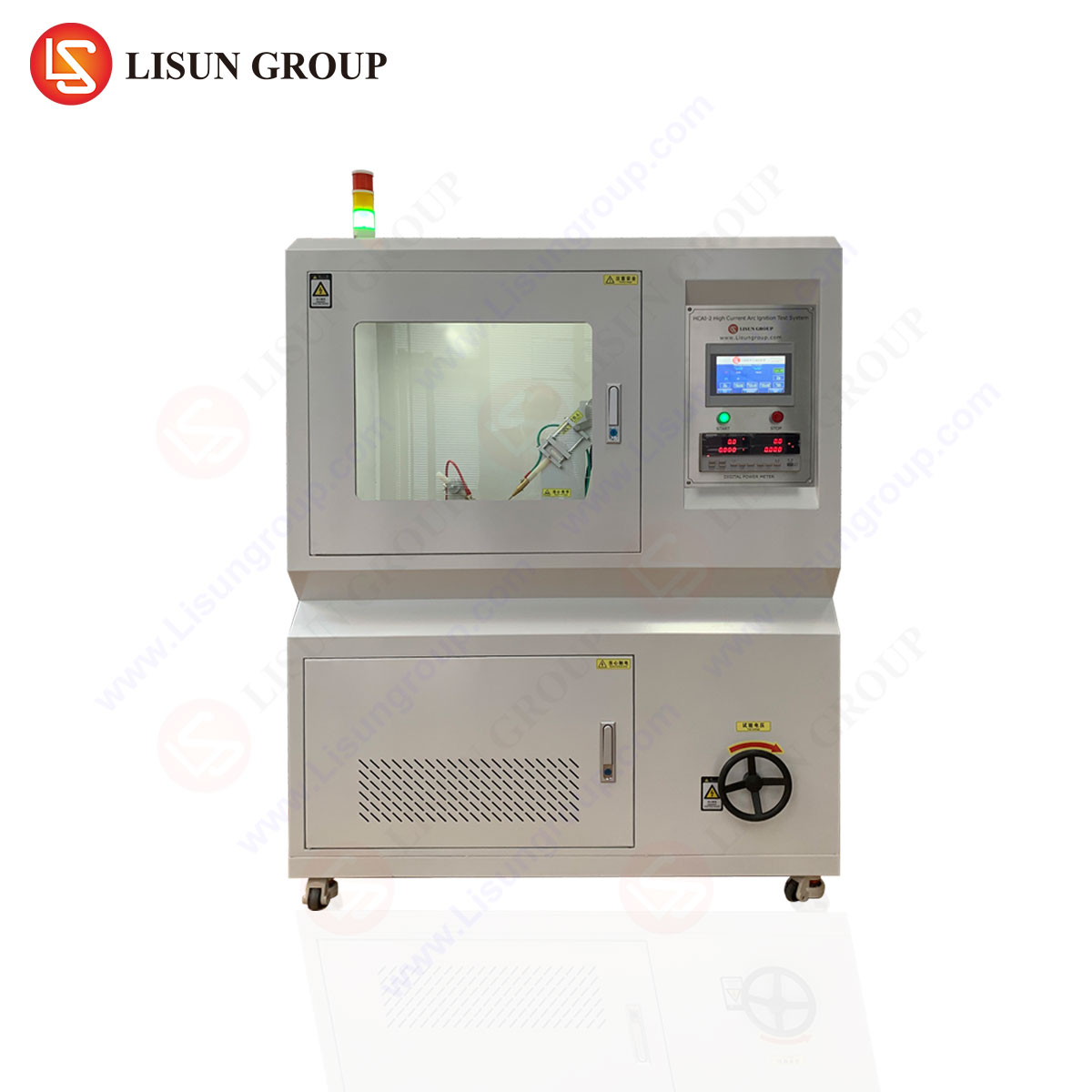
O LISUN RSY-LT Hot Wire Ignition Tester embodies the engineering rigor required for definitive compliance testing. Designed to meet and exceed the specifications outlined in IEC 60695-2-10, -11, -12, -13, UL 746A, and analogous standards, it integrates high-fidelity control systems with a robust mechanical framework.
Core Specifications and Design Principles:
- Gama de temperaturas: 50°C to 1000°C, with a resolution of 1°C, covering all standard severity levels and allowing for margin testing.
- Control Accuracy: Advanced PID controller with auto-tuning function ensures stability within ± 2°C of setpoint during the critical pre-heat and application phases, far tighter than the standard’s ± 10°C requirement.
- Application Force: A calibrated weight-and-lever system provides the mandated 1.0N force, with a precision-machined stop to guarantee the 30-second application time.
- Calibration Verification: The unit includes an integrated calibration station, simplifying the mandatory periodic verification of the glow-wire temperature profile using standardized tin (Sn) solder pellets (melting point 232°C).
- Safety & Observation: A transparent polycarbonate viewing shield protects the operator while allowing unobstructed observation of the test. An integrated fume extraction port allows for connection to external ventilation, maintaining laboratory air quality.
Competitive Advantages in Industrial Application:
The RSY-LT’s advantages are realized in daily laboratory operations. Its superior temperature stability minimizes false failures or passes due to thermal drift. The intuitive human-machine interface (HMI) allows for programmable test sequences, storing multiple temperature profiles for different product lines, which is invaluable for laboratories serving multiple industries such as Eletrónica automóvel (testing connector housings per ISO 20653) and Dispositivos médicos (validating enclosure materials per IEC 60601-1). The robust construction of the application mechanism ensures long-term repeatability, a critical factor for quality assurance departments in Componentes eléctricos manufacturing, where batch-to-batch consistency of switch and socket materials must be verified.
Cross-Industry Application Scenarios and Material Evaluation
The Hot Wire Test is a ubiquitous requirement across sectors where electrical insulation and structural polymers are used.
- Household Appliances & Electrical and Electronic Equipment: For motor housings, connector blocks, switchgear enclosures, and internal supports in products like washing machines, air conditioners, and power strips. A failure could lead to internal fire propagation.
- Eletrónica automóvel: Testing components like fuse box housings, sensor connectors, and control module casings, where under-hood temperatures and potential electrical faults pose a significant thermal risk.
- Luminárias: Evaluating plastic components in luminaires, especially LED drivers and lamp holders, where sustained operation and potential fault conditions generate heat.
- Telecommunications Equipment & Industrial Control Systems: Assessing chassis, circuit board mounts, and terminal blocks in servers, routers, and PLCs installed in unmanned or critical infrastructure locations.
- Componentes aeroespaciais e de aviação: While often subject to more stringent smoke and toxicity tests, the glow-wire principle is applied to evaluate interior materials and electrical component housings for resistance to localized overheating.
- Cable and Wiring Systems: Used for testing cable ties, clips, and conduit materials that must not propagate flame from a localized hot source.
In each case, the test is performed on end-product parts or on standardized plaques of the material. The results, expressed as GWFI or GWIT, are then used by design engineers to select appropriate materials and by certification bodies (UL, TÜV, Intertek) to grant safety marks.
Interpretation of Test Results and Failure Analysis
A “pass” or “fail” determination follows a strict observational protocol. Technicians monitor for:
- Ignition: Sustained flaming of the specimen during glow-wire application.
- Duration of Flaming: Whether any flames extinguish within 30 seconds after glow-wire removal.
- Incendiary Droplets: Whether any molten material drips and ignites the tissue paper.
A failure typically triggers a root-cause analysis. This may involve material science investigation: was the polymer formulation sub-optimal? Were flame retardants improperly compounded or degraded during molding? Alternatively, an engineering analysis may be required: is the part geometry too thin, concentrating thermal stress? Does the design place the material too close to a known heat source in the final assembly? The precision of the tester, such as the RSY-LT, is crucial here, as it eliminates apparatus variability from the fault diagnosis equation, allowing the investigation to focus solely on material or design factors.
Integration within a Broader Fire Hazard Assessment Protocol
It is imperative to contextualize the Hot Wire Test as one instrument in a broader orchestra of fire hazard evaluations. It specifically addresses the hazard of glowing or overheated electrical parts. It is complementary to, but distinct from, tests evaluating resistance to flaming sources (e.g., needle-flame test), current overload (e.g., high-current arc ignition test), or bulk material flammability (e.g., UL94 vertical/horizontal burn). A comprehensive safety certification for a complex product, such as an industrial variable frequency drive or a medical imaging device, will strategically employ a combination of these tests, each selected based on a hazard-based risk assessment as mandated by modern safety standards.
Conclusão
The Hot Wire Test remains a cornerstone of electrical safety evaluation, providing a severe, standardized, and reproducible assessment of a material’s response to localized thermal stress. Its principles are rooted in simulating a credible, high-severity fault condition. As material technology advances and product designs become more compact and power-dense, the test’s relevance endures. The reliability of the results, however, is fundamentally dependent on the precision, stability, and compliance of the test apparatus. Implementing a rigorously engineered system, such as the LISUN RSY-LT Hot Wire Ignition Tester, is not merely a matter of regulatory compliance but a critical investment in product safety, reliability, and brand integrity across the global electronics supply chain.
Perguntas frequentes (FAQ)
Q1: What is the practical difference between GWFI and GWIT, and how should a design engineer use them?
GWFI indicates a material’s performance during and immediately after a thermal insult, assessing if it creates a fire hazard. GWIT provides a safety margin against ignition itself. A design engineer typically uses GWFI for compliance checks against a product standard’s mandatory temperature (e.g., “must withstand 750°C”). GWIT is more often used for material selection and comparison in early design stages, choosing a material with a GWIT significantly higher than the expected maximum service temperature of the component.
Q2: Why is the calibration of the glow-wire tester performed with solder pellets instead of directly measuring the wire temperature during the test?
Direct measurement during the test is impractical as the thermocouple would interfere with the specimen contact. The solder pellet calibration method accounts for the thermal mass and heat loss characteristics of the entire glow-wire assembly. By determining the controller setpoint needed to melt a standard pellet (with a known melting point like 232°C for tin), a calibration curve is established. This ensures the actual wire temperature at the point of contact is known and reproducible, which is the critical parameter.
Q3: For the RSY-LT tester, how often should calibration and verification be performed, and what does the process entail?
Per IEC 60695-2-10, verification should be performed before each test series, whenever the glow-wire is replaced, and at least every 500 tests. The process involves using the integrated calibration station. A solder pellet is placed on a specified area of the wire. The controller is set to a temperature expected to melt the pellet. The test is run, and the setpoint is adjusted until the melting point is precisely achieved. This validated setpoint is then used for subsequent tests at that target temperature.
Q4: Can the Hot Wire Test be performed on finished products, or only on material plaques?
It can be performed on both. Standards prescribe testing on “end-product” or “end-product parts” wherever possible, as this accounts for real-world factors like wall thickness, geometry, and molding stresses. However, for material qualification and supplier quality control, tests are often conducted on standardized flat plaques (e.g., 60mm x 60mm, with various thicknesses). The results from plaques may not directly translate to a complex molded part, so critical components are often tested in their final form.
Q5: In industries like aerospace or medical devices, are there modifications to the standard Hot Wire Test?
While the core principle is often referenced, these high-reliability industries frequently impose supplementary or more stringent requirements. Aerospace standards (e.g., from FAA or EUROCAE) may mandate the test in conjunction with extreme altitude simulation or require specific flame persistence times shorter than 30 seconds. Medical device standards (IEC 60601-1) may specify the test for particular parts and often require documentation of the test setup and results to be included in the rigorous risk management file. The flexibility of testers like the RSY-LT to accommodate programmable parameters is essential for these applications.

 PT
PT  EN
EN  ES
ES  RU
RU  TR
TR  AR
AR  DE
DE  PL
PL  IT
IT  FR
FR  KO
KO  JA
JA  ID
ID