





Generate Turbidity and Haze: A Technical Guide to Distinct Light Scattering Phenomena
Introduction: The Critical Role of Optical Clarity in Material Science
Within the manufacturing and quality assurance sectors of advanced industries, the quantification of light interaction with materials transcends mere aesthetic assessment. Two distinct yet often conflated phenomena—turbidity and haze—serve as critical indicators of material purity, structural integrity, and functional performance. Precise measurement of these parameters is non-negotiable for components where optical clarity, diffusion properties, or internal contamination can directly impact safety, efficiency, and reliability. This technical treatise delineates the fundamental physics underlying these scattering events, their divergent implications across specialized industrial applications, and the methodologies required for their accurate, standards-compliant characterization.
Fundamental Physics: Differentiating Scattering Mechanisms
Turbidity and haze both describe the attenuation of transmitted light due to scattering, yet they originate from different physical mechanisms and are quantified over distinct angular ranges. Turbidity is a measure of the total light scattering caused by suspended particulates or inhomogeneities within a bulk medium, such as a liquid or solid polymer. It is intrinsically linked to the concentration and size distribution of scattering centers. The scientific principle is governed by the Beer-Lambert law, where the intensity of transmitted light decreases exponentially with path length and the concentration of scatterers. High turbidity indicates significant light loss due to forward, lateral, and backward scattering, often signaling contamination, incomplete polymerization, or phase separation.
Haze, conversely, is a specific optical attribute defined as the percentage of transmitted light that deviates from the incident beam by more than 2.5 degrees. It quantifies wide-angle scattering, which produces a cloudy or milky appearance—a loss of contrast and transparency—while still allowing a substantial portion of light to pass directly through. This phenomenon is predominantly a surface or near-surface effect in transparent and translucent materials, arising from microscopic imperfections, surface roughness, or embedded microstructures designed for light diffusion. The critical distinction lies in the angular integration: turbidity accounts for total scatter, whereas haze specifically quantifies wide-angle scatter, making them complementary but non-interchangeable metrics.
Industrial Implications: Where Clarity Dictates Performance
The ramifications of uncontrolled turbidity and haze extend across a spectrum of high-technology sectors. In Dispositivos médicos, such as intravenous fluid bags or optical diagnostic cuvettes, elevated turbidity can indicate particulate contamination, posing direct patient risks and violating pharmacopeial standards like USP . For Eletrónica automóvel e Componentes para o sector aeroespacial e da aviação, polymer encapsulants and cockpit display covers must exhibit minimal haze to ensure legibility under varied lighting conditions, while specific, controlled haze may be engineered into interior lighting diffusers to prevent glare.
Within Luminárias e Eletrónica de consumo, the management of haze is paramount. A display lens with excessive, uncontrolled haze will degrade image sharpness and color fidelity, whereas a backlight guide plate may require a precise, uniform haze value to ensure even illumination. In Componentes eléctricos like optocouplers or transparent sensor housings, internal turbidity from impurities can attenuate signal transmission, leading to device failure. For Cable and Wiring Systems, the clarity of insulating materials can be an indicator of crystalline structure and degradation, while in Equipamento de telecomunicações, the performance of optical connectors is severely compromised by scattering losses at interfaces.
Metrological Standards and Compliance Frameworks
Accurate, reproducible measurement necessitates adherence to established international standards, which define apparatus geometry, calibration protocols, and calculation methods. Key standards include:
- ASTM D1003 / ISO 14782: Standard Test Method for Haze and Luminous Transmittance of Transparent Plastics. This is the principal methodology for haze measurement, specifying CIE Standard Illuminant C and the 2.5-degree separation angle.
- ISO 7027: Water Quality — Determination of Turbidity. This standard prescribes nephelometric methods (measuring scattered light at 90 degrees) for fluid analysis, critical for processes involving coolants or hydraulic fluids in Industrial Control Systems.
- ASTM E2387: Standard Practice for Goniometric Optical Scatter Measurements.
Compliance with these standards is not optional for manufacturers supplying global markets; it is a foundational requirement for quality certification and liability mitigation.
Integrated Measurement Solution: The HM-100 Haze and Medidor de Turbidez
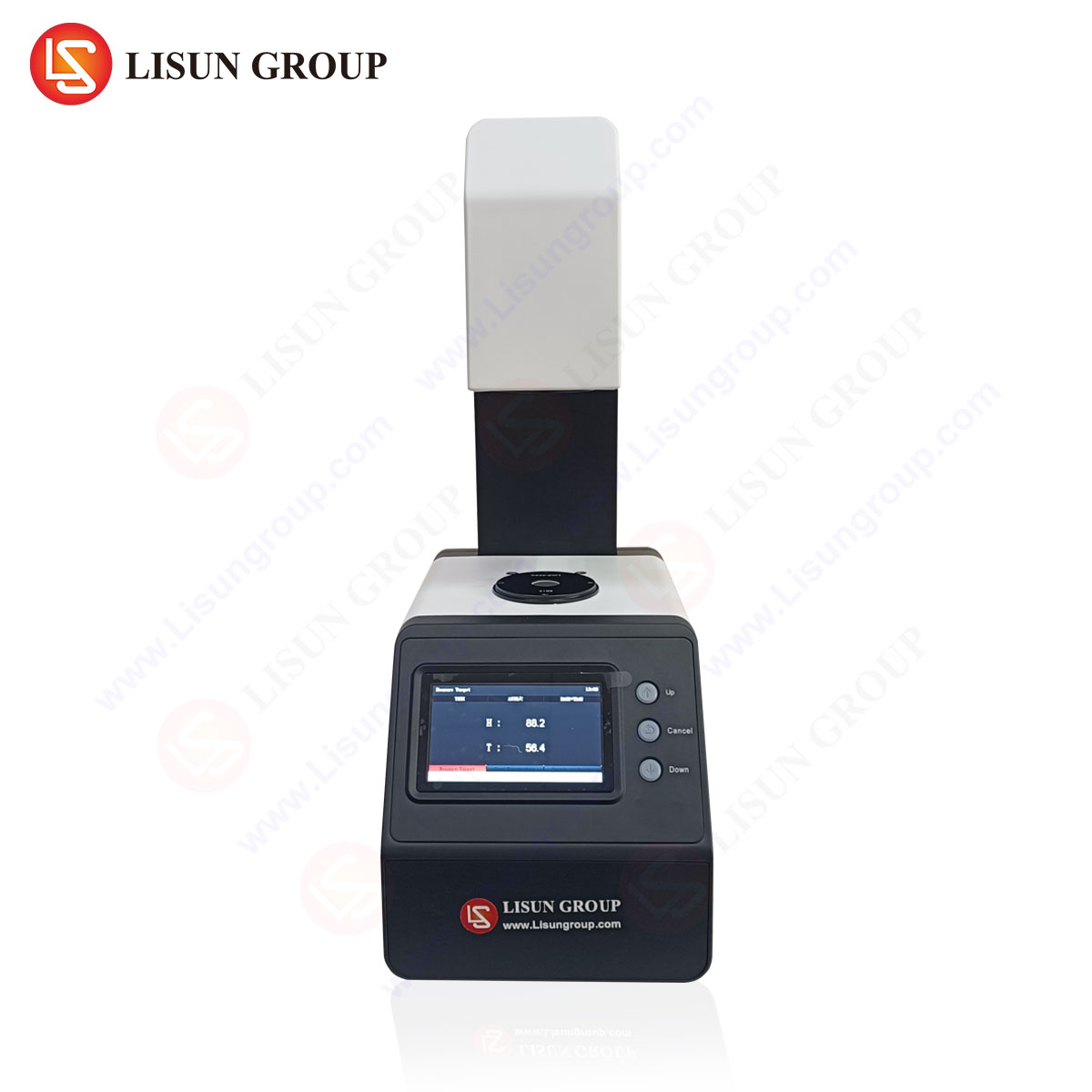
To address the dual requirement for haze and turbidity quantification within a single, precise instrument, the LISUN HM-100 Medidor de névoa/Turbidity Meter provides an integrated metrological platform. The device employs a closed optical path system with an integrating sphere, conforming to the geometry stipulated in ASTM D1003 and ISO 14782. Its design facilitates the simultaneous determination of total transmittance, haze, and, through its operational modes, turbidity values.
The HM-100 operates on the principle of comparative photometry. A light source projects a collimated beam onto the sample. Transmitted light is collected by an integrating sphere; a photodetector first measures the total transmitted light. A light trap is then engaged to exclude the unscattered, direct beam, allowing the detector to measure only the widely scattered light component. Haze is calculated as the ratio of scattered light to total transmitted light, expressed as a percentage. For turbidity measurement, the instrument can be calibrated against standard formazin or other reference suspensions, providing readings in Nephelometric Turbidity Units (NTU) or other relevant scales.
Technical Specifications and Operational Parameters
The HM-100 is characterized by the following key specifications:
- Measurement Parameters: Haze (%), Total Transmittance (%), Turbidity (NTU, ASBC, EBC).
- Light Source and Detector: CIE Standard Illuminant A (2856K) and CIE Standard Illuminant C, with a silicon photodetector.
- Faixa de medição: Haze: 0.01% to 99.99%; Transmittance: 0.01% to 99.99%.
- Repetibilidade: Haze: ≤0.05% (for standard haze values <1%); ≤0.1% (for standard haze values ≥1%).
- Sample Aperture: Configurable for standard specimen sizes.
- Conformidade: Conforms to ASTM D1003, ISO 14782, ISO 7027, and JIS K 7136.
Application-Specific Use Cases Across Target Industries
The utility of the HM-100 is demonstrated in concrete application scenarios:
- Electrical and Electronic Equipment: Verifying the clarity and haze of polycarbonate housings for Industrial Control Systems panels to ensure display readability and operator safety.
- Electrodomésticos: Measuring the haze of transparent detergent dispenser windows or glass-ceramic cooktop surfaces to guarantee a premium visual appearance.
- Eletrónica automóvel: Quantifying turbidity in silicone gel encapsulants for electronic control units (ECUs) to detect moisture ingress or filler agglomeration that could lead to thermal or electrical failure.
- Luminárias: Precisely characterizing the diffusion properties of PMMA or PS lenses for LED fixtures, ensuring uniform light distribution without excessive brightness hotspots.
- Dispositivos médicos: Assessing the turbidity of saline solution in pre-filled syringe assemblies or the haze of polymer blister packs, directly correlating to product purity and package integrity.
- Office Equipment: Evaluating the transparency and haze of scanner platens or projector lenses, where optical distortions directly degrade output quality.
Competitive Advantages in Precision Instrumentation
The HM-100 distinguishes itself through several engineered advantages. Its integrated design eliminates the need for separate haze and turbidity meters, streamlining laboratory workflow and reducing capital expenditure. The high repeatability, particularly at very low haze levels (<1%), is critical for industries like Componentes para o sector aeroespacial e da aviação or high-end Eletrónica de consumo, where material specifications are exceptionally stringent. The instrument’s compliance with multiple international standards ensures that data is defensible for audit and certification purposes across global supply chains. Furthermore, its robust construction and calibration stability provide long-term measurement reliability, reducing downtime and maintenance costs in high-throughput QA/QC environments.
Conclusão
The scientific differentiation between turbidity and haze is not an academic exercise but a practical necessity for modern manufacturing. As material performance requirements escalate across electronics, automotive, medical, and aerospace domains, the ability to precisely quantify these distinct light-scattering phenomena becomes integral to product development, process control, and final quality validation. Employing sophisticated, standards-compliant instrumentation like the HM-100 Haze Meter/Turbidity Meter provides the empirical data required to make informed decisions, mitigate risk, and drive innovation in material transparency and purity.
FAQ
Q1: Can the HM-100 measure both the haze of a solid plastic lens and the turbidity of a liquid coolant with the same instrument?
A1: Yes. The HM-100 is designed as a dual-purpose instrument. For solid samples, it measures haze and total transmittance per ASTM D1003 using a sample holder. For liquids, using an appropriate cuvette, it can measure turbidity in NTU by employing its calibrated turbidity measurement mode, adhering to principles outlined in ISO 7027.
Q2: How critical is the repeatability specification of ≤0.05% for haze in real-world applications?
A2: Extremely critical. In sectors such as Luminárias or high-resolution display manufacturing, batch-to-batch variations in haze of just a few tenths of a percent can lead to perceptible differences in light output uniformity and image clarity. This level of repeatability is necessary for statistical process control (SPC) and for meeting tight engineering tolerances.
Q3: What is the importance of using CIE Standard Illuminants A and C?
A3: Standardized illuminants ensure measurement consistency and comparability of data across different laboratories and instruments. Illuminant C approximates average daylight and is specified in ASTM D1003. The inclusion of Illuminant A (tungsten) provides additional data points that can be useful for materials whose optical properties vary with light source color temperature, relevant for Eletrónica automóvel and interior lighting applications.
Q4: For a material designed to be a diffuser (e.g., in an LED panel light), is a low or high haze value desirable?
A4: A high, but precisely controlled and uniform, haze value is typically desirable for a diffuser. The goal is to maximize wide-angle scattering to eliminate glare and create even illumination. The HM-100 allows manufacturers to quantify this haze value accurately, ensuring consistency across production runs and enabling precise formulation of the diffusing material.

 PT
PT  EN
EN  ES
ES  RU
RU  TR
TR  AR
AR  DE
DE  PL
PL  IT
IT  FR
FR  KO
KO  JA
JA  ID
ID