




Understanding Haze and Transmittance in Material Testing: Fundamental Optical Properties for Modern Industry
Introduction to Optical Clarity Metrics in Material Science
The quantitative assessment of a material’s interaction with visible light constitutes a critical domain of materials characterization, particularly for components where visual interface, safety, or functional performance is paramount. Two intrinsically linked yet distinct optical properties—haze and luminous transmittance—serve as the primary metrics for evaluating the clarity and light-transmitting behavior of transparent and translucent materials. In industrial contexts, these are not merely aesthetic parameters but are rigorously specified to ensure product quality, user experience, and compliance with international standards. Precise measurement of these properties enables engineers and quality control professionals to predict material performance in real-world applications, from the diffuser in a medical display to the polycarbonate lens of an automotive indicator light.
Defining Luminous Transmittance: The Measure of Total Light Transmission
Luminous transmittance (Tt) is defined as the ratio of the total transmitted luminous flux to the incident luminous flux. Expressed as a percentage, it quantifies the total amount of visible light that passes through a material, irrespective of directional change. A material with 90% transmittance allows nine-tenths of the incident light to pass through, with the remaining tenth being absorbed or reflected. This property is fundamental for applications requiring maximum light throughput, such as protective viewing windows on industrial control panels, optical lenses in office equipment scanners, or cover glasses for photovoltaic displays in aerospace cockpits. High transmittance is often correlated with material purity and the absence of light-absorbing impurities or colorants.
The Phenomenon of Haze: Quantifying Light Scattering
In contrast to total transmittance, haze (H) specifically quantifies the percentage of transmitted light that deviates from the incident beam by more than 2.5 degrees due to forward scattering within or on the surface of the material. It is a measure of the milkiness or cloudiness perceived in a nominally transparent specimen. Haze arises from microscopic inhomogeneities—such as surface roughness, internal crystallinity variations, filler particles, density fluctuations, or microscopic voids—that cause diffuse transmission. A clear polycarbonate sheet may exhibit less than 1% haze, while a light-diffusing film for an LED fixture may be engineered to possess 90% haze or higher. Controlling haze is essential for applications ranging from anti-glare displays on consumer electronics to uniform light distribution in automotive tail lamp assemblies.
The Interdependence and Distinction Between Haze and Transmittance
It is a common misconception that haze and transmittance are inversely proportional. While related, they are independent properties. A material can exhibit high transmittance and high haze simultaneously; a pristine frosted glass window transmits most incident light (high Tt) but scatters it broadly (high H), obscuring clear vision. Conversely, a deeply tinted but polished automotive window may have low transmittance due to absorption but very low haze, preserving image clarity for transmitted light. The accurate, separate measurement of both parameters is therefore non-negotiable for comprehensive material specification. Standards such as ASTM D1003 and ISO 14782 provide the definitive test methods for determining these properties using integrated sphere spectrophotometry.
Integrated Sphere Methodology for Conformant Measurement
The principle of measurement for both haze and total luminous transmittance is predicated on the use of a CIE-standard illuminant (typically Illuminant C or D65) and an integrating sphere. This spherical cavity, coated with a highly reflective, diffuse material, collects light transmitted through the sample. The fundamental measurement sequence involves four key steps: first, a baseline measurement with no sample; second, a measurement with the sample placed at the sphere’s entrance port to capture total transmitted light; third, a measurement with a light trap deployed to capture only the narrowly transmitted, non-scattered beam; and fourth, a measurement with the sample removed and the trap deployed to correct for sphere integrity. From these radiometric readings, both total transmittance (Tt) and diffuse transmittance (Td) are computed, with haze derived as (Td / Tt) × 100%.
The HM-100 Medidor de névoa: Engineered for Precision and Compliance
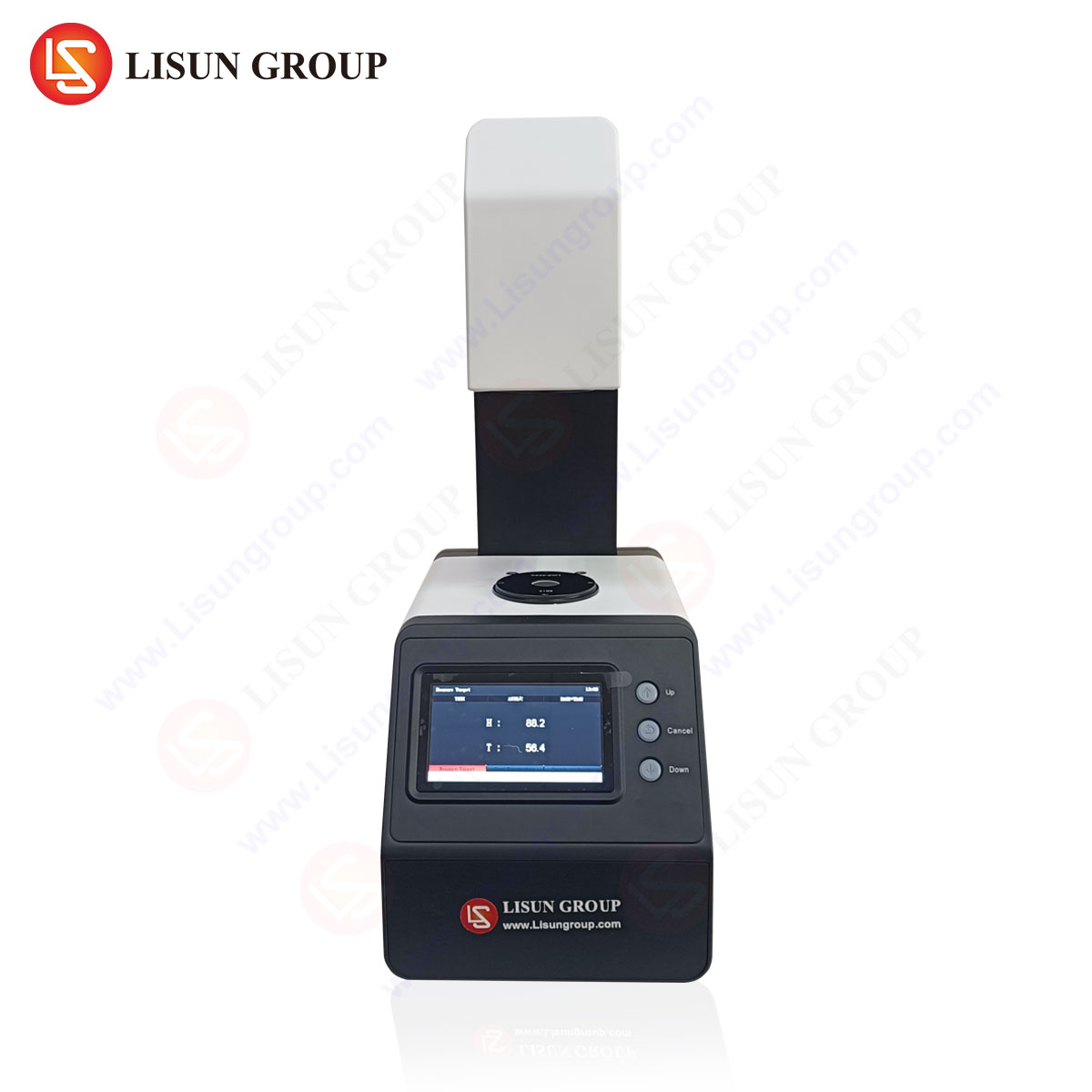
O LISUN HM-100 Haze Meter/Medidor de Turbidez embodies a fully integrated system designed for the exacting requirements of modern material testing laboratories and production quality control stations. Its design and operation are meticulously aligned with the stipulations of ASTM D1003, ISO 14782, and JIS K 7105, ensuring that measurement data is directly comparable across global supply chains. The instrument incorporates a high-stability tungsten halogen lamp, filtered to approximate CIE Illuminant C, and a precision silicon photodetector with spectral response corrected to the CIE standard photopic observer (V(λ) function). This ensures that measurements accurately reflect human visual perception of luminance and haze.
Technical Specifications and Operational Advantages of the HM-100
The HM-100’s architecture provides several distinct advantages for industrial testing environments. Its integrating sphere is constructed from molded barium sulfate, a material chosen for its near-perfect diffuse reflectance and exceptional long-term stability, resisting yellowing or degradation far better than traditional coatings. The instrument features automatic calibration cycles, including zero calibration with a light trap and standard white board calibration, minimizing operator-induced error. Measurement results for Haze (H), Total Transmittance (Tt), and Diffuse Transmittance (Td) are displayed simultaneously on a high-resolution LCD touchscreen with data logging capability for traceability.
Key specifications include a transmittance measurement range of 0-100% with a resolution of 0.01%, and a haze measurement range of 0-100% with a resolution of 0.01%. The repeatability is specified at ≤0.1% for haze and ≤0.5% for transmittance, a critical factor for detecting subtle batch-to-batch variations in polymer resins or coated films. The instrument’s sample port accommodates flat specimens up to 50mm in thickness, with an optional fixture for roll film or liquid samples, enhancing its versatility.
Aplicações específicas do sector e casos de utilização
In the Equipamento elétrico e eletrónico e Eletrónica de consumo sectors, the HM-100 is deployed to test anti-glare and anti-reflective coatings on display panels, touchscreens, and protective windows. Specifying a precise haze value (e.g., 2% ±0.5%) ensures optimal balance between image clarity and reduction of specular reflections. For Luminárias, manufacturers of LED diffuser plates, lenses, and covers rely on haze measurements to engineer light distribution profiles, ensuring uniform luminance without hotspots, critical for both commercial lighting and automotive interior illumination.
Eletrónica automóvel e Componentes para o sector aeroespacial e da aviação utilize the meter to validate materials for interior lens covers, instrument panel displays, and external signal lamps. Polycarbonate or acrylic used in tail lights must meet stringent SAE and ECE regulations for both total transmitted luminous intensity (governed by Tt) and angular dispersion (influenced by H). Similarly, cockpit transparencies and cabin lighting diffusers require precise optical characterization.
Para Dispositivos médicos, clarity of fluid paths in IV sets or sight glasses, and the optical properties of polymer housings for diagnostic displays, are vital. Low haze is often mandated to prevent visual obstruction. In Equipamento de telecomunicações e Industrial Control Systems, the clarity of optical port windows and indicator lenses affects signal integrity and operator safety. The testing of Componentes eléctricos such as transparent switch caps, socket covers, and Cable and Wiring Systems involving clear insulating jackets further demonstrates the meter’s utility across discrete manufacturing domains.
Data-Driven Quality Assurance and Standardization
Implementing a standardized haze and transmittance testing protocol with an instrument like the HM-100 transforms subjective visual inspection into objective, quantifiable data. This facilitates Statistical Process Control (SPC), enabling the detection of process drift in injection molding (due to temperature or pressure variations), extrusion coating, or polymer compounding. The ability to generate certified test reports aligned with international standards is indispensable for supplier qualification and regulatory submissions in highly regulated industries like medical devices and aerospace.
Conclusão
The rigorous quantification of haze and luminous transmittance represents a cornerstone of material qualification for any industry utilizing transparent polymers, glasses, films, or liquids. As product designs increasingly integrate these materials for both functional and aesthetic purposes, the demand for accurate, reliable, and standardized measurement escalates. Advanced instrumentation, designed and built to the principles of integrating sphere photometry and conforming to global test standards, provides the necessary technological foundation for quality assurance, research & development, and compliance across the interconnected landscape of modern manufacturing.
Secção FAQ
Q1: How does the HM-100 compensate for minor surface scratches or dust on a sample?
While the instrument is designed to measure bulk and surface scattering properties, significant surface defects will inherently contribute to the haze reading, which is often the parameter of interest for final product quality. For consistent measurement of bulk material properties only, samples should be clean and optically polished. The HM-100’s measurement integrates all forward-scattered light, making proper sample preparation essential for repeatable results focused on material rather than surface contamination.
Q2: Can the HM-100 measure colored or tinted samples accurately?
Yes. The instrument’s detection system is spectrally corrected to the CIE photopic V(λ) function, meaning it measures luminous transmittance—the transmittance as perceived by the human eye under standard illumination. It accurately reports the total and diffuse transmittance of colored filters, tinted windows, or dyed polymers, providing valid haze calculations regardless of sample color, provided sufficient light is transmitted for a stable measurement.
Q3: What is the difference between haze and turbidity, as both are listed for the HM-100?
While conceptually similar as measures of light scattering, the terms are context-dependent. “Haze” is the standardized term for transparent solids (plastics, glasses), defined by the angular deviation (>2.5°). “Turbidity” typically refers to the cloudiness in liquids, often caused by suspended particles. The HM-100 can be configured with an optional liquid sample holder, applying the same integrating sphere principle to quantify the scattering properties of fluids, useful for testing hydraulic fluids, cleaning solvents, or pharmaceutical solutions.
Q4: How often should the HM-100 be calibrated, and what is required?
Regular calibration is crucial for maintaining metrological traceability. It is recommended to perform a zero calibration (using the built-in light trap) before each testing session or batch of samples. A full calibration using the provided standard reference materials (typically a haze standard and a transmittance standard) should be conducted weekly or monthly, depending on usage frequency and internal quality protocols. Annual calibration by an accredited laboratory is advised for instruments used in certified or regulated testing.
Q5: Is the HM-100 suitable for testing very thin films or coatings?
Yes, but careful sample handling is required. Very thin films (<0.1mm) may require a rigid backing or holder to remain flat at the sample port. The instrument can accurately measure the haze and transmittance of films, coatings on substrates, and laminates. It is critical to note that when measuring a coating on a substrate, the result is for the entire composite structure. For coating properties alone, a differential measurement against an uncoated substrate would be necessary.

 PT
PT  EN
EN  ES
ES  RU
RU  TR
TR  AR
AR  DE
DE  PL
PL  IT
IT  FR
FR  KO
KO  JA
JA  ID
ID