




Evaluating Mechanical Robustness: A Comparative Analysis of IEC 60068-2-31 and ASTM D5276 for Product Reliability Validation
The assurance of product reliability across diverse environmental stresses constitutes a fundamental pillar of modern engineering design and quality assurance. Among these stresses, the mechanical shock incurred from free-fall impacts—whether during transportation, handling, or in-service accidents—poses a significant risk to functional integrity. Two preeminent international standards, IEC 60068-2-31 and ASTM D5276, provide structured methodologies for simulating and assessing a product’s resilience to such shocks. This technical analysis delineates the scope, methodology, and application of these standards, while examining the instrumental role of specialized testing apparatus, such as the LISUN DT-60KG Drop Tester, in executing compliant and repeatable validation procedures.
Defining the Scope: IEC 60068-2-31 “Test Ec: Rough Handling Shocks, Primarily for Equipment-Type Specimens”
IEC 60068-2-31, part of the broader IEC 60068 series of environmental testing standards, is formally titled “Environmental testing – Part 2-31: Tests – Test Ec: Rough handling shocks, primarily for equipment-type specimens.” Its primary objective is to assess the ability of a specimen to withstand the relatively severe shocks encountered during non-repetitive rough handling events. The standard is conceptually oriented towards equipment that may be subjected to manual or mechanical handling processes, such as tipping, knocking, or jolting from platforms.
The methodology prescribed is not a simple, single-orientation ensaio de queda. Instead, it outlines a sequence of shocks applied to the faces and corners of the specimen. A defining characteristic of Test Ec is its use of a swing hammer or a free-fall drop onto a padded surface to impart a shock pulse. The standard specifies key parameters including the number of shocks (typically two per face and per corner), the impact velocity or drop height, and the characteristics of the shock-absorbing material on the impact surface (often chipboard or plywood over a concrete base). The resultant shock pulse is non-sinusoidal and is intended to replicate the complex, high-acceleration, short-duration transients of real-world impacts. Pass/fail criteria are generally based on a post-test visual inspection, dimensional check, and functional performance verification as defined by the relevant product specification.
Methodology of Simulated Transit: ASTM D5276 “Standard Test Method for Drop Test of Loaded Containers by Free Fall”
In contrast, ASTM D5276, “Standard Test Method for Drop Test of Loaded Containers by Free Fall,” is explicitly focused on evaluating the performance of shipping containers, unit loads, or their interior packaging systems. Its domain is the distribution environment. The standard’s philosophy centers on simulating the hazards encountered during manual and mechanical handling within the logistics chain, such as parcels being dropped from conveyors, forklifts, or during truck loading/unloading.
The test procedure involves orienting the test specimen (the packaged product) in a predetermined attitude and releasing it to free-fall onto a rigid, non-resilient, horizontal impact surface, typically a thick steel or concrete plate. The height of drop is determined based on the packaged product’s mass, as outlined in a schedule within the standard, reflecting the principle that heavier items are generally handled from lower heights. The standard meticulously defines the requirements for the release mechanism to ensure no initial rotation or velocity is imparted, guaranteeing a true free-fall impact. Assessment criteria are broader than IEC 60068-2-31, encompassing the integrity of both the container and the product itself. Performance is judged against acceptance criteria which may include container failure, product damage, or the ability of the cushioning material to protect the product from exceeding its fragility level.
Comparative Analysis: Intent, Application, and Resultant Data
A side-by-side examination reveals complementary yet distinct roles for these standards.
| Parâmetro | IEC 60068-2-31 (Test Ec) | ASTM D5276 |
|---|---|---|
| Primary Focus | Robustness of the equipment/product itself to handling shocks. | Performance of the packaging system in protecting the product during distribution. |
| Test Specimen | The product (e.g., a device, component, or bare equipment). | The packaged product (product inside its shipping container). |
| Impact Surface | Padded (e.g., chipboard over concrete) to simulate floors or platforms. | Rigid, non-resilient (steel/concrete) to simulate worst-case floors, truck beds, etc. |
| Pulse Character | Complex, high-acceleration, short-duration shock. | High-g, short-duration half-sine pulse (theoretically). |
| Typical Application | Design validation, product safety, in-use durability. | Packaging design validation, transit qualification. |
| Industry Relevance | Electrical/Electronic Equipment, Automotive Electronics, Medical Devices, Industrial Controls. | All industries, but applied at the shipping unit level. |
The fundamental divergence lies in the unit under test: IEC 60068-2-31 tests the product’s inherent ruggedness, while ASTM D5276 tests the packaging system’s protective efficacy. Consequently, the data generated serves different purposes. IEC test data informs design improvements to chassis, mounts, and internal components. ASTM test data guides the selection of cushioning materials, box construction, and palletizing strategies. A comprehensive reliability strategy for a new medical monitor, for example, would employ IEC 60068-2-31 to harden the device against knocks in a hospital setting, and ASTM D5276 to validate its corrugated and foam packaging for inter-facility shipping.
Instrumentation for Precision: The Role of the Programmable Drop Test Apparatus
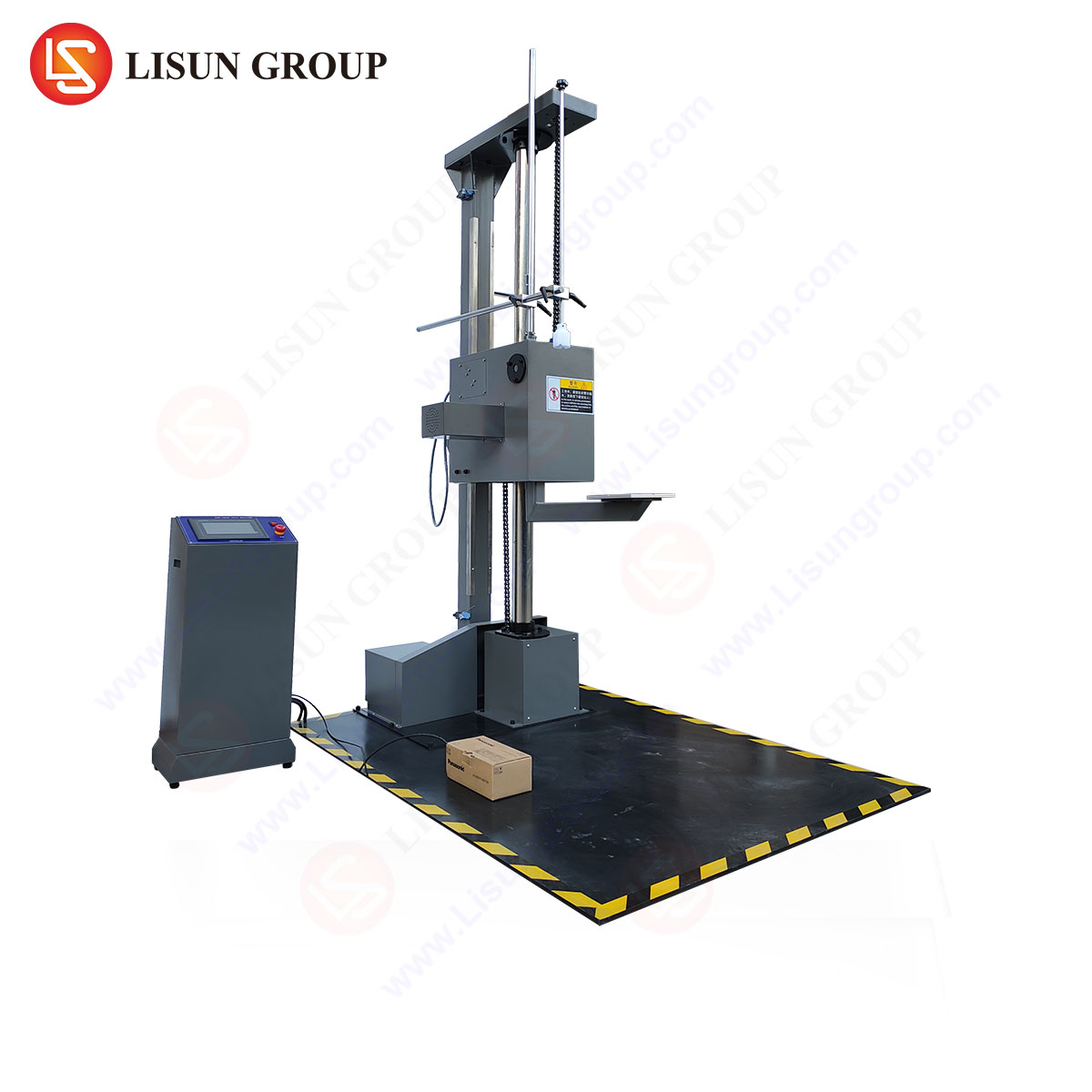
Accurate, repeatable, and compliant execution of both standards necessitates specialized equipment that transcends simple manual dropping. Programmable drop testers provide the controlled environment required. The LISUN DT-60KG Testador de queda exemplifies this category of instrumentation, engineered to facilitate testing per IEC, ASTM, and other related standards (e.g., ISTA, MIL-STD).
The DT-60KG is designed with a dual-column structure and a pneumatically controlled release mechanism to ensure a clean, non-rotational drop as mandated by ASTM D5276. Its key specifications include a maximum test load capacity of 60 kg, a drop height adjustable from 300 to 1500 mm (or higher in custom configurations), and a test platform size of 1000 x 1200 mm. The system is governed by a microcomputer-based controller, allowing for the programmable sequencing of drop angles—faces, edges, and corners—critical for the multi-orientation shock sequence of IEC 60068-2-31. The base is constructed from high-strength steel plate, providing the rigid, non-resilient impact surface required by ASTM D5276, while optional fixtures allow for the installation of standardized padding materials for IEC testing.
Testing Principle and Competitive Advantage: The core principle involves securing the specimen to a lift table, which is then raised to a pre-programmed height. Upon activation, an electromagnetic or pneumatic release disengages instantaneously, allowing the specimen and table to free-fall onto the base with zero initial push or spin. The DT-60KG’s advantages lie in its repeatability, safety (enclosed test area with interlock), and flexibility. Its programmability allows an automotive electronics supplier to run an automated IEC corner-drop sequence on an engine control unit (ECU) sample in the morning, and an ASTM series of flat drops on packaged lighting fixtures in the afternoon, all with precise height control and result logging.
Industry-Specific Application Contexts
The application of these standards and compatible instrumentation spans the breadth of modern manufacturing.
- Electrical Components & Industrial Control Systems: Circuit breakers, contactors, and PLCs are tested per IEC 60068-2-31 to ensure terminal blocks and internal connections do not loosen from handling shocks during installation in panels.
- Telecommunications & Office Equipment: Routers, servers, and multi-function printers undergo IEC testing for robustness. Their shipping cartons, often containing multiple units, are validated using ASTM D5276 to assess palletized load stability.
- Automotive Electronics & Aerospace Components: Sensors, infotainment systems, and avionics black boxes are subjected to severe IEC shock sequences to simulate vibration and impact within the vehicle or aircraft structure, beyond typical shipping stresses.
- Lighting Fixtures & Household Appliances: A LED streetlight fixture or a robotic vacuum cleaner is tested to IEC standards for durability against installation impacts or in-home bumps. Their retail packaging is separately evaluated with ASTM drops to prevent damage during last-mile delivery.
- Medical Devices & Consumer Electronics: A portable dialysis unit must withstand IEC-type handling shocks in clinical environments. A smartphone’s inherent design ruggedness is validated similarly, while its retail box is tested per ASTM protocols.
Integrating Standards into a Cohesive Reliability Engineering Strategy
A sophisticated reliability program does not view these standards in isolation. They are sequential phases in a product’s lifecycle validation. The product’s intrinsic mechanical strength is first verified using IEC 60068-2-31 (or related shock tests like IEC 60068-2-27). Once confirmed, the minimally acceptable product fragility profile is established. This fragility data, often expressed as a product’s ability to withstand a certain g-level, then becomes the input for packaging design. The proposed packaging system is subsequently tested per ASTM D5276, with the product instrumented to measure transmitted shocks, verifying that the packaging attenuates real-world drop forces to levels below the product’s proven fragility.
This integrated approach, supported by precise apparatus like the DT-60KG, enables a closed-loop engineering process. Failure during IEC testing drives product redesign. Failure during ASTM testing drives packaging redesign. The outcome is a product and package system optimized for total lifecycle cost and reliability, reducing warranty returns, field failures, and brand damage due to transit-related incidents.
Perguntas frequentes (FAQ)
Q1: Can the LISUN DT-60KG be used to test both the product itself and its final shipping package?
Yes, the DT-60KG is designed for this dual-purpose application. For testing the product per IEC 60068-2-31, the specimen is mounted directly to the drop table. For testing the packaged product per ASTM D5276, the shipping container is placed on the table. The rigid baseplate satisfies ASTM’s requirement for a non-resilient surface, while optional padding kits can be added to the base or drop table to meet IEC’s specified impact surface conditions.
Q2: How is the appropriate drop height determined for ASTM D5276 testing?
ASTM D5276 provides a guideline schedule correlating the mass of the packaged product to a recommended drop height. For example, a package weighing 20 kg might be dropped from a height of 500 mm. The specific height can also be dictated by distribution environment data, customer agreements, or other standards like ISTA, which uses drop heights based on package weight and shipment type. The programmable controller of the DT-60KG allows these heights to be set and replicated accurately.
Q3: What are the key safety features of a modern drop tester like the DT-60KG?
Critical safety features include a fully enclosed test zone with interlocked safety doors that halt operation if opened, a two-handed start procedure to keep the operator’s hands clear, a mechanical or pneumatic locking system for the lift table during maintenance, and an emergency stop button. The stable dual-column design also prevents tipping during the test of heavy, top-heavy loads.
Q4: For IEC 60068-2-31 testing, how are the “corners” of a specimen defined and tested?
The standard defines a corner as the intersection of three mutually perpendicular faces. The test requires applying shocks to those corners considered most vulnerable. In practice, using a tester like the DT-60KG, this is achieved by securing the specimen to an adjustable fixture on the drop table that can orient the chosen corner to be the point of impact. The sequence typically involves two shocks per selected corner.
Q5: What kind of data output or documentation is generated from these tests?
While the core pass/fail criteria are functional and visual inspection, testing is often documented with a formal report including: test standard used, equipment identification (e.g., DT-60KG Serial #), specimen description and photos, test parameters (orientations, heights, number of drops), pre-test and post-test functional data, and photographs of any damage. Some advanced setups may integrate accelerometers on the specimen or table to record the actual shock pulse for engineering analysis.

 PT
PT  EN
EN  ES
ES  RU
RU  TR
TR  AR
AR  DE
DE  PL
PL  IT
IT  FR
FR  KO
KO  JA
JA  ID
ID