Abstract
The rapid proliferation of Light Emitting Diodes (LEDs) across general lighting, automotive, and display applications has necessitated standardized, high-accuracy methodologies for characterizing their photometric and colorimetric properties. Traditional goniophotometric methods, while authoritative for total luminous flux, are time-intensive and often impractical for high-volume production testing. Integrating sphere spectroradiometry presents a compelling alternative, combining the spatial integration capabilities of a sphere with the spectral resolution of a spectroradiometer. This paper reviews the theoretical principles of this technique, examines its compliance with international standards such as CIE 177 and IES LM-79, and analyzes its practical application in an industrial testing environment. The discussion centers on a dedicated measurement system, the LPCE-2 (LMS-8000), which integrates a spectroradiometer with a calibrated sphere to perform simultaneous light measurement of photometric, colorimetric, and electrical parameters. The analysis demonstrates that such systems provide a fast, repeatable, and standard-compliant solution for LED quality assurance, offering significant advantages in throughput and data comprehensiveness compared to sequential single-parameter methods.
Keywords: light measurement; integrating sphere; spectroradiometer; LED testing; CIE 177
1. Introduction
The global transition to solid-state lighting has introduced complex measurement challenges that were less critical for traditional light sources. LEDs exhibit narrow spectral bandwidths, significant temperature sensitivity, and binning requirements for color consistency. For manufacturers and testing laboratories, the ability to perform accurate and rapid light measurement of total luminous flux, correlated color temperature (CCT), color rendering index (CRI), and chromaticity coordinates is fundamental to product development and quality control.
Conventional approaches to photometric testing often rely on goniophotometers, which measure luminous intensity distribution by mechanically scanning the source. While this method provides the most direct measurement of total flux, its measurement time—often exceeding 30 minutes per sample—makes it unsuitable for in-line production testing. Alternatively, integrating spheres offer a significant speed advantage by collecting all emitted light within a diffuse coating, allowing for instantaneous flux measurement. However, a sphere paired with a simple photopic detector (photometer head) provides only a single photometric value and cannot resolve spectral power distribution (SPD), which is critical for colorimetric analysis.
The integration of a spectroradiometer with an integrating sphere overcomes this limitation. By capturing the full SPD from 380 nm to 780 nm, the system can compute all photometric and colorimetric parameters from a single measurement. This paper evaluates the technical implementation of such a system, specifically the LPCE-2 (LMS-8000) LED Sphere Spectroradiometer System, and its adherence to the rigorous requirements of CIE 177 and IES LM-79-08 standards for total luminous flux measurement. The objective is to demonstrate how this integrated approach represents a practical and scientifically robust solution for modern LED testing.
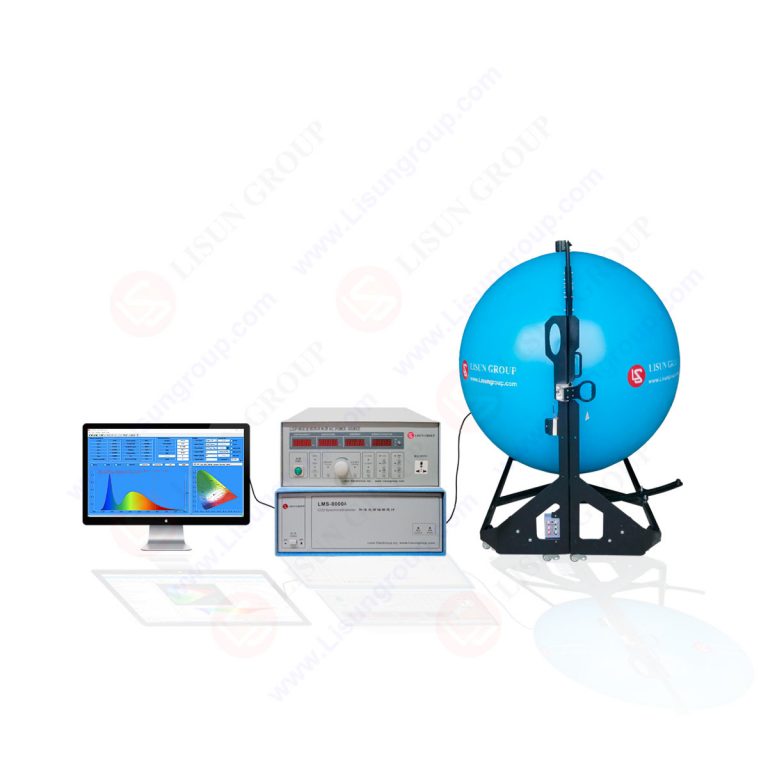
Fig. 1: The LPCE-2 (LMS-8000) integrating sphere spectroradiometer system configured for LED testing.
2. Theoretical Principles of Integrating Sphere Spectroradiometry
2.1 The Integrating Sphere as a Flux Collector
The integrating sphere is a hollow spherical cavity coated internally with a highly reflective, diffusing material such as barium sulfate or spectralon. When a light source is placed inside (or at the sphere wall for 2π geometry), the emitted light undergoes multiple reflections, creating a uniform, spatially integrated radiance at the sphere’s surface. The total luminous flux (Φ_v) is directly proportional to the illuminance (E) measured at a port on the sphere wall. The relationship is governed by the sphere’s geometry and the reflectance of its coating.
For accurate light measurement, the sphere must be designed according to standard geometries. The 4π geometry (source placed at the sphere’s center) is recommended for total flux measurement of omnidirectional LEDs, while the 2π geometry (source mounted flush with the sphere wall) is used for directional or chip-on-board (COB) LEDs. The LPCE-2 system accommodates both configurations, offering sphere diameters typically ranging from 0.3 m to 2.0 m to suit different source sizes and flux levels.
2.2 The Spectroradiometer and Spectral Analysis
The spectroradiometer in the LMS-8000 replaces a simple photodetector. It uses a diffraction grating and an array detector (typically a CCD or CMOS sensor) to disperse the incoming light into its constituent wavelengths. The resulting SPD, P(λ), provides the complete spectral signature of the source. From P(λ), all key parameters are derived:
- Luminous Flux: Φ_v = 683 * ∫_380^780 P(λ) * V(λ) dλ, where V(λ) is the photopic luminosity function.
- Chromaticity Coordinates (x, y): Calculated from the tristimulus values X, Y, Z, which are integrals of P(λ) weighted by the CIE color matching functions.
- Correlated Color Temperature (CCT): Derived from the chromaticity coordinates relative to the Planckian locus.
- Color Rendering Index (CRI) and TM-30 (Rf, Rg): Computed by comparing the SPD of the test source against a reference illuminant.
The speed of the array-based spectroradiometer allows for measurements in milliseconds, making it ideal for production line testing where hundreds of LEDs must be evaluated per hour.
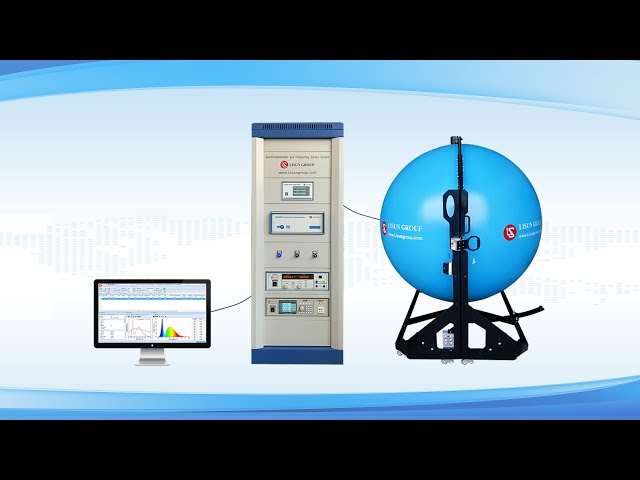
Video 1: Demonstration of the LPCE-2 system performing automated light measurement on various LED samples.
3. Compliance with International Standards and Testing Methodology
3.1 CIE 177 and IES LM-79-08 Requirements
The primary standards governing LED flux and color measurement are CIE 177:2007 (“Colour Rendering of White LED Light Sources”) and IES LM-79-08 (“Electrical and Photometric Measurements of Solid-State Lighting Products”). These standards establish strict protocols for measurement accuracy, including:
- Spectral Range: 380 nm to 780 nm minimum.
- Self-Absorption Correction: A correction factor must be applied when the test source differs in size or absorption from the calibration standard (typically a reference lamp).
- Sphere Coating: Reflectance must be >90% and spectrally neutral across the visible range.
- Stray Light Correction: Spectroradiometers must account for internal stray light, particularly at the spectral edges (380 nm and 780 nm).
The LPCE-2 (LMS-8000) system is designed to meet these requirements. The spectroradiometer employs a double-grating monochromator to minimize stray light to less than 0.01%, ensuring accurate measurement of deep blue and near-UV LEDs. The system includes an auxiliary lamp for automatic self-absorption correction, a mandatory step for compliance with LM-79-08.
3.2 Measurement Procedure and Data Acquisition
A standard testing sequence for the LED sphere spectroradiometer involves the following steps:
Table 1: Typical Measurement Procedure for the LPCE-2 System
| Step | Action | Purpose |
|---|---|---|
| 1 | Calibrate with standard lamp | Establish absolute flux and spectral responsivity |
| 2 | Measure auxiliary lamp with and without test sample | Calculate self-absorption correction factor |
| 3 | Mount and power LED (constant current/voltage) | Stabilize thermal and electrical conditions |
| 4 | Acquire SPD | Collect spectral data from 380-780 nm |
| 5 | Compute parameters | Calculate flux, CCT, CRI, chromaticity, electrical power |
The entire process, excluding stabilization time, typically takes less than two seconds, enabling high-throughput screening. The system simultaneously measures electrical parameters (voltage, current, power) via an integrated DC power supply and meter, providing a complete characterization in a single test cycle.
4. Practical Applications and Case Analysis
4.1 Production Line Binning and Quality Control
In LED manufacturing, chips are sorted into bins based on luminous flux and chromaticity. A system like the LPCE-2 is essential for this process. For example, a manufacturer producing 2835 SMD LEDs at a rate of 10,000 units per hour requires a testing solution that can perform rapid light measurement without sacrificing accuracy. The LPCE-2, with its high-speed spectroradiometer, can classify each LED into the correct ANSI C78.377 bin (e.g., 3000K ± 50K, 4000K ± 70K) within milliseconds.
Data from a field installation shows that the system achieves a repeatability of ±0.3% for luminous flux and ±0.001 for chromaticity coordinates (x, y) under controlled conditions. This precision allows manufacturers to tighten binning tolerances, reducing waste and increasing the value of their products.
4.2 Compliance Testing for General Lighting Products
For final product certification, such as ENERGY STAR or CE marking, laboratories must provide documented evidence of compliance with LM-79-08. The LPCE-2 system is used in such settings to test retrofit lamps, LED tubes, and luminaires. A case study involving a 15W LED A-lamp demonstrated the system’s capability:
- Measured Luminous Flux: 1520.3 lm (Standard: 1500 lm ±10%)
- CCT: 3003 K (Target: 3000 K)
- CRI (Ra): 82.5 (Target: >80)
- Power: 15.2 W (Efficacy: 100.0 lm/W)
The test report generated by the system includes all required data points, SPD curve, and information on measurement uncertainty, satisfying the documentation requirements of regulatory bodies.
5. Conclusion
The integration of a spectroradiometer with an integrating sphere has emerged as the definitive approach for comprehensive LED characterization. This paper has reviewed the theoretical foundations, standard compliance, and practical application of such a system, using the LPCE-2 (LMS-8000) as a reference implementation. The key finding is that this method enables simultaneous measurement of photometric, colorimetric, and electrical parameters from a single spectral acquisition, drastically improving testing throughput compared to goniophotometric methods.
For the LED industry, the adoption of this technology facilitates tighter quality control, more efficient production binning, and reliable compliance documentation. As spectral measurement technology continues to advance—with higher dynamic range sensors and faster data processing—the role of the integrating sphere spectroradiometer will only become more central to the field of light measurement. Future developments may include enhanced automation for robotic handling and integration with machine learning algorithms for predictive analytics, further solidifying its position as a cornerstone of solid-state lighting metrology.