

UL 1017:2023 Figure 25 Accessibility Probe
Leave a Message
The UL 1017:2023 Figure 25 Accessibility Probe is a specialized safety testing instrument designed to evaluate the accessibility of hazardous components, such as rotating brushes and live conductors, in vacuum cleaners, blower cleaners, and household floor finishing machines through openings measuring 1.375 inches (34.9 millimeters) or larger. This probe simulates the anthropometric dimensions of human limbs, specifically the 5th percentile female and 95th percentile male arm, hand, and finger sizes for the 13–18 month age bracket, ensuring a realistic simulation of accidental contact scenarios. Constructed from high-rigidity stainless steel to prevent deformation under test forces and insulated plastic with a minimum resistance of 100 MΩ for operator protection, the probe adheres to the stringent dimensional tolerances specified in UL 1017:2023. It is an essential tool for manufacturers to validate product safety and demonstrate compliance with international standards including UL, CSA, and IEC.
Specifications:
Tool Type: Accessibility Probe (UL 1017:2023 Figure 25; for testing hazardous part accessibility in machines with openings ≥34.9mm)
Probe Material: Stainless steel (high rigidity; maintains dimensional stability under test force; corrosion-resistant for industrial environments)
Handle Material: Insulated plastic (nylon/PA; insulation resistance ≥ 100 MΩ; heat-resistant up to 110°C; ergonomic non-slip grip)
Simulated Human Dimensions (13–18 Month Age Bracket):
– A (Upper Arm Circumference, Female 5th Percentile): 11.9 cm (4.685 in) ± 0.1 cm
– B (Shoulder-to-Elbow Length, Male 95th Percentile): 16.8 cm (6.61 in) ± 0.1 cm
– C (Forearm Circumference, Female 5th Percentile): 12.1 cm (4.76 in) ± 0.1 cm
– D (Elbow-to-Fingertip Length, Male 95th Percentile): 22.7 cm (8.94 in) ± 0.1 cm
– E (Minimum Hand Clearance Diameter, Female 5th Percentile): 3.49 cm (1.374 in) ± 0.05 cm
– F (Hand Length, Male 95th Percentile): 10.2 cm (4.016 in) ± 0.1 cm
– G1 (Middle Finger Length, Male 95th Percentile): 4.5 cm (1.772 in) ± 0.05 cm
– G2 (Middle Finger Diameter, Female 5th Percentile): 0.79 cm (0.311 in) ± 0.02 cm
Applied Opening Size: For openings ≥1.375 in (34.9 mm)
Core Function: Assesses accessibility of hazardous parts in cleaning and floor maintenance equipment through large openings; simulates human contact scenarios; verifies compliance with UL 1017:2023, CSA C22.2 No.1017:2023, and IEC 61032:2017 standards.
Test Procedures:
1. Inspect the probe for any deformation, insulation damage, or dimensional deviations; verify that all simulated dimensions conform to UL 1017:2023 specifications.
2. Energize the equipment under test (EUT, e.g., vacuum cleaner) and operate it under normal conditions.
3. Grasp the insulated handle and fully insert the probe into EUT openings measuring ≥34.9 mm (e.g., suction ports).
4. Manipulate the probe to simulate accidental contact, aligning with the predefined arm, hand, and finger dimensions.
5. Utilize a detection method to determine if the probe contacts hazardous parts, such as rotating mechanisms or energized conductors.
6. Document test results: A pass indicates no contact with hazardous parts; a fail indicates accessibility to dangerous components.
Applications:
1. Testing vacuum cleaner suction port openings (≥34.9 mm) in accordance with UL 1017:2023 Figure 25 to prevent access to rotating brush assemblies.
2. Verifying blower cleaner air outlet apertures for compliance with CSA C22.2 No.1017:2023, ensuring isolation from internal fan components.
3. Conducting safety assessments on household floor polisher base openings per IEC 61032:2017 to mitigate risks associated with live electrical parts.
4. Implementing quality control protocols for vacuum cleaner manufacturers to ensure large openings adhere to UL 1017 hazardous part isolation requirements.
5. Performing post-production validation tests on wet/dry vacuum cleaner tank openings to confirm alignment with global cleaning equipment safety standards, including UL, CSA, and IEC.
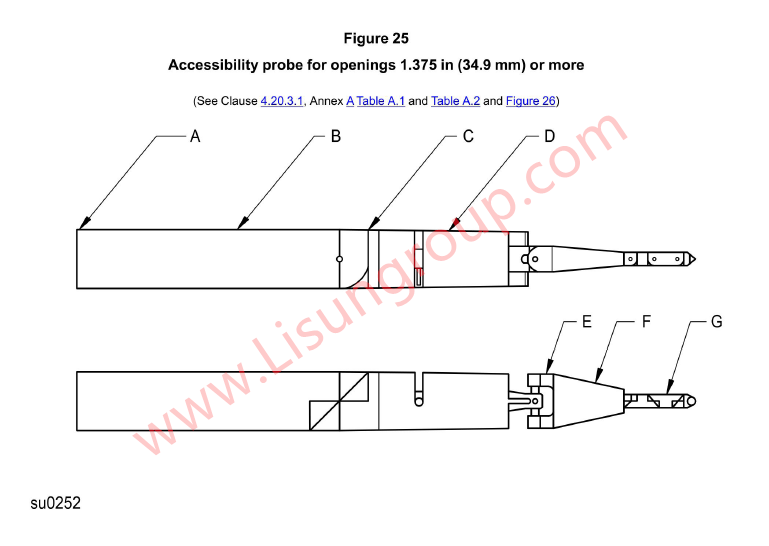
UL 1017:2023 Figure 25
Tags:SMT-UL1017F25