


EN 50636-2-100 Figure 2 Arm Probe for Testing Tortuous Path Guarding of Cutting Means Through the Feed Intake Opening
Leave a Message
The EN 50636-2-100 Figure 2 Arm Probe is a specialized safety testing instrument designed for evaluating tortuous path guarding at feed intake openings of power-driven cutting equipment, including woodworking table saws, metal shears, and plastic cutters. This probe simulates the anatomical configuration and articulation of a human arm and hand to assess whether protective guards effectively prevent access to hazardous cutting components, such as saw blades and shear edges, during equipment operation. Constructed from high-strength, impact-resistant polymeric materials to withstand mechanical contact, and incorporating a flexible pivot joint that replicates wrist articulation, this instrument ensures rigorous compliance with international machinery safety regulations, including EN 50636-2-100 and UL 62841-4-6. It is essential for manufacturers to mitigate operator injury risks and achieve conformity with global cutting equipment safety standards.
Specifications:
Instrument Type: EN 50636-2-100 Figure 2 Arm Probe (for tortuous path guarding testing of cutting equipment feed intakes)
Material Composition: Handle constructed from nylon polymer; tip fabricated from stainless steel
Articulation Characteristics: Single flexible pivot joint (simulates wrist articulation; maximum bending angle: ±90°; maintains structural integrity under applied test forces)
Maximum Applied Force: ≤20 N
Primary Function: Evaluates the efficacy of feed intake guards in obstructing access to hazardous cutting components via tortuous pathways; verifies compliance with EN 50636-2-100 requirements
Test Procedures:
1. Conduct a visual and tactile inspection of the probe to identify any structural anomalies, including cracks, joint degradation, or permanent deformation, to confirm mechanical integrity.
2. Position the equipment under test (EUT) with its feed intake aperture oriented in the standard operational configuration (e.g., table saw feed slot in open position).
3. Align the probe’s distal tip with the feed intake opening, maintaining orientation consistent with potential user hand insertion trajectories.
4. Apply controlled force to advance the probe through the intake aperture, articulating the joint to simulate realistic insertion pathways.
5. Determine whether the probe makes contact with hazardous cutting components (e.g., rotating saw blade) or is effectively obstructed by the protective guard.
6. Document test outcomes: Compliance is achieved if no contact occurs; non-compliance is indicated if the probe reaches dangerous mechanical elements.
Applications:
1. Verification of feed intake guarding systems on woodworking table saws, in accordance with EN 50636-2-100:2017 Figure 2 specifications, to prevent saw blade accessibility.
2. Quality assurance testing of lumber feed channels in woodworking planers during manufacturing processes.
3. Conformity assessment of paper feed slots in industrial paper cutters during post-production validation, ensuring adherence to international machinery safety regulations.
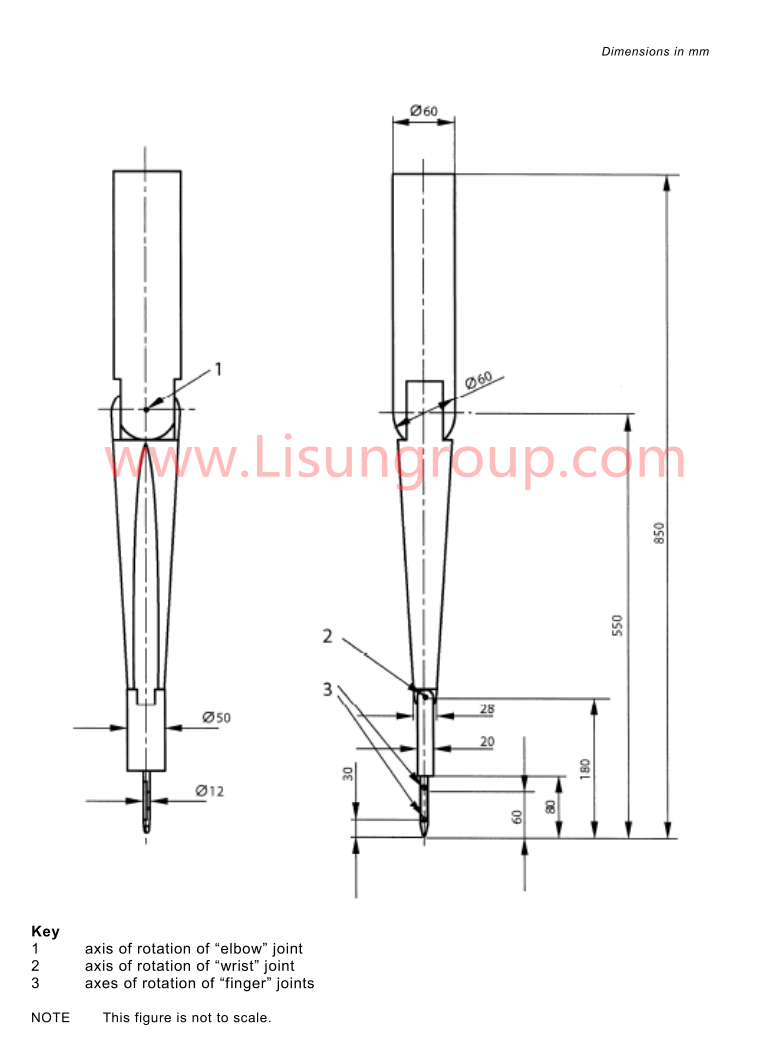
EN 50636-2-100 Figure 2 Arm Probe for Testing Tortuous Path Guarding of Cutting Means Through the Feed Intake Opening